• HOME
  • NEWS
  • EXPLORE
    • CAREER
      • Companies
      • Jobs
    • EVENTS
    • iGEM
      • News
      • Team
    • PHOTOS
    • VIDEO
    • WIKI
  • BLOG
  • COMMUNITY
    • FACEBOOK
    • INSTAGRAM
    • TWITTER
Thursday, July 2, 2026
BIOENGINEER.ORG
No Result
View All Result
  • Login
  • HOME
  • NEWS
  • EXPLORE
    • CAREER
      • Companies
      • Jobs
        • Lecturer
        • PhD Studentship
        • Postdoc
        • Research Assistant
    • EVENTS
    • iGEM
      • News
      • Team
    • PHOTOS
    • VIDEO
    • WIKI
  • BLOG
  • COMMUNITY
    • FACEBOOK
    • INSTAGRAM
    • TWITTER
  • HOME
  • NEWS
  • EXPLORE
    • CAREER
      • Companies
      • Jobs
        • Lecturer
        • PhD Studentship
        • Postdoc
        • Research Assistant
    • EVENTS
    • iGEM
      • News
      • Team
    • PHOTOS
    • VIDEO
    • WIKI
  • BLOG
  • COMMUNITY
    • FACEBOOK
    • INSTAGRAM
    • TWITTER
No Result
View All Result
Bioengineer.org
No Result
View All Result
Home NEWS Science News Biology

The functional diversity in a noxious heat and chemical sensor among mosquito species

Bioengineer by Bioengineer
February 18, 2020
in Biology
Reading Time: 2 mins read
0
IMAGE
Share on FacebookShare on TwitterShare on LinkedinShare on RedditShare on Telegram

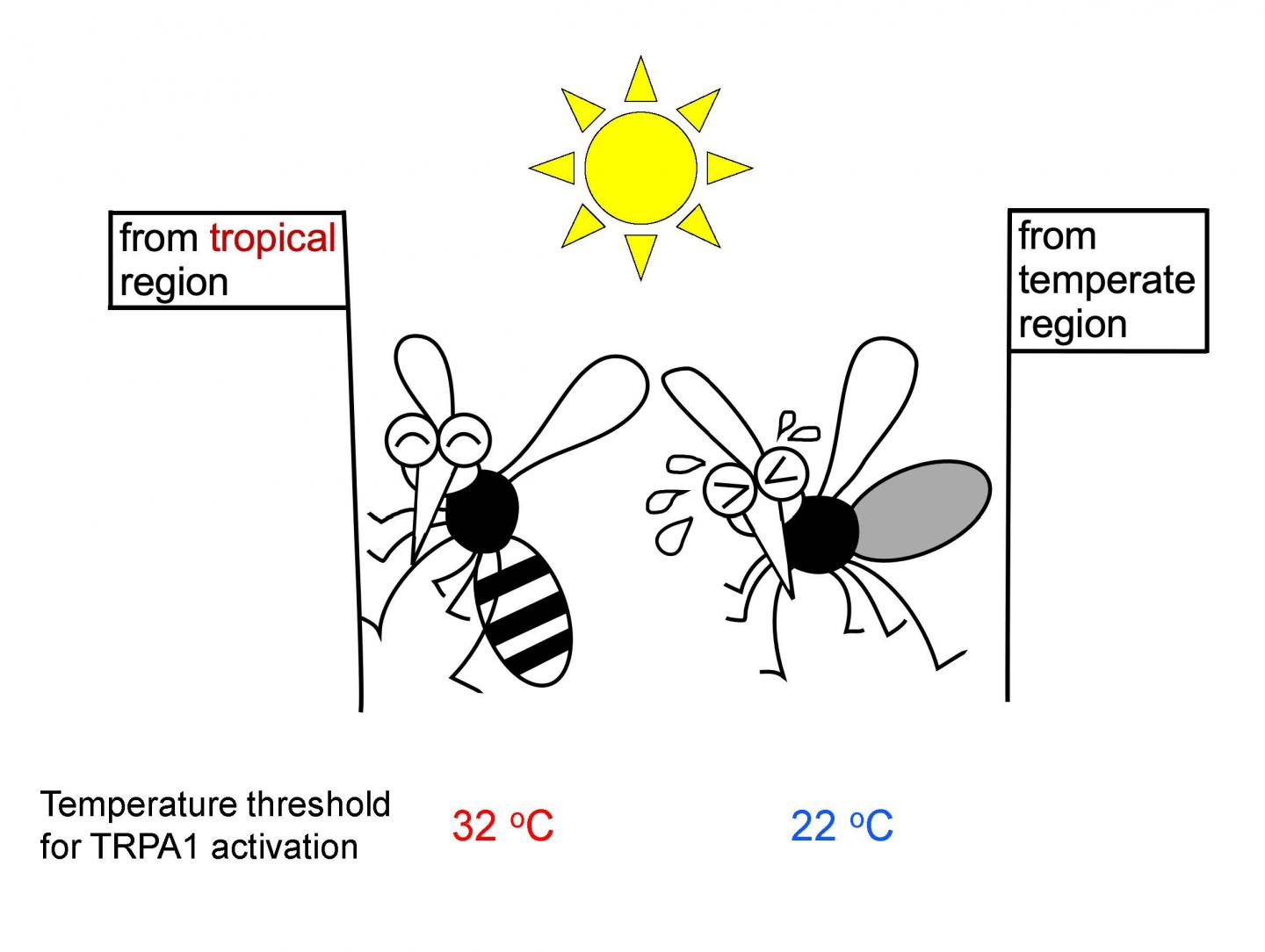
Researchers in the National Institute for Physiological Sciences in Japan discovered functional differences in TRPA1 which serves as a receptor for noxious heat and chemicals among mosquito species
IMAGE

Credit: Makoto Tominaga


Okazaki, Japan – Mosquitos are hazardous insects for human, and many researchers are investigating the way to prevent from a mosquito bite. The activation of sensory receptors triggers the avoidance behaviors in animals including insects. Therefore, the researchers focused on a sensory receptor called TRPA1 which is expressed in sensory neurons and perceives noxious stimuli such as heat and chemicals in this study.

The authors compared TRPA1 from several mosquito species and found that their responses varied among species. Thermal sensitivity of TRPA1 from species inhabiting the temperate zone (Culex pipiens) was considerably higher than that from species inhabiting the tropical zone (Aedes aegypti). In concordance with the finding, Culex pipiens behaviorally avoided high temperature of 30°C, while A. aegypti did not, suggesting that thermal property of TRPA1 changed according to the thermal conditions of habitats.

Sensitivity of TRPA1 to citronella, used as an insect repellent, was also compared. TRPA1 sensitivity to citronella was highly differed among mosquito species. This implies that the effect of repellents potentially varies among species, thus species diversity should be taken into account for controlling mosquitos.

In addition, several chemical compounds that activate mosquito TRPA1 were newly found in the present study. These findings may supply informative information for the development of novel repellents for mosquitos in the future.

The article, “Diverse sensitivities of TRPA1 from different mosquito species to thermal and chemical stimuli” was published in Scientific Reports.

###

Media Contact
Makoto Tominaga
[email protected]
81-564-595-286

Related Journal Article

http://dx.doi.org/10.1038/s41598-019-56639-w

Tags: BiologyCell BiologyEcology/EnvironmentEvolutionMolecular BiologyPhysiology
Share12Tweet8Share2ShareShareShare2

Related Posts

New Study Reveals How to Reduce Risk of Dangerous Wildlife Encounters This Summer — Biology

New Study Reveals How to Reduce Risk of Dangerous Wildlife Encounters This Summer

July 2, 2026
Hepatic IFRD1 Alleviates Metabolic Dysfunction-Linked Steatohepatitis Through the GLUD1/α-KG Pathway — Biology

Hepatic IFRD1 Alleviates Metabolic Dysfunction-Linked Steatohepatitis Through the GLUD1/α-KG Pathway

July 2, 2026

Intricate Food Webs Support Ecosystem Health and Stability

July 2, 2026

Fatty Liver Accelerates Aggressive Cancer Metastasis

July 2, 2026
Please login to join discussion

POPULAR NEWS

  • Detection of EDCs in Breast Milk and Infant Urine Up to Six Months Highlights Early Exposure Risks

    77 shares
    Share 31 Tweet 19
  • Saying Goodbye to PGY-6: Pediatric Fellowship Realities

    103 shares
    Share 41 Tweet 26
  • New Drug Candidate Developed at McMaster Shows Potential for Treating Brain Cancer

    58 shares
    Share 23 Tweet 15
  • KTU Researchers Explore Ultrasound’s Role in Enhancing Blood Flow Beyond Diagnostics

    53 shares
    Share 21 Tweet 13

About

We bring you the latest biotechnology news from best research centers and universities around the world. Check our website.

Follow us

Recent News

Food Web Complexity Drives Biodiversity Impact

CSF Turnover Dysfunction: Early iRBD Biomarker?

Alcohol Impairment Contributes to Nearly Half of Fatal Electric Scooter Accidents in Sweden

Subscribe to Blog via Email

Enter your email address to subscribe to this blog and receive notifications of new posts by email.

Join 82 other subscribers
  • Contact Us

Bioengineer.org © Copyright 2023 All Rights Reserved.

Welcome Back!

Login to your account below

Forgotten Password?

Retrieve your password

Please enter your username or email address to reset your password.

Log In
No Result
View All Result
  • Homepages
    • Home Page 1
    • Home Page 2
  • News
  • National
  • Business
  • Health
  • Lifestyle
  • Science

Bioengineer.org © Copyright 2023 All Rights Reserved.