□ DGIST (President: Kuk Yang) announced on the 26th that Professor Park Jin-hee’s team at the Department of Physics and Chemistry generated new metal-organic frameworks (MOFs) and successfully visualized unstable radical states and identified electron transfer paths according to energy types through structural analysis.
Credit: .
□ DGIST (President: Kuk Yang) announced on the 26th that Professor Park Jin-hee’s team at the Department of Physics and Chemistry generated new metal-organic frameworks (MOFs) and successfully visualized unstable radical states and identified electron transfer paths according to energy types through structural analysis.
□ MOFs have a large surface area as they have a porous structure with numerous small holes (pores) like honeycombs. In addition, MOFs with various structures and characteristics can be designed depending on which metal and organic ligand are connected. Since they have high crystallinity due to their regular lattice structure, the molecular structure can be understood more accurately through single crystal structure analysis. Because of their unique characteristics, MOFs are drawing attention as a new material to solve environmental and energy problems. In particular, they have been studied in various fields such as eco-friendly catalysts, sensors, energy storage, adsorption and separation.
□ Radicals formed by electron transfer refer to atoms or molecules with unpaired odd electrons. Since electrons are not paired, they are very unstable and highly reactive. Attempts have been made to utilize these characteristics for sensors, catalysts, batteries, and multi-functional photo-electro-chromic devices.
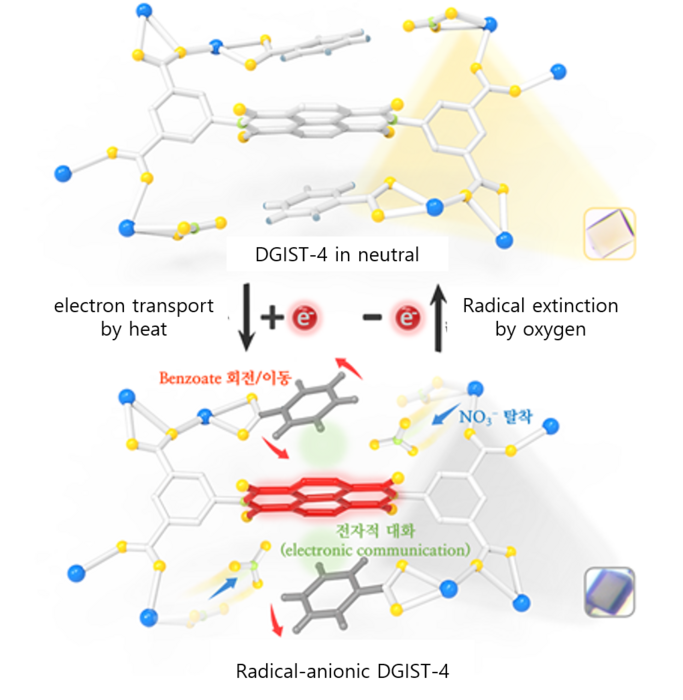
□ Recently, electron transfer within the MOF structure for radical formation has been actively examined. However, it was impossible to analyze the structure after losing or gaining electrons due to the instability of the formed radicals despite structural analysis of these radicals is absolutely necessary to accurately understand and apply the properties expressed in the radical state. The research team found a way to stably introduce ligands in a sufficiently reduced radical state into the MOF structure through solvothermal synthesis. The new MOF developed through this process was named ‘DGIST-4.’ It was possible to successfully conduct structural analysis before and after the reduction process (electron transfer) using DGIST-4.
□ This study looked into X-ray irradiation, one of the various external stimuli of ‘DGIST-4,’ and conducted a structural analysis at the same time using the radiation test facility. The structural change of ‘DGIST-4’ according to the X-ray irradiation time was sequentially observed. As a result, the team successfully confirmed the structural change according to the radical formation. So far, very few studies confirmed structural changes because of radical formation. In particular, this study holds very high value as it is the first research that verified the sequential structural change caused by X-ray irradiation.
□ This research outcomes was possible because of the special properties of ‘DGIST-4’ developed by this research team. DGIST-4 responds to various external stimuli such as X-rays, ultraviolet rays, visible rays, infrared rays, and heat because it has various electron transfer paths within the lattice. Electron transfer changes the structure of DGIST-4 and accompanies the change of crystal colors from yellow to black, which elongates the absorption wavelength to efficiently absorb near-infrared rays over 800 nm. In particular, unlike other radicals that are easily annihilated by heat, DGIST-4 could be successfully used for photothermal conversion because the radicals formed after electron transfer can be maintained for a relatively long time.
□ In addition, the team verified the cause of the structural change of radicals formed in the DGIST-4 lattice using the density functional theory (DFT) and confirmed that the structural change obtained through experiments and that through theoretical calculations show the same tendency, once again proving the accuracy of the experimental results.
□ As described above, the research outcomes of DGIST-4, capable of analyzing structural changes following electron transfer and allowing electron transfer by various external stimuli, are expected to set the guidelines for the design and application of smart redox-active materials that can be used in eco-friendly sensors, catalysts, batteries, and multi-functional photo-electro-chromic devices.
Correspondence Author Email Address : [email protected]
Journal
Chem
Article Title
Multi-stimuli-engendered radical-anionic MOFs: Visualization of structural transformation upon radical formation
Article Publication Date
20-Apr-2022