• HOME
  • NEWS
  • EXPLORE
    • CAREER
      • Companies
      • Jobs
    • EVENTS
    • iGEM
      • News
      • Team
    • PHOTOS
    • VIDEO
    • WIKI
  • BLOG
  • COMMUNITY
    • FACEBOOK
    • INSTAGRAM
    • TWITTER
Sunday, May 10, 2026
BIOENGINEER.ORG
No Result
View All Result
  • Login
  • HOME
  • NEWS
  • EXPLORE
    • CAREER
      • Companies
      • Jobs
        • Lecturer
        • PhD Studentship
        • Postdoc
        • Research Assistant
    • EVENTS
    • iGEM
      • News
      • Team
    • PHOTOS
    • VIDEO
    • WIKI
  • BLOG
  • COMMUNITY
    • FACEBOOK
    • INSTAGRAM
    • TWITTER
  • HOME
  • NEWS
  • EXPLORE
    • CAREER
      • Companies
      • Jobs
        • Lecturer
        • PhD Studentship
        • Postdoc
        • Research Assistant
    • EVENTS
    • iGEM
      • News
      • Team
    • PHOTOS
    • VIDEO
    • WIKI
  • BLOG
  • COMMUNITY
    • FACEBOOK
    • INSTAGRAM
    • TWITTER
No Result
View All Result
Bioengineer.org
No Result
View All Result
Home NEWS Science News Biology

The downward trend: Nature’s decline risks our quality of life

Bioengineer by Bioengineer
January 21, 2021
in Biology
Reading Time: 2 mins read
0
IMAGE
Share on FacebookShare on TwitterShare on LinkedinShare on RedditShare on Telegram

Scientists conducted a sweeping review of nature’s contributions to humans in order to present a clear breakdown of global trends since 1970. Not surprisingly, the results are grim
IMAGE

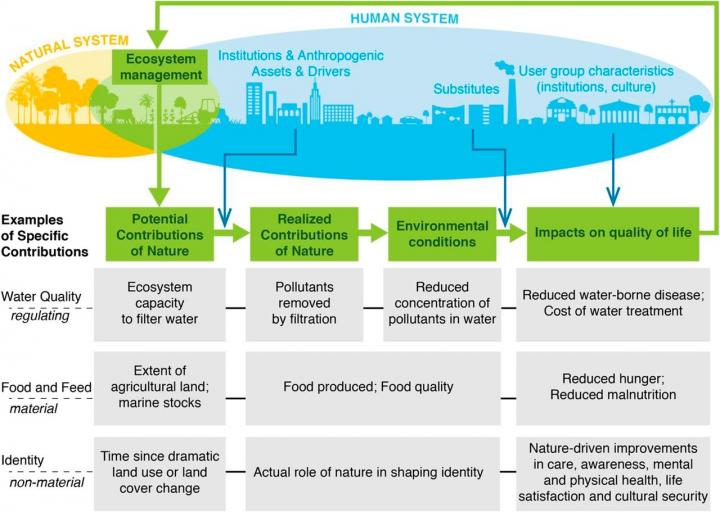
Credit: Brauman et al. (2020)

It is no secret that over the last few decades, humans have changed nature at an ever-increasing rate. A growing collection of research covers the many ways this is impacting our quality of life, from air quality to nutrition and income. To better understand how which areas are most at risk, scientists have combed through volumes of literature to present global trends in the relationship between human wellbeing and environmental degradation.

Their work, which included Fabrice DeClerck from the Alliance of Bioversity International and CIAT, was summarized in “Global trends in nature’s contributions to people”, which was recently published in Proceedings of the National Academy of Sciences.

This systematic review builds on the Intergovernmental Science-Policy Platform on Biodiversity and Ecosystem Services (IPBES) Global Assessment Report, which in 2019 provided the most comprehensive assessment yet of nature’s decline and biodiversity loss, when it emphasized that 1 million plant and animal species face extinction.

The PNAS review evaluates how biodiversity loss affects human wellbeing. It differentiates between nature’s potential contributions, realized contributions, environmental conditions, and impact on quality of life. Material and non-material indicators, including greenhouse gas concentration, pest control and cultural knowledge were used to assess whether trends were worsening, about the same, or improving since 1970. Unsurprisingly, many were shown to be in sharp decline. Particularly in the context of agriculture, the review underscores that we face interrelated risks such as declining crop yields, declining pollinator populations, and reduced soil productivity.

Even increases in areas such as volume of crop commodity production hold a warning, as trends on human health from food diverge depending on variables such as region and socioeconomic context.

This paper represents one step in documenting the importance of nature’s contributions to people, which the scientists hope can improve our ability to manage earth systems effectively, equitably, and sustainably.

“Nature contributes to our health and well-being in many ways, and our actions put these benefits at risk,” said author Kate Brauman of the University of Minnesota.

###

Media Contact
Eliot Gee
[email protected]

Original Source

https://doi.org/10.1073/pnas.2010473117

Related Journal Article

http://dx.doi.org/10.1073/pnas.2010473117

Tags: Agricultural Production/EconomicsBiodiversityBiologyClimate ChangeDeveloping CountriesEarth ScienceEnvironmental HealthPlant SciencesPublic HealthQuality of Life
Share12Tweet8Share2ShareShareShare2

Related Posts

Ancient Plant Populations Reveal Fresh Insights into Climate Resilience — Biology

Ancient Plant Populations Reveal Fresh Insights into Climate Resilience

May 8, 2026
Rare Brain Disorders in Children Linked to Mutations in Lesser-Known Protein Complex — Biology

Rare Brain Disorders in Children Linked to Mutations in Lesser-Known Protein Complex

May 8, 2026

From Odd Insect to Underwater Predator: The Remarkable Evolution of a Bloodthirsty Fruit Fly

May 8, 2026

SNU Professor Sangwoo Seo’s Team Develops Next-Generation CRISPR Biocontainment Technology to Control Microbial Survival Without DNA Cleavage

May 8, 2026
Please login to join discussion

POPULAR NEWS

  • Research Indicates Potential Connection Between Prenatal Medication Exposure and Elevated Autism Risk

    840 shares
    Share 336 Tweet 210
  • New Study Reveals Plants Can Detect the Sound of Rain

    727 shares
    Share 290 Tweet 181
  • Scientists Investigate Possible Connection Between COVID-19 and Increased Lung Cancer Risk

    68 shares
    Share 27 Tweet 17
  • Salmonella Haem Blocks Macrophages, Boosts Infection

    61 shares
    Share 24 Tweet 15

About

We bring you the latest biotechnology news from best research centers and universities around the world. Check our website.

Follow us

Recent News

Evaluating Digoxin Use in Patients with Symptomatic Rheumatic Heart Disease

Evaluating the Effectiveness and Safety of Digitalis Glycosides in Treating Heart Failure

Urdu Fall Risk Questionnaire Adapted for Elderly

Subscribe to Blog via Email

Enter your email address to subscribe to this blog and receive notifications of new posts by email.

Join 82 other subscribers
  • Contact Us

Bioengineer.org © Copyright 2023 All Rights Reserved.

Welcome Back!

Login to your account below

Forgotten Password?

Retrieve your password

Please enter your username or email address to reset your password.

Log In
No Result
View All Result
  • Homepages
    • Home Page 1
    • Home Page 2
  • News
  • National
  • Business
  • Health
  • Lifestyle
  • Science

Bioengineer.org © Copyright 2023 All Rights Reserved.