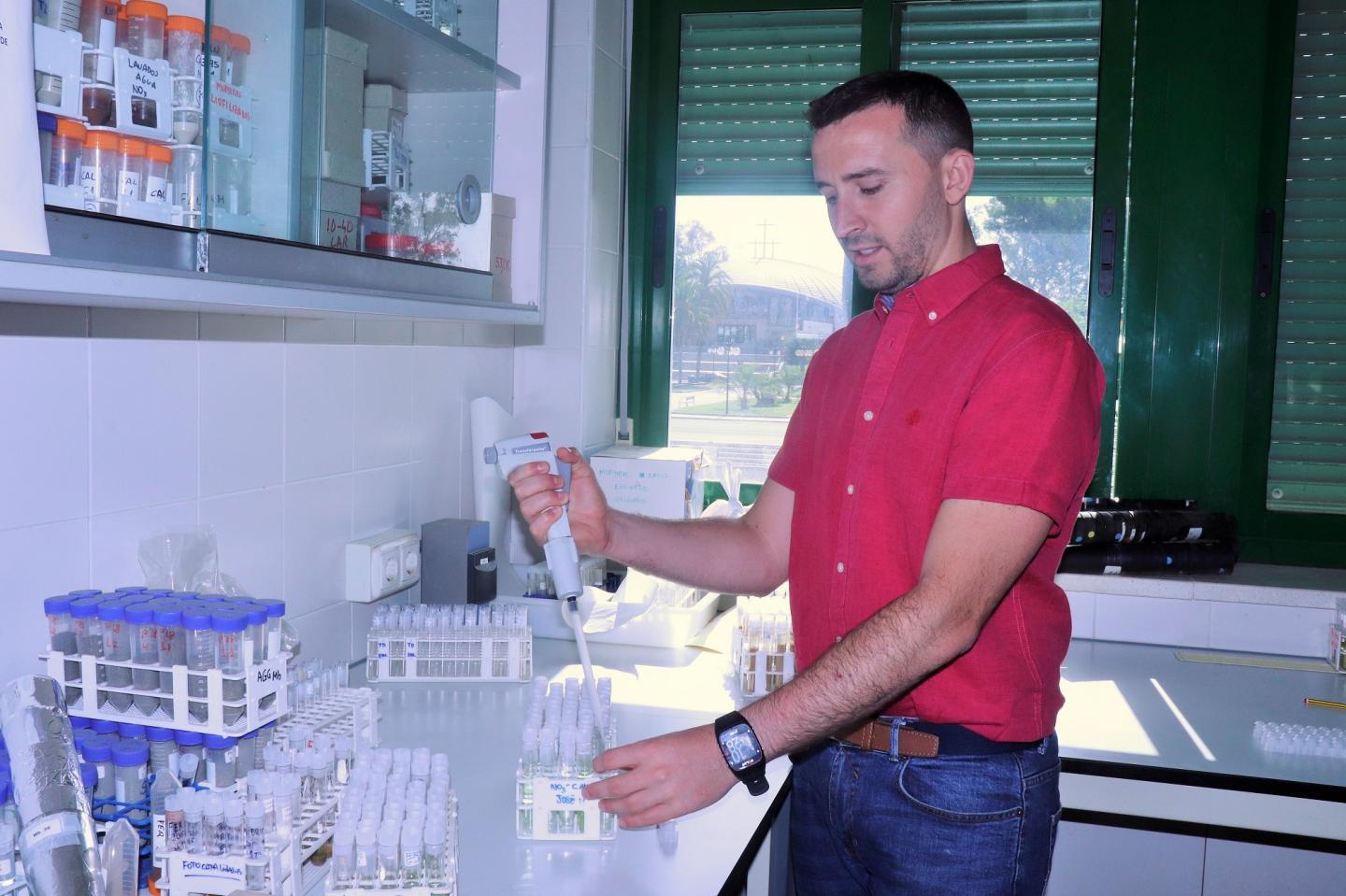
Credit: Universidad de Córdoba
Agriculture contributes to 70% of total emissions by humans of nitrous oxide (N2O), a potent polluting gas and the one to blame for the hole in the ozone layer. The root of this issue is in the widespread use of chemical fertilizers, such as urea and ammonium nitrate. Once these products have been used in soil for crops, a portion of them are lost in the form of N2O, which goes directly into the atmosphere. The pollution problem of fertilizers is heightened with the growing rise in the demand for foods that require these fertilizers in order to attain profitable agricultural production.
The industry continues to search for formulas that reduce this pollution without negatively affecting production. Nevertheless, it is faced with a core problem. The emission of pollutants from fertilizers is very difficult to predict since it depends on factors that are hard to control, such as humidity, temperature, activity of microorganisms in the soil and variability of time and space, among others. If a realistic estimate of emissions from these pollutants cannot be made, it is tough to come up with strategies to reduce these emissions.
An international research group, including University of Cordoba researcher Antonio Rafael Sánchez Rodríguez, studied different mathematical prediction methods to measure the emissions of pollutants from fertilizers, such as urea and ammonium nitrate, in order to find out which one gives data that most closely resemble reality. This research is supported by the UK-China Virtual Joint Centre for Improved Nitrogen Agronomy (CINAg) and members from universities in the UK, Portugal, Australia and Spain have participated. Among those is British researcher Ute Skiba, who collaborates with the Intergovernmental Panel on Climate Change (IPCC) to reduce emission factors from pollutants used in agriculture.
In order to find a more efficient method, the research team tested and compared two statistical models. The first, known as the Bayesian method, is based on probability and provides results within a range of values that allows for inferring possible results. The second one, the trapezoidal method, is more widely used but is unable to predict variability of emission factors, since it estimates emission production to be linear, which is not actually the case. Emissions depend on many factors and changes in each one affect the reactions that are involved in emitting polluting gases.
The experiment took place on four experimental fields in the United Kingdom. Fertilizers were applied in the form of ammonium nitrate, urea and a third kind that was a mixture of urea and a potential inhibitor of urease, that minimizes ammonia emissions but, according to several studies, increases the emission of another pollutant, N2O.
The results show that N2O emissions were greater when ammonium nitrate was used, compared to using urea. Moreover, the use of the inhibitor did not show any significant differences in this sense. The research concludes that the Bayesian method offers more realistic predictions regarding nitrous oxide emissions, and therefore it is of great use when choosing more sustainable strategies for agriculture.
In its current condition, the Bayesian method is limited to cases in which fertilization produces a peak of emissions followed by a large drop. However, likewise, it is more useful than traditional methods when choosing a fertilization strategy that emits fewer polluting gases into the atmosphere. From now on, this research group will try applying this method in order to also measure emissions from organic nitrogen fertilizers.
###
N. Cowan, P. Levy, J. Drewer, A. Carswell, R. Shaw, I. Simmons, C. Bache, J. Marinheiro, J. Brichet, A.R. Sánchez Rodríguez, J. Cotton, P.W. Hill, D.R. Chadwick, D.L. Jones, T.H. Misselbrook, U. Skiba. “Application of Bayesian statistics to estimate nitrous oxide emisión factors of three nitrogen fertilisers on UK grasslands”. Environment International. DOI: 10.1016/j.envint.2019.04.054
Media Contact
Elena Lázaro
[email protected]
Original Source
https:/
Related Journal Article
http://dx.