• HOME
  • NEWS
  • EXPLORE
    • CAREER
      • Companies
      • Jobs
    • EVENTS
    • iGEM
      • News
      • Team
    • PHOTOS
    • VIDEO
    • WIKI
  • BLOG
  • COMMUNITY
    • FACEBOOK
    • INSTAGRAM
    • TWITTER
Thursday, June 25, 2026
BIOENGINEER.ORG
No Result
View All Result
  • Login
  • HOME
  • NEWS
  • EXPLORE
    • CAREER
      • Companies
      • Jobs
        • Lecturer
        • PhD Studentship
        • Postdoc
        • Research Assistant
    • EVENTS
    • iGEM
      • News
      • Team
    • PHOTOS
    • VIDEO
    • WIKI
  • BLOG
  • COMMUNITY
    • FACEBOOK
    • INSTAGRAM
    • TWITTER
  • HOME
  • NEWS
  • EXPLORE
    • CAREER
      • Companies
      • Jobs
        • Lecturer
        • PhD Studentship
        • Postdoc
        • Research Assistant
    • EVENTS
    • iGEM
      • News
      • Team
    • PHOTOS
    • VIDEO
    • WIKI
  • BLOG
  • COMMUNITY
    • FACEBOOK
    • INSTAGRAM
    • TWITTER
No Result
View All Result
Bioengineer.org
No Result
View All Result
Home NEWS Science News Health

The delicate balance of treating growing but brittle bones

Bioengineer by Bioengineer
February 1, 2019
in Health
Reading Time: 2 mins read
0
IMAGE
Share on FacebookShare on TwitterShare on LinkedinShare on RedditShare on Telegram

IMAGE

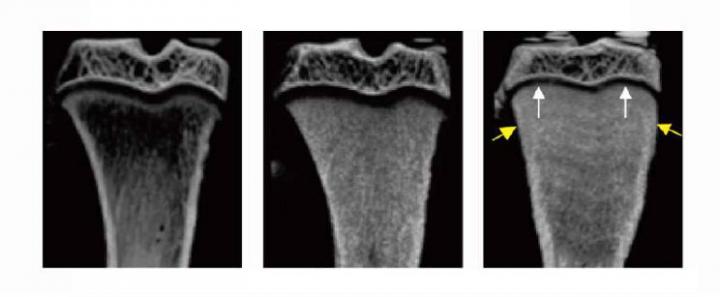
Credit: Sato et al., Bone, November 2018

Turning off a bone receptor protein could potentially treat osteoporosis in children without affecting bone growth.

Osteoporosis is a medical condition that causes bones to become fragile and brittle. It is a major health problem worldwide, mainly affecting adults. However, children can also rarely be affected as a result of other diseases or genetic disorders.

Adults are commonly treated for osteoporosis with drugs called bisphosphonates, which slow the activity of bone-absorbing cells called osteoclasts, allowing bone-building cells known as osteoblasts a better chance to work effectively. Since osteoclasts play an intrinsic role in the process of bone growth, there are concerns that bisphosphonates could negatively affect bone development in children. As of now, not enough research has been done to fully understand the potential consequences.

However, according to a study published in Bone, Masahiko Takahata of Hokkaido University and colleagues in Japan have found early evidence that inhibiting a bone receptor protein could help treat osteoporosis in children without impairing bone growth.

Through testing in rats, Takahata and his colleagues used an antibody to neutralize a bone receptor protein called Siglec-15. This receptor is involved in bone remodelling–the lifelong process of bone resorption and formation–and regulates bone marrow production of osteoclasts.

The team found that inhibiting Siglec-15 in the growing bones of young rats increased bone mass and strength without impairing growth. On the other hand, while normal bisphosphonate treatment also increased bone mass and strength, it caused bone abnormalities and growth retardation.

The researchers hypothesize that the anti-Siglec-15 therapy suppresses osteoclast activity in one layer of the growth plate at the end of bones, the secondary spongiosa, without affecting the osteoclasts in another growth plate layer, the primary spongiosa. This is because the primary spongiosa osteoclasts can respond to other signals for continuous generation and activation.

These findings suggest that anti-Siglec-15 therapy could be an alternative therapy with an ideal safety profile for osteoporosis in children, the researchers say; but further studies are required, as osteoclast behaviour in rats may not fully align with that in humans.

Discussing his and the team’s work, Dr. Takahata remarked “to develop a novel therapy for clinical treatment of juvenile osteoporosis, we plan to verify the effect of anti-Siglec-15 therapy on bone mass, continuing to experiment with an animal model of juvenile osteoporosis in our future studies.”

###

Media Contact
Tyler Tannert
 @hokkaidouni

011-706-2186

Original Source

https://www.global.hokudai.ac.jp/blog/the-delicate-balance-of-treating-growing-but-brittle-bones/

Related Journal Article

http://dx.doi.org/10.1016/j.bone.2018.07.026

Tags: BiochemistryBiologyCell BiologyMedicine/HealthOrthopedic Medicine
Share12Tweet8Share2ShareShareShare2

Related Posts

Asian Working Group Revises Sarcopenia Criteria 2019-2025

June 25, 2026

AI-Powered Platform Advances Structure-Based Drug Discovery

June 25, 2026

BALatrine Reduces Helminth Infections: Central Java Trial

June 24, 2026

Late Neanderthal Genetic Diversity in Northwest Europe

June 24, 2026
Please login to join discussion

POPULAR NEWS

  • Saying Goodbye to PGY-6: Pediatric Fellowship Realities

    103 shares
    Share 41 Tweet 26
  • Multi-Hospital Study Reveals Long Covid Burden Is Twice as High as Current Estimates

    92 shares
    Share 36 Tweet 23
  • Detection of EDCs in Breast Milk and Infant Urine Up to Six Months Highlights Early Exposure Risks

    77 shares
    Share 31 Tweet 19
  • New Drug Candidate Developed at McMaster Shows Potential for Treating Brain Cancer

    58 shares
    Share 23 Tweet 15

About

We bring you the latest biotechnology news from best research centers and universities around the world. Check our website.

Follow us

Recent News

Scientists Attack Soybean Cyst Nematode by Starving Its Food Source

Asian Working Group Revises Sarcopenia Criteria 2019-2025

AI-Powered Platform Advances Structure-Based Drug Discovery

Subscribe to Blog via Email

Enter your email address to subscribe to this blog and receive notifications of new posts by email.

Join 82 other subscribers
  • Contact Us

Bioengineer.org © Copyright 2023 All Rights Reserved.

Welcome Back!

Login to your account below

Forgotten Password?

Retrieve your password

Please enter your username or email address to reset your password.

Log In
No Result
View All Result
  • Homepages
    • Home Page 1
    • Home Page 2
  • News
  • National
  • Business
  • Health
  • Lifestyle
  • Science

Bioengineer.org © Copyright 2023 All Rights Reserved.