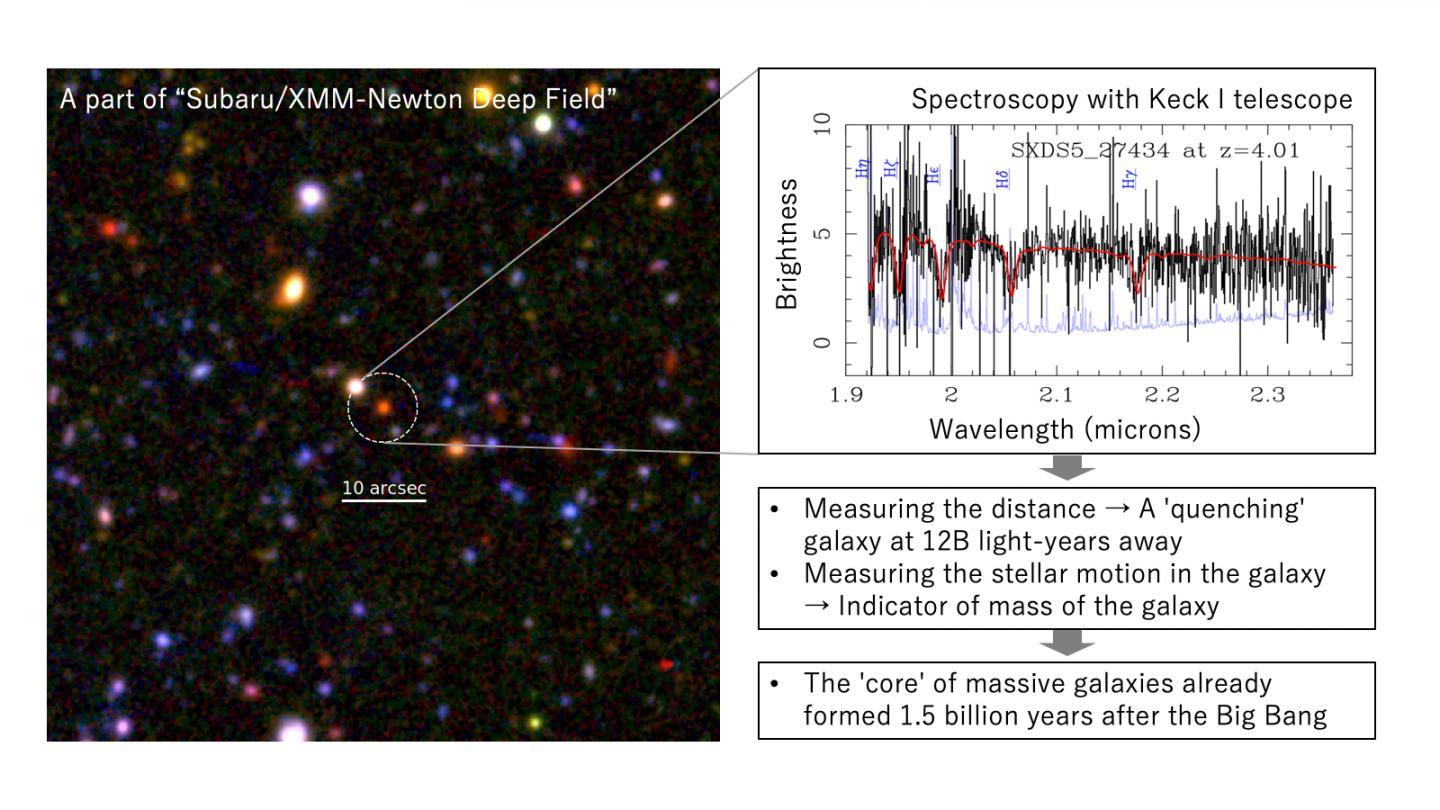
Credit: NAOJ/Tanaka et al. 2019
A distant galaxy more massive than our Milky Way – with more than a trillion stars – has revealed that the ‘cores’ of massive galaxies in the Universe had formed already 1.5 billion years after the Big Bang, about 1 billion years earlier than previous measurements revealed.
Researchers published their analysis on November 6, 2019 in The Astrophysical Journal Letters, a journal of the American Astronomical Society.
“If we point a telescope to the sky and take a deep image, we can see so many galaxies out there,” said Masayuki Tanaka, paper author and associate professor of astronomical science in the Graduate University for Advanced Studies and the National Astronomical Observatory of Japan. “But our understanding of how these galaxies form and grow is still quite limited — especially when it comes to massive galaxies.”
Galaxies are broadly categorized as dead or alive: dead galaxies are no longer forming stars, while living galaxies are still bright with star formation activity. A ‘quenching’ galaxy is a galaxy in the process of dying — meaning its star formation is significantly suppressed. Quenching galaxies are not as bright as fully alive galaxies, but they’re not as dark as dead galaxies. Researchers use this spectrum of brightness as the first line of identification when observing the Universe.
The researchers used the telescopes at the W.M. Keck Observatory in Hawaii to observe a quenching galaxy in what is called the Subaru/XMM-Newton Deep Field. This region of the sky has been closely observed by several telescopes, producing a wealth of data for scientists to study. Tanaka and his team used an instrument called MOSFIRE on the Keck I telescope to obtain measurements of the galaxy. They obtained a two-micron measurement in the near-infrared spectrum, which the human eye cannot see, but it confirmed that the light from the galaxy was emitted just 1.5 billion years after the Big Bang. The team also confirmed that the galaxy’s star formation was suppressed.
“The suppressed star formation tells you that a galaxy is dying, sadly, but that is exactly the kind of galaxy we want to study in detail to understand why quenching occurs,” said Francesco Valentino, a co-author of the paper and an assistant professor at the Cosmic Dawn Center in Copenhagen.
According to Valentino, astronomers believe that massive galaxies are the first to die in the history of the Universe and that they hold the key to understanding why quenching occurs in the first place.
“We also found that the ‘cores’ of massive galaxies today seem to be fully formed in the early Universe,” Tanaka said. How stars move within a galaxy depends on how much mass that object contains. Tanaka and his team found that the stars in the distant galaxy seem to move just as quickly as those closer to home. “The previous measurement of this kind was made when the Universe was 2.5 billion years old. We pushed the record up to 1.5 billion years and found, to our surprise, that the core was already pretty mature.”
The researchers are continuing to investigate how massive galaxies form and how they die in the early Universe, and they are searching for more massive quenching galaxies in the far distant Universe that may shed light on earlier phases of the process.
“When did the first dead galaxy appear in the Universe?” Tanaka asked. “This is a very interesting question for us to address. To do so, we will continue to observe the deep sky with the largest telescopes and expand our search as more advanced facilities become available.”
###
Funders: Japan Society for the Promotion of Science, the Danish National Research Foundation, the Carlsberg Foundation, the European Research Council, the Japanese Cabinet Office, the Ministry of Education, Culture, Sports, Science and Technology-Japan, the Toray Science Foundation, the National Astronomical Observatory of Japan, the Kavli Institute for the Physics and Mathematics of the Universe, the High Energy Accelerator Research Organization, Academia Sinica Institute of Astronomy and Astrophysics, Princeton University
Media Contact
Dr. Hideaki Fujiwara
[email protected]
Original Source
https:/
Related Journal Article
http://dx.