Researchers from the Structural Bioinformatics and Network Biology Laboratory at IRB Barcelona develop a system to predict tumour response to different treatments.
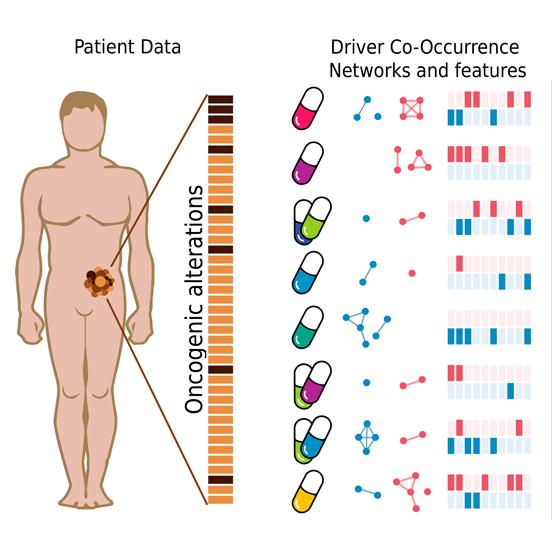
Credit: SBNB lab (IRB Barcelona)
Cancer driver genes are those with mutations that are essential for tumour development and spread. Led by ICREA researcher Patrick Aloy, scientists from the Structural Bioinformatics and Network Biology (SBNB) Laboratory at IRB Barcelona have developed a computational pipeline that predicts tumour response to different cancer treatments. This system is based on the identification of complex response markers derived from the patterns of co-occurrence between cancer driver genes carrying mutations. It has been tested experimentally and with data from breast cancer patients and has achieved 66% accuracy in the prediction of these responses.
Given their key role in tumour development, cancer driver genes have been widely studied in recent decades. Knowledge of which of these genes are affected in a specific tumour can help to identify the most appropriate therapeutic strategy for that patient, in an approach known as precision medicine. For the first time, researchers from the SBNB Lab propose the co-occurrence (or lack thereof) of alterations in two or more cancer driver genes as a key factor in predicting the response to a certain treatment.
“The sum of two or more cancer driver genes affected by mutations leads to the formation of a complex network of biomarkers, alters the molecular profile of the tumour and affects its response to treatments,” says Aloy. “Through this work, we see that studying cancer driver genes as a whole, analysing the different combinations, can bring about a great advance towards precision medicine,” he adds.
From bioinformatics to experimental and clinical analysis.
Although there are a lot of data on cancer genomes, less information is available on the outcome of therapeutic interventions in patients. The researchers started from a public database that collects information on the effect of multiple treatments on the growth of human tumours that have been implanted in a mouse model. Based on these data, they selected 53 treatments (or combinations of treatments) and compared the molecular profiles of tumours that responded to each treatment and those that did not.
“After developing our computational model, we validated it experimentally in human tumours implanted in mice,” says Lídia Mateo, postdoctoral researcher at the SBNB Lab and first author of the study. “We were able to predict the outcome of the therapy in 12 of the 14 case studies, well above the power of approved biomarkers to predict drug response,” she adds. The researchers also validated the algorithm with treatment response data from patients with breast cancer.
The work, which has been published in Genome Medicine, was carried out in collaboration with the Vall d’Hebron Oncology Institute (VHIO) and the Memorial Sloan Kettering Cancer Center (MSKCC), thereby allowing the predictive system to be applied to the analysis of clinical trial results.
###
This study was funded by the European Research Council, the Ministry of Science and Innovation and the Catalan Government. Lídia Mateo has an FPI fellowship.
Reference article:
Lidia Mateo, Miquel Duran-Frigola, Albert Gris-Oliver, Marta Palafox, Maurizio Scaltriti, Pedram Razavi, Sarat Chandarlapaty, Joaquin Arribas, Meritxell Bellet, Violeta Serra & Patrick Aloy
Personalized cancer therapy prioritization based on driver alteration co-occurrence patterns
Genome Medicine (2020) DOI: 10.1186/s13073-020-00774-x
Media Contact
Nahia Barberia
[email protected]
Original Source
https:/
Related Journal Article
http://dx.