• HOME
  • NEWS
  • EXPLORE
    • CAREER
      • Companies
      • Jobs
    • EVENTS
    • iGEM
      • News
      • Team
    • PHOTOS
    • VIDEO
    • WIKI
  • BLOG
  • COMMUNITY
    • FACEBOOK
    • INSTAGRAM
    • TWITTER
Tuesday, May 12, 2026
BIOENGINEER.ORG
No Result
View All Result
  • Login
  • HOME
  • NEWS
  • EXPLORE
    • CAREER
      • Companies
      • Jobs
        • Lecturer
        • PhD Studentship
        • Postdoc
        • Research Assistant
    • EVENTS
    • iGEM
      • News
      • Team
    • PHOTOS
    • VIDEO
    • WIKI
  • BLOG
  • COMMUNITY
    • FACEBOOK
    • INSTAGRAM
    • TWITTER
  • HOME
  • NEWS
  • EXPLORE
    • CAREER
      • Companies
      • Jobs
        • Lecturer
        • PhD Studentship
        • Postdoc
        • Research Assistant
    • EVENTS
    • iGEM
      • News
      • Team
    • PHOTOS
    • VIDEO
    • WIKI
  • BLOG
  • COMMUNITY
    • FACEBOOK
    • INSTAGRAM
    • TWITTER
No Result
View All Result
Bioengineer.org
No Result
View All Result
Home NEWS Science News

Textile-fiber-embedded multiluminescent device for future wearable devices

Bioengineer by Bioengineer
March 31, 2020
in Science News
Reading Time: 3 mins read
0
IMAGE
Share on FacebookShare on TwitterShare on LinkedinShare on RedditShare on Telegram

Principal researcher Soon Moon Jeong at DGIST developed in-plane electro-luminescent(EL) technology that inserts electrodes into a luminous layer
IMAGE

Credit: DGIST

Dr. Soon Moon Jeong’s research team in the Division of Energy Technology at DGIST has developed a new structure of luminescence technology. This will enable the production of light-emitting elements that overcome the limitations of existing methods, expecting to greatly help improve the efficiency of light-emitting elements used in various ways such as billboards and banners.

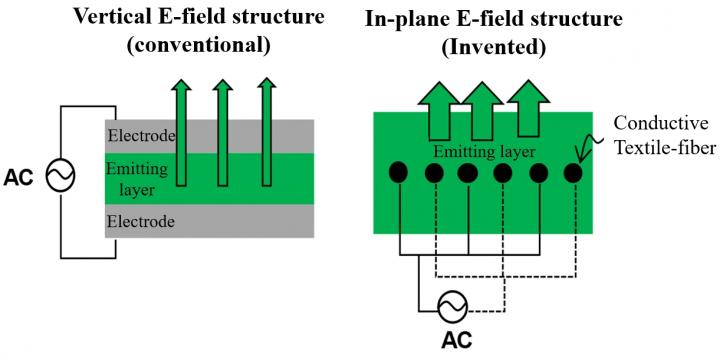
Light emitting devices need electrodes to transmit energy to the light emitting layer. The ‘flat electrode’ used here is an electrode consists of a coplanar structure surrounding the light emitting layer, which has limitation as the light emitted from the light emitting layer is blocked by the electrode. The decreasing flexibility of the electrodes was also an obstacle to manufacturing a flexible light emitting device that emits light constantly.

To overcome these limitations, Dr. Jeong’s team cross-inserted a new type of electrode made of fibers inside the light emitting layer unlike existing light emitting devices, through which they could develop a new light-emitting technology using an in-plane electric field generated in parallel to the light-emitting layer. The light-emitting device produced this way improved efficiency significantly by emitting light more flexibly and stably than the existing light-emitting devices.

Dr. Jeong’s research team applied a new luminescent film using zinc sulfide (ZnS) and polydimethylsiloxane (PDMS) to the luminescent layer while using the in-plane electric field. Through this, they made possible at the same time the mechanoluminescence (ML) which generates light by applying mechanical force and electroluminescence (EL) which generates light by operating the electric field. While it was not possible in the conventional light emitting devices, this new technology could maintain constant and efficient light intensity in various environments.

The light-emitting device developed this time provided important clues to overcome various limitations of the existing light-emitting device. First, the structure of light emitting device developed by Dr. Jeong’s team solved the problem of the existing light emitting device in which electrodes are inserted into the light emitting layer and block light. By doing so, the research team also solved at once the disadvantage that thick electrodes needed to further increase the light intensity of light emitting device rather blocking the light of the light emitting layer between them.

Dr. Jeong in the Division of Energy Technology said “We want to change the paradigm of related industries in the future through the development of devices that emit light constantly, despite any changes of forms. This is definitely possible if we improve the light emitting device further, and it is expected to be used in various forms of light emitting textile and wearable devices.”

This research finding was published on the latest issue of Materials Today, a world-renowned international journal in materials engineering. This research was conducted with the support of DGIST and the mid-carrier researcher support project carried out by the Ministry of Science and ICT.

###

Media Contact
Kwanghoon Choi
[email protected]

Original Source

https://dgist.ac.kr/en/html/sub06/060202.html

Related Journal Article

http://dx.doi.org/10.1016/j.mattod.2019.08.004

Tags: Electrical Engineering/ElectronicsElectromagneticsNanotechnology/MicromachinesTechnology/Engineering/Computer Science
Share12Tweet8Share2ShareShareShare2

Related Posts

Humans and Zebra Finches Share Similar Speech Learning Techniques #ASA190 — Chemistry

Humans and Zebra Finches Share Similar Speech Learning Techniques #ASA190

May 11, 2026
New Study Uncovers How Fungal Parasites Attack Strawberries and Raspberries — Agriculture

New Study Uncovers How Fungal Parasites Attack Strawberries and Raspberries

May 11, 2026

City of Hope Researchers to Present Groundbreaking Immunotherapy and Precision Medicine Advances Across Multiple Cancer Types at ASCO 2026

May 11, 2026

Medicaid Expansion Reduces Mortality in Young Adults with Kidney Failure

May 11, 2026
Please login to join discussion

POPULAR NEWS

  • Research Indicates Potential Connection Between Prenatal Medication Exposure and Elevated Autism Risk

    841 shares
    Share 336 Tweet 210
  • New Study Reveals Plants Can Detect the Sound of Rain

    728 shares
    Share 290 Tweet 182
  • Salmonella Haem Blocks Macrophages, Boosts Infection

    62 shares
    Share 25 Tweet 16
  • Breastmilk Balances E. coli and Beneficial Bacteria in Infant Gut Microbiomes

    57 shares
    Share 23 Tweet 14

About

We bring you the latest biotechnology news from best research centers and universities around the world. Check our website.

Follow us

Recent News

Humans and Zebra Finches Share Similar Speech Learning Techniques #ASA190

New Study Uncovers How Fungal Parasites Attack Strawberries and Raspberries

City of Hope Researchers to Present Groundbreaking Immunotherapy and Precision Medicine Advances Across Multiple Cancer Types at ASCO 2026

Subscribe to Blog via Email

Enter your email address to subscribe to this blog and receive notifications of new posts by email.

Join 82 other subscribers
  • Contact Us

Bioengineer.org © Copyright 2023 All Rights Reserved.

Welcome Back!

Login to your account below

Forgotten Password?

Retrieve your password

Please enter your username or email address to reset your password.

Log In
No Result
View All Result
  • Homepages
    • Home Page 1
    • Home Page 2
  • News
  • National
  • Business
  • Health
  • Lifestyle
  • Science

Bioengineer.org © Copyright 2023 All Rights Reserved.