In a series of tests over five years, key parameters in solar panel performance were measured, producing data for better error correction factors and for choosing the most efficient panel
Credit: Thomas Hobirk, MPI-CEC
WASHINGTON, D.C., January 2, 2020 — Photovoltaics used in solar panels are sensitive to environmental factors and often suffer degradation over time. International Electrotechnical Commission standards for accelerated degradation do not include field tests. While some testing facilities have made data available, much of the data needed to make business decisions for PV is not available publicly.
In testing solar panels, the sun’s intensity, the spectral composition and the angle of light are important factors in understanding why certain panels are successful and others degrade more quickly. Tests must also include many parameters beyond just temperature.
To address the knowledge gap in degradation mechanisms for various PV types, researchers performed tests over five years in which they collected weather data and panel performance information. These data points were processed using aggregation and regression algorithms and filtering masks to understand the change over time. The results are published in the Journal of Renewable and Sustainable Energy, from AIP Publishing.
“Our study highlights that one of the proposed methods of tackling this problem, i.e., applying the irradiance mask, might add bias to the data without decreasing the spread,” author Peter Kraus said. “What we were surprised by was that a simple data aggregation to a longer time interval, coupled with the year-on-year method for calculating degradation rates, yielded reasonable results that were validated when the pyranometer data was excluded.”
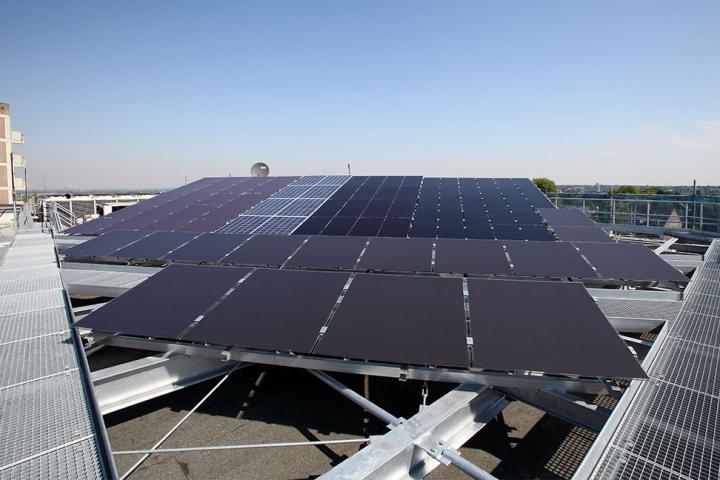
The tests were performed at a PV power plant installed at the Max Planck Institute for Chemical Energy Conversion in Mülheim an der Ruhr, Germany. The rooftop installation includes five inorganic PV technologies: micromorph thin film silicon, cadmium telluride, copper-indium-gallium-selenium, polycrystalline silicon and amorphous silicon.
Pyranometers are sensors used to measure sunlight irradiance, but they are prone to errors and malfunction. As a result, they must be regularly checked and calibrated.
To handle this problem, the researchers employed an open-source testing methodology created by the National Renewable Energy Laboratory and Sun Power Corporation called clear sky irradiance, which is the expected solar irradiance at a given location in ideal clear-sky conditions.
They compared performance ratios based on measured real-world data and data modeled using clear sky irradiance to show the difference between datasets, highlight data inconsistencies and report accurate performance over time.
The authors plan to continue to produce detailed data on the PV plant to expand the dataset over longer periods of time and bring raw performance data into the open where it can be used to improve the technology.
###
The article, “Reliable long-term performance assessment of commercial photovoltaic 2 modules tested under field conditions over 5 years,” is authored by Peter Kraus, Cyriac Massué, Saskia Heumann and Robert Schlögl. The article appeared in the Journal of Renewable and Sustainable Energy on Dec. 31, 2019 (DOI: 10.1063/1.5128171) and can be accessed at https:/
ABOUT THE JOURNAL
Journal of Renewable and Sustainable Energy is an interdisciplinary journal that publishes across all areas of renewable and sustainable energy relevant to the physical science and engineering communities. Topics covered include solar, wind, biofuels and more, as well as renewable energy integration, energy meteorology and climatology, and renewable resourcing and forecasting. See https:/
Media Contact
Larry Frum
[email protected]
301-209-3090
Related Journal Article
http://dx.