• HOME
  • NEWS
  • EXPLORE
    • CAREER
      • Companies
      • Jobs
    • EVENTS
    • iGEM
      • News
      • Team
    • PHOTOS
    • VIDEO
    • WIKI
  • BLOG
  • COMMUNITY
    • FACEBOOK
    • INSTAGRAM
    • TWITTER
Sunday, December 21, 2025
BIOENGINEER.ORG
No Result
View All Result
  • Login
  • HOME
  • NEWS
  • EXPLORE
    • CAREER
      • Companies
      • Jobs
        • Lecturer
        • PhD Studentship
        • Postdoc
        • Research Assistant
    • EVENTS
    • iGEM
      • News
      • Team
    • PHOTOS
    • VIDEO
    • WIKI
  • BLOG
  • COMMUNITY
    • FACEBOOK
    • INSTAGRAM
    • TWITTER
  • HOME
  • NEWS
  • EXPLORE
    • CAREER
      • Companies
      • Jobs
        • Lecturer
        • PhD Studentship
        • Postdoc
        • Research Assistant
    • EVENTS
    • iGEM
      • News
      • Team
    • PHOTOS
    • VIDEO
    • WIKI
  • BLOG
  • COMMUNITY
    • FACEBOOK
    • INSTAGRAM
    • TWITTER
No Result
View All Result
Bioengineer.org
No Result
View All Result
Home NEWS Science News Chemistry

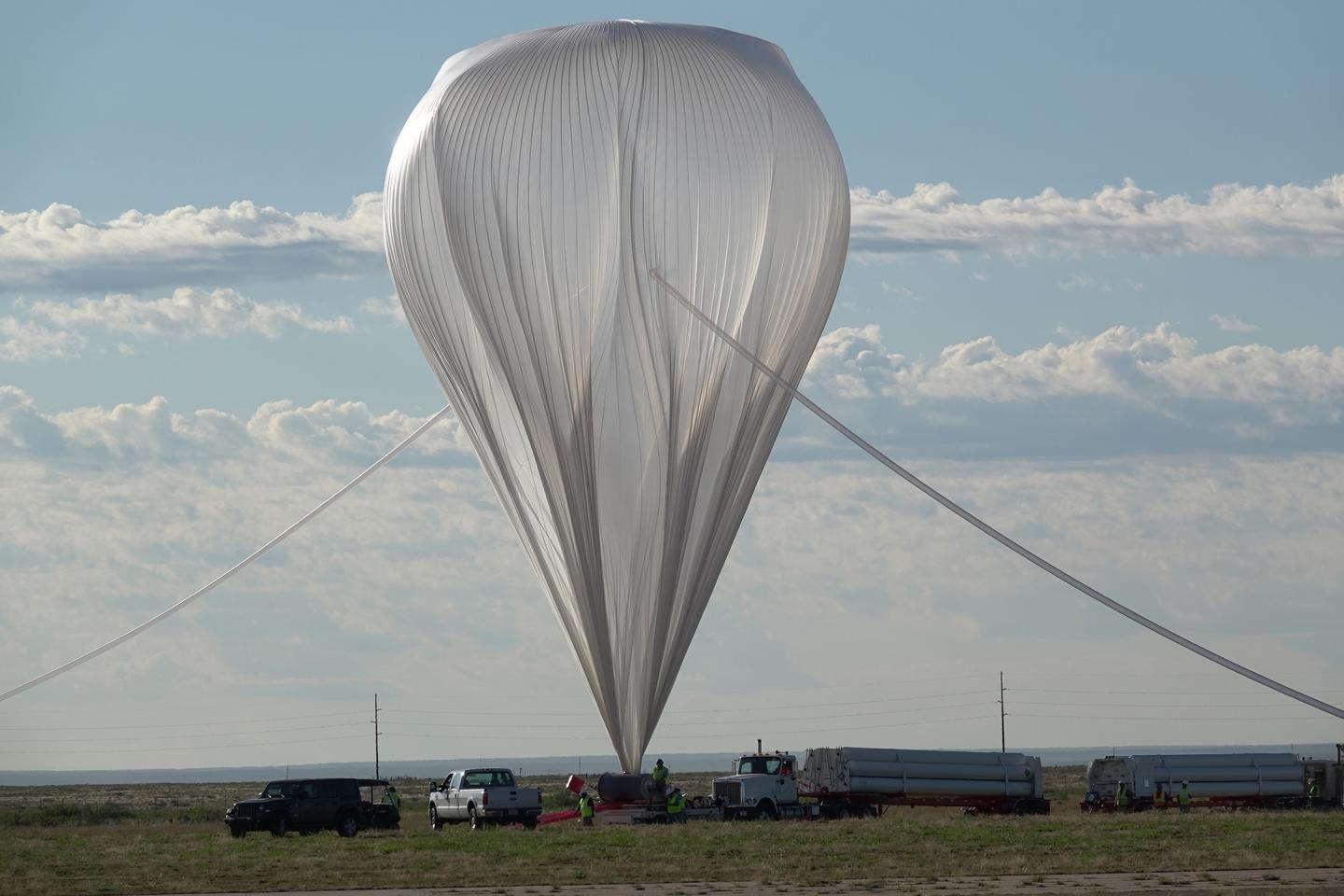
Telescope seeking new planets launches via football field-sized balloon

Bioengineer by Bioengineer
October 1, 2019
in Chemistry
Reading Time: 2 mins read
0
IMAGE
Share on FacebookShare on TwitterShare on LinkedinShare on RedditShare on Telegram

Instrument designed and built by UMass Lowell targets Earth-like objects in space hidden by stars’ glare
IMAGE

Credit: Photo credit: NASA

LOWELL, Mass. – In a quest to discover new Earth-like planets capable of supporting life, NASA on Saturday launched a telescope designed and built by UMass Lowell that could one day find new planets and other objects in space that have yet to be detected because they are awash in light from stars they orbit.

Launched at 11:07 a.m. EST from the NASA Columbia Scientific Balloon Facility in Fort Sumner, N.M., the telescope was lifted to the edge of the Earth’s atmosphere to about 125,000 feet – roughly 3.5 times higher than the typical cruising altitude of a passenger jet – by a gigantic helium balloon some 39 million cubic feet, about the size of a football field.

The project is funded by a $5.6 million, five-year grant from NASA to UMass Lowell. Physics Prof. Supriya Chakrabarti, who directs the university’s Lowell Center for Space Science and Technology (LoCSST), is leading the research team that designed and built the telescope.

Known as “PICTURE-C,” which stands for Planetary Imaging Concept Testbed Using a Recoverable Experiment-Coronagraph, the telescope weighs 1,500 pounds and is about 14 feet long and 3 feet wide. The instrument boasts a unique imaging system designed to block out direct light from stars so that objects close to them, including planets that would otherwise be hidden from view by stars’ glare, can be studied in detail.

“Our ultimate goal is to directly image planets similar to Earth around nearby stars. To prepare for that, in this flight, we tested the capabilities of the instrument’s key technologies by imaging asteroid belt-like systems around other stars,” Chakrabarti said.

PICTURE-C includes an optical control system that allows it to stay on target, which was designed and built by UMass Lowell Research Scientist Christopher Mendillo of Boston and Physics Associate Prof. Timothy Cook of Newton.

UMass Lowell Senior Mechanical Engineer Jason Martel of Ayer and graduate students Kuravi Hewawasam of Lowell and Glenn Howe of Malden contributed to the mission, along with other collaborators including researchers from NASA’s Jet Propulsion Laboratory and Goddard Space Flight Center.

“In our pursuit of space exploration, we are training the next generation of astronomers, space scientists and engineers through hands-on involvement in all phases of various missions, from instrument development to data analysis,” Chakrabarti said.

During the test mission, the device was aloft for several hours, after which NASA ground controllers released the telescope from the balloon, which parachuted gently back to Earth to be reused for its next mission, which is scheduled for next year.

###

UMass Lowell is a national research university located on a high-energy campus in the heart of a global community. The university offers its more than 18,000 students bachelor’s, master’s and doctoral degrees in business, education, engineering, fine arts, health, humanities, sciences and social sciences. UMass Lowell delivers high-quality educational programs, vigorous hands-on learning and personal attention from leading faculty and staff, all of which prepare graduates to be leaders in their communities and around the globe. http://www.uml.edu

Media Contact
Nancy Cicco
[email protected]

Tags: AstronomyAstrophysicsComets/AsteroidsExperiments in SpacePlanets/MoonsSpace/Planetary ScienceStars/The Sun
Share14Tweet9Share2ShareShareShare2

Related Posts

Cutting Electrolyte Reduction Boosts High-Energy Battery Performance

Cutting Electrolyte Reduction Boosts High-Energy Battery Performance

December 19, 2025
Microenvironment Shapes Gold-Catalysed CO2 Electroreduction

Microenvironment Shapes Gold-Catalysed CO2 Electroreduction

December 11, 2025

Photoswitchable Olefins Enable Controlled Polymerization

December 11, 2025

Cation Hydration Entropy Controls Chloride Ion Diffusion

December 10, 2025
Please login to join discussion

POPULAR NEWS

  • Nurses’ Views on Online Learning: Effects on Performance

    Nurses’ Views on Online Learning: Effects on Performance

    70 shares
    Share 28 Tweet 18
  • NSF funds machine-learning research at UNO and UNL to study energy requirements of walking in older adults

    71 shares
    Share 28 Tweet 18
  • Unraveling Levofloxacin’s Impact on Brain Function

    53 shares
    Share 21 Tweet 13
  • Exploring Audiology Accessibility in Johannesburg, South Africa

    51 shares
    Share 20 Tweet 13

About

We bring you the latest biotechnology news from best research centers and universities around the world. Check our website.

Follow us

Recent News

TMEM120A Regulates Fat Lipids via ER CoA Channel

Hidden Deforestation from Global Mining in 21st Century

Empowerment Model Boosts COPD Patients via Telenursing

Subscribe to Blog via Email

Success! An email was just sent to confirm your subscription. Please find the email now and click 'Confirm' to start subscribing.

Join 70 other subscribers
  • Contact Us

Bioengineer.org © Copyright 2023 All Rights Reserved.

Welcome Back!

Login to your account below

Forgotten Password?

Retrieve your password

Please enter your username or email address to reset your password.

Log In
No Result
View All Result
  • Homepages
    • Home Page 1
    • Home Page 2
  • News
  • National
  • Business
  • Health
  • Lifestyle
  • Science

Bioengineer.org © Copyright 2023 All Rights Reserved.