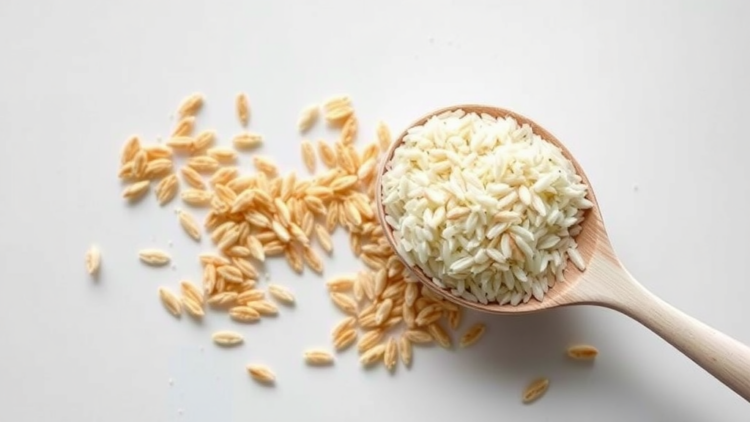
Rice bran, the fibrous outer layer stripped away when brown rice is polished into white rice, is produced at a staggering scale of more than 63 million tons every year. Most of it is pressed for its oil, but what remains after defatting is a protein- and polysaccharide-rich residue that the food industry has long struggled to exploit. Now, a team of Chinese researchers has shown that an otherwise stubborn insoluble fraction of rice bran can be transformed into a high-performance, food-grade emulsion stabilizer—simply by decorating it with the right tea catechin molecules. The findings, published in Current Research in Food Science, reveal how subtle differences in the molecular architecture of tea polyphenols translate into dramatic changes in emulsion stability.
The material at the heart of the study is the insoluble rice bran natural complex, or IRBNC, a composite left behind when soluble proteins and bioactive polysaccharides are extracted from defatted rice bran. Roughly half of the defatted bran ends up in this residue, in which tightly bound proteins, insoluble polysaccharides, and phenolic compounds form networks so robust that conventional separation techniques struggle to dismantle them. Rather than fighting this recalcitrance, the researchers embraced it. Because plant-derived natural complexes are assembled in situ during plant growth through cross-linking of proteins, polysaccharides, and polyphenols, they possess a structural integrity and richness of intermolecular interactions that artificially blended systems cannot match. The problem was that their particle sizes were uneven and their surface chemistry unoptimized for interfacial work.
Earlier work by the same group had shown that mechanical pretreatment could partially improve the wettability of IRBNC particles, and that the green tea catechin EGCG could markedly enhance their emulsion-stabilizing capacity. But a critical question remained open: were EGCG’s benefits unique to its particular structure, or did they depend on generalizable features such as the number of phenolic hydroxyl groups and the presence of a galloyl moiety? To answer this, the team selected three representative catechin monomers—epicatechin (EC), epigallocatechin (EGC), and epicatechin gallate (ECG)—which differ systematically in hydroxyl count and galloylation, and conjugated each of them to IRBNC at three dosages: 25, 50, and 100 milligrams of catechin per gram of complex.
The evidence for genuine interaction was unambiguous. Bound phenol content rose with catechin dosage, although binding efficiency fell at higher loadings, indicating that the complex surfaces saturate at around 25 milligrams per gram. Free amino and sulfhydryl groups in the proteins declined steadily, consistent with quinone-mediated covalent reactions under the alkaline conditions used for conjugation, alongside extensive hydrogen bonding. Infrared spectroscopy showed attenuated hydroxyl and carbonyl bands, while X-ray diffraction revealed that the semi-crystalline cellulose signature of the complex broadened and weakened, signaling a shift toward a more amorphous, flexible architecture. Protein secondary structure analysis confirmed partial unfolding, with ordered alpha-helices and beta-sheets giving way to more disordered conformations that favor interfacial adsorption.
Wettability emerged as the decisive parameter. Native IRBNC particles, with a water contact angle of roughly 127 degrees, are so hydrophobic that they resist stable positioning at oil–water interfaces. Catechin modification progressively introduced hydrophilic hydroxyl groups, pushing the contact angle toward the golden value of 90 degrees at which particles anchor most effectively. ECG-modified particles reached 91.05 degrees at just 25 milligrams per gram, while EGC required 50 milligrams per gram to approach the same range. Interfacial tension measurements confirmed the functional payoff: equilibrium tension at the oil–water boundary dropped from 20.43 to 16.19 millinewtons per meter after modification, reflecting faster and denser particle adsorption and stronger interfacial film formation.
When the modified particles were used to prepare oil-in-water Pickering emulsions, the benefits carried through. Droplet sizes shrank to around 46 to 49 micrometers at optimal dosages, compared with large, heterogeneous droplets stabilized by unmodified IRBNC. Confocal microscopy visualized continuous fluorescent shells of protein and polysaccharide encasing the oil droplets, evidence of compact interfacial layers built from the reorganized complexes. Rheological testing showed enhanced viscoelasticity, with storage moduli exceeding loss moduli across the tested frequency range, indicating emulsions with a robust, elastic network character rather than a fragile suspension of isolated droplets.
Oxidative stability improved in parallel. During 30 days of accelerated storage at 45 degrees Celsius, emulsions stabilized by moderately modified particles accumulated fewer lipid hydroperoxides and lower levels of thiobarbituric acid reactive substances, the markers of primary and secondary oxidation respectively. The researchers attribute this dual protection to the synergistic action of catechin antioxidant chemistry—phenolic hydroxyls scavenging free radicals—and the physical barrier formed by particle-laden interfaces, which restricts oxygen diffusion and shields lipid substrates from pro-oxidants. ECG, with its galloyl group and highest hydroxyl density, delivered the strongest suppression of both oxidation markers.
The study also carries a clear warning about dosage. At excessive catechin concentrations of 50 to 100 milligrams per gram, particles over-crosslinked and aggregated, wettability overshot into excessive hydrophilicity, and emulsion stability deteriorated—droplets coarsened, creaming intensified, and oxidation markers climbed. This structure–dosage–function triangle means that each catechin demands its own optimal loading: 25 milligrams per gram for EC and ECG, and 50 for EGC. The galloyl-bearing ECG proved the most efficient overall performer, achieving tight interfacial packing and superior stability at low dosage, whereas the smaller EC adsorbed rapidly but formed weaker films.
Beyond the immediate numbers, the work establishes a rational design principle for natural Pickering stabilizers: molecular features of polyphenols—hydroxyl density and galloyl substitution—can be used as tunable levers to restructure insoluble plant complexes for interfacial duty. Given the enormous global stream of rice bran waste, the approach offers a route to convert a low-value by-product into functional ingredients for beverages, sauces, encapsulated nutrients, and delivery systems for lipophilic bioactives. The authors note that advanced molecular and interfacial characterization will be needed to fully resolve the interaction pathways and assembly mechanisms at oil–water interfaces, but the demonstration that a tea molecule’s architecture can dictate the fate of a rice milling residue is a striking example of structure-guided food materials engineering.
Subject of Research: Structure-dependent interfacial modification of insoluble rice bran natural complexes by catechin monomers for Pickering emulsion stabilization
Article Title: Enhancing Pickering emulsion stabilization of insoluble rice bran natural complexes: Structure-dependent interfacial regulation by catechin monomers
Article References: Cui, H., Li, H., Yu, E., Wu, X., Lin, L., & Wu, W. (2026). Enhancing Pickering emulsion stabilization of insoluble rice bran natural complexes: Structure-dependent interfacial regulation by catechin monomers. Current Research in Food Science, 13, Article 101554. https://doi.org/10.1016/j.crfs.2026.101554
Image Credits: AI Generated
DOI: 10.1016/j.crfs.2026.101554
Keywords: Pickering emulsion, rice bran, catechins, EGCG, ECG, interfacial regulation, wettability, lipid oxidation, protein-polysaccharide complex, food-grade stabilizer, tea polyphenols, emulsion stability
Cite Scienmag News
APA
MLA
Chicago
Alan Morgan. (September 12, 2026). Tea Catechins Transform Waste Rice Bran into Powerful Emulsion Stabilizers. Scienmag. https://scienmag.com/tea-catechins-transform-waste-rice-bran-into-powerful-emulsion-stabilizers/
Alan Morgan. “Tea Catechins Transform Waste Rice Bran into Powerful Emulsion Stabilizers.” Scienmag, 12 September 2026, https://scienmag.com/tea-catechins-transform-waste-rice-bran-into-powerful-emulsion-stabilizers/. Accessed 12 September 2026.
Alan Morgan. “Tea Catechins Transform Waste Rice Bran into Powerful Emulsion Stabilizers.” Scienmag. September 12, 2026. https://scienmag.com/tea-catechins-transform-waste-rice-bran-into-powerful-emulsion-stabilizers/
Copy citation
Download RIS
Tags: application of tea catechins inbioactive polysaccharides in rice brancatechinsECGEGCGemulsion stabilityenhancing rice bran functional properties with tea polyphenolsfood-grade emulsion stabilizer developmentfood-grade stabilizerinnovative strategies for rice bran residue valorizationinsoluble rice bran complex (IRBNC)interfacial regulationlipid oxidationnatural emulsion stabilizers from rice branPickering emulsionplant-based natural complexes in food sciencepolyphenol architecture and emulsion stabilityprotein-polysaccharide complexrice branRice bran waste valorizationsustainable utilization of rice bran byproductstea catechin molecular decorationtea polyphenolswettability