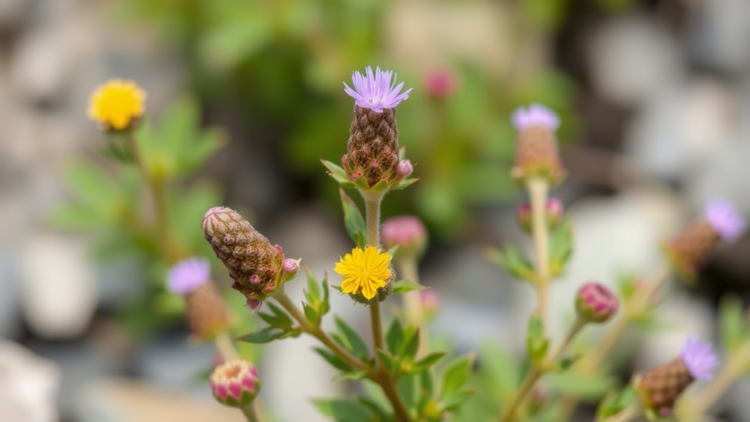
High on the ridges of the Kashmir Himalaya, a low-growing aromatic shrub is quietly rewriting what scientists thought they knew about how plants reproduce and survive as altitude climbs. A new field study of Thymus linearis, a wild thyme native to the Western Himalaya, has documented a striking shift in the plant’s reproductive strategy along a 1,700-meter elevational gradient, one that pits the sheer quantity of pollen a flower produces against the functional quality of that pollen. The findings, published in the journal Discover Plants, offer a rare within-species test of a framework that has mostly been explored at the level of entire plant communities, and they carry sobering implications for high-altitude species facing a warming climate.
An international pattern long recognized by ecologists holds that pollen–ovule ratios, a conservative indicator of a plant’s breeding system, tend to rise with elevation across diverse floras. The conventional interpretation is that plants at altitude, facing sparse and unreliable pollinators, invest more heavily in pollen to increase the odds of outcrossing. But quantity is only half the story. Reproductive success depends not only on how much pollen is available but on how well that pollen performs, a distinction central to the pollen quantity–quality framework proposed by Aizen and Harder in 2007. Until now, simultaneous measurements of pollen quantity and quality within a single species along a natural elevational gradient have remained scarce.
Researchers from the Department of Botany at the University of Kashmir, led by Latif Ahmad Peer with Sadaf Wani and Taliyah Manzoor as equal first authors, set out to close that gap. Between July and August 2024, at the peak flowering season, the team sampled five populations of Thymus linearis across the Kashmir Valley, from a low-elevation site at 1,800 meters to the alpine heights of Pir ki Gali at 3,499 meters. At each site they measured sixteen vegetative and reproductive traits in fifteen randomly selected mature individuals, and took finer-grained pollen measurements from three individuals per site, a sample size comparable to other alpine reproductive studies. In total, the team counted and stained thousands of individual pollen grains under the microscope, using acetocarmine to assess stainability, a widely used comparative proxy for pollen functionality.
The results were unambiguous in their direction. The pollen–ovule ratio climbed from roughly 3,269 pollen grains per ovule at the lowest site to 4,740 at Pir ki Gali, an increase of about 45 percent that rose significantly with elevation. Over the same gradient, pollen stainability fell from 91.3 percent to 70.8 percent, a 22 percent reduction in functional quality. Plotted against each other, the two variables traced a strong negative relationship across populations, with the pollen–ovule ratio and stainability explaining more than 70 percent of each other’s variation. That direct relationship narrowly missed conventional statistical significance, a nuance the authors acknowledge candidly, but the opposing elevational trends were each individually significant and together are consistent with a genuine trade-off in which high-altitude plants compensate for deteriorating pollen quality by manufacturing more of it.
Every population examined fell above a pollen–ovule ratio of 2,900, placing all of them squarely in the xenogamous, or outcrossing, category under Cruden’s classic 1977 classification. What changed with elevation was the intensity of that investment. The authors suggest several non-exclusive mechanisms behind the quality decline. Intensifying ultraviolet-B radiation at altitude can damage DNA during the delicate stages of pollen development known as microsporogenesis, while the cold that characterizes high mountains is well known to disrupt normal male gamete formation. Nutrient-poor alpine soils may also force plants to choose between producing abundant pollen and producing functional pollen. Distinguishing among these mechanisms, the authors stress, will require experimental manipulation that goes beyond their correlational field design.
The second major surprise of the study concerns the leaves. A substantial body of literature, from the worldwide leaf economics spectrum onward, predicts that leaf size should shrink with elevation as plants adopt more resource-conservative phenotypes in cold, windswept environments. Thymus linearis defied that expectation. Three of the four measured leaf dimensions increased significantly toward the top of the gradient, and lower leaf width showed the most dramatic differentiation of any trait in the entire dataset, expanding from 0.18 centimeters at 1,800 meters to 0.46 centimeters at 3,499 meters, a 156 percent difference between the lowest and highest populations. The team interprets this through a photosynthetic-compensation hypothesis: at Pir ki Gali the growing season lasts only three to four months, compared with five to six months at lower elevations, and larger leaves may allow plants to maximize carbon gain during that compressed window, outweighing the costs of increased water loss and heat load.
The third pattern emerged in the plant’s overall architecture. Populations at mid-elevation sites such as Drung and Dara were taller, produced more secondary branches, and carried more inflorescences. At the highest site, the plants were stockier and more heavily invested in support structures: stem circumference increased by 71 percent and root circumference by 76 percent relative to the lowest site, while inflorescence numbers dropped by 64 percent. Regression analysis revealed that stem girth thickened by roughly 0.024 centimeters for every 100 meters of elevation gain, and root girth by 0.029 centimeters over the same distance. These structural traits were tightly coupled with one another and with leaf dimensions, correlation coefficients ranging from 0.97 to 0.99, painting a picture of a coordinated stress-tolerant syndrome rather than isolated trait shifts. The pattern is broadly consistent with the stress-tolerant expectations of Grime’s CSR framework, although the authors are careful to note that their measured traits do not permit a formal classification of ecological strategies.
To capture how these traits move together, the researchers performed a principal component analysis on fourteen morphological traits. The first two components accounted for a remarkable 88.17 percent of total variation, with the first axis alone explaining 65.62 percent and primarily representing a gradient of structural investment. The highest-elevation population occupied the extreme positive end of that axis, associated with the thickest stems, largest root systems, and broadest leaves, effectively the strongest stress-tolerant phenotype in the dataset. A second analysis that included the two pollen variables produced an essentially identical population structure and, tellingly, loaded the pollen–ovule ratio and pollen stainability in opposite directions on the first axis, providing independent multivariate corroboration of the quantity–quality trade-off.
The study’s most consequential contribution may be what it implies for interpreting community-level data. Previous work in southwestern China documented rising pollen–ovule ratios across 84 species along an elevation gradient and interpreted the trend as a shift toward outcrossing. The Kashmir results suggest such interpretations may be incomplete: if pollen quality declines as quantity rises, then elevated pollen–ovule ratios could partly reflect a compensatory response to stress rather than a straightforward increase in outcrossing. A recent global meta-analysis finding that reproductive responses to elevation are largely species-specific reinforces the value of single-species studies like this one, which can reveal mechanistic trade-offs invisible to broader surveys.
The authors are equally clear about the limitations. Pollen traits were measured in three individuals per population rather than fifteen, reflecting the labor-intensive nature of pollen counting, and acetocarmine staining measures stainability rather than true germination capacity. The observational design cannot disentangle which of the many covarying environmental factors along the gradient drives the observed patterns, nor can it separate phenotypic plasticity from genetically based local adaptation. Common-garden and reciprocal-transplant experiments, direct pollinator observations, and pollen germination assays are the logical next steps. Yet the climate implications are difficult to ignore. As temperatures rise, mountain species are expected to shift upward to track suitable conditions, and Thymus linearis may already be pressing against a ceiling: its highest-elevation population has the lowest pollen stainability of any site studied. If warming pushes populations further upslope or disrupts growing seasons, pollen quality could deteriorate further, creating a reproductive bottleneck precisely where species are forced to retreat. The pronounced differentiation among populations along the gradient, whether plastic or heritable, argues for conserving multiple populations across the full elevational range rather than one or two flagship sites, so that the functional diversity this thyme has evolved to cope with its mountains is not lost before it is fully understood.
Subject of Research: Elevational variation in pollen quantity, pollen quality, and stress-tolerant morphology in the Himalayan plant Thymus linearis
Article Title: Elevational shift in pollen quantity–quality trade-off and stress-tolerant morphology in Himalayan Thymus linearis
Article References: Wani, S., Manzoor, T., & Peer, L. A. (2026). Elevational shift in pollen quantity–quality trade-off and stress-tolerant morphology in Himalayan Thymus linearis. Discover Plants, 3(1), Article 389. https://doi.org/10.1007/s44372-026-00871-y
Image Credits: AI Generated
DOI: 10.1007/s44372-026-00871-y
Keywords: Thymus linearis, Kashmir Himalaya, elevational gradient, pollen-ovule ratio, pollen stainability, plant reproduction, leaf traits, stress tolerance, phenotypic variation, climate change, outcrossing, plant morphology
Cite Scienmag News
APA
MLA
Chicago
Gavin Prescott. (September 12, 2026). Himalayan Thyme Reveals Pollen Trade-Off That May Threaten Its Mountaintop Future. Scienmag. https://scienmag.com/himalayan-thyme-reveals-pollen-trade-off-that-may-threaten-its-mountaintop-future/
Gavin Prescott. “Himalayan Thyme Reveals Pollen Trade-Off That May Threaten Its Mountaintop Future.” Scienmag, 12 September 2026, https://scienmag.com/himalayan-thyme-reveals-pollen-trade-off-that-may-threaten-its-mountaintop-future/. Accessed 12 September 2026.
Gavin Prescott. “Himalayan Thyme Reveals Pollen Trade-Off That May Threaten Its Mountaintop Future.” Scienmag. September 12, 2026. https://scienmag.com/himalayan-thyme-reveals-pollen-trade-off-that-may-threaten-its-mountaintop-future/
Copy citation
Download RIS
Tags: alpine plant pollination ecologyclimate changeecological implications of pollen trade-offseffects of warming climate on high elevation specieselevational gradienthigh-altitude plant reproductionhigh-altitude plant survival and pollinationHimalayan thyme pollen trade-offimpact of climate change on Himalayan floraKashmir Himalayaleaf traitsmountain plant reproductive strategiesoutcrossingphenotypic variationplant morphologyplant reproductionplant reproductive success at high altitudepollen ovule ratio as breeding indicatorpollen quantity and quality in alpine plantspollen stainabilitypollen-ovule ratiostress toleranceThymus linearisThymus linearis elevational adaptation