• HOME
  • NEWS
  • EXPLORE
    • CAREER
      • Companies
      • Jobs
    • EVENTS
    • iGEM
      • News
      • Team
    • PHOTOS
    • VIDEO
    • WIKI
  • BLOG
  • COMMUNITY
    • FACEBOOK
    • INSTAGRAM
    • TWITTER
Wednesday, July 8, 2026
BIOENGINEER.ORG
No Result
View All Result
  • Login
  • HOME
  • NEWS
  • EXPLORE
    • CAREER
      • Companies
      • Jobs
        • Lecturer
        • PhD Studentship
        • Postdoc
        • Research Assistant
    • EVENTS
    • iGEM
      • News
      • Team
    • PHOTOS
    • VIDEO
    • WIKI
  • BLOG
  • COMMUNITY
    • FACEBOOK
    • INSTAGRAM
    • TWITTER
  • HOME
  • NEWS
  • EXPLORE
    • CAREER
      • Companies
      • Jobs
        • Lecturer
        • PhD Studentship
        • Postdoc
        • Research Assistant
    • EVENTS
    • iGEM
      • News
      • Team
    • PHOTOS
    • VIDEO
    • WIKI
  • BLOG
  • COMMUNITY
    • FACEBOOK
    • INSTAGRAM
    • TWITTER
No Result
View All Result
Bioengineer.org
No Result
View All Result
Home NEWS Science News

Targeting legumain as a novel therapeutic strategy in cancers

Bioengineer by Bioengineer
January 3, 2017
in Science News
Reading Time: 2 mins read
0
Share on FacebookShare on TwitterShare on LinkedinShare on RedditShare on Telegram
IMAGE

Credit: Dr. Chun Wai Mai et al, Bentham Science Publishers

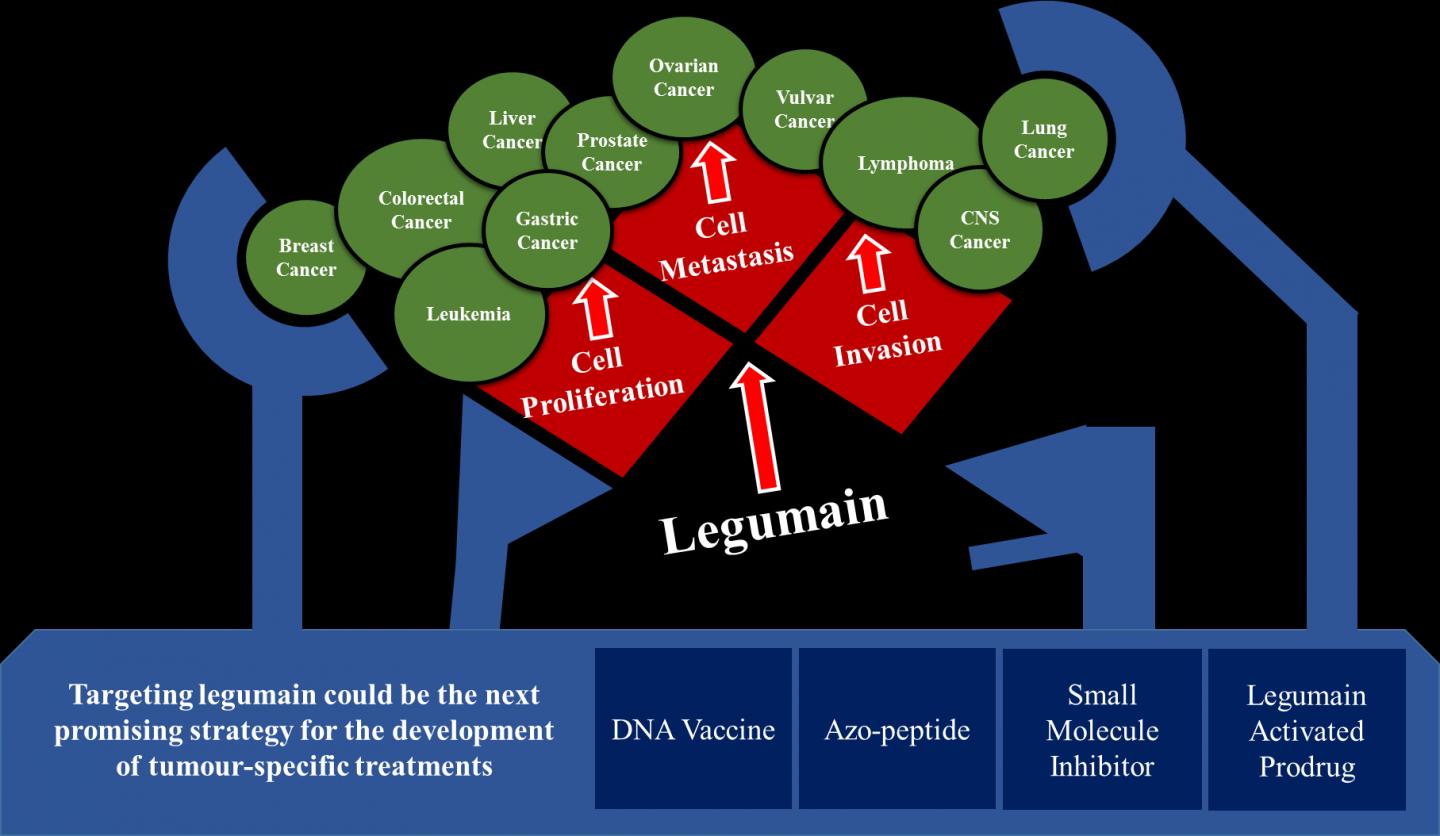
Legumain (LGMN), or asparaginyl endopeptidase, is a newly identified lysosomal cysteine protease. It was recently found to be over-expressed in tumour microenvironment , an enclosed environment that facilitates the interaction among the human solid tumours, tumour-associated endothelial and stromal cells, as well as in tumour-associated macrophages. These non-malignant cells support the growth of the tumours, metastasis and the survival of tumours. One of the identified key biomarkers driving the complexity of tumour microenvironment is LGMN. LGMN is a robust acidic cysteine endopeptidase with remarkably restricted specificity for hydrolysis of asparaginyl bonds.

LGMN is well conserved, having been reportedly preent in plants, invertebrate parasites, as well as in mammals. Mammalian LGMN processes the self and foreign antigens expressed by antigen presenting cells and proteolytically activates toll-like receptor, the innate immunity receptor. Since LGMN has been implicated in tumour development and can potentially be developed into both diagnostic and therapeutic markers. This review aims to relate the recent findings on the biology of LGMN in cancers, to the therapeutic advancements in targeting LGMN in human cancers.

LGMN may serve as both a potential oncogenic marker and a molecular target for treatment of cancer especially for personalized medicine. Although recent findings have shed light on the functional roles and expression patterns of LGMN, further investigations are still warranted to elucidate the exact role and underlying mechanism of action for LGMN in cancer. Recent discoveries have also demonstrated that targeting LGMN directly or utilizing LGMN as a prodrug activator are promising strategies for cancer management in the future. However, further research is necessary before such therapeutic strategies can be fully realized.

###

For more info, please visit https://benthamscience.com/journals/current-drug-targets/article/148446/

Reference: Mai, CW.; et al (2016). Targeting Legumain As a Novel Therapeutic Strategy in Cancers. Current Drug Targets., DOI: 10.2174/1389450117666161216125344 10.2174/1389450117666161216125344

Media Contact

Faizan ul Haq
[email protected]
@BenthamScienceP

http://benthamscience.com/

############

Story Source: Materials provided by Scienmag

Share12Tweet8Share2ShareShareShare2

Related Posts

Flame retardant BDE-209 targets molecularly linked to ulcerative colitis

July 6, 2026
Ultra-high frequency particle impacts mimic rockbursts to shatter hard rock

Ultra-high frequency particle impacts mimic rockbursts to shatter hard rock

July 6, 2026

Kidney transplant outcomes in older adults studied by German researchers

July 6, 2026

Embodied cognition yields interpretable trajectory predictions for autonomous systems.

July 6, 2026
Please login to join discussion

POPULAR NEWS

  • Detection of EDCs in Breast Milk and Infant Urine Up to Six Months Highlights Early Exposure Risks

    77 shares
    Share 31 Tweet 19
  • New Drug Candidate Developed at McMaster Shows Potential for Treating Brain Cancer

    58 shares
    Share 23 Tweet 15
  • Saying Goodbye to PGY-6: Pediatric Fellowship Realities

    103 shares
    Share 41 Tweet 26
  • KTU Researchers Explore Ultrasound’s Role in Enhancing Blood Flow Beyond Diagnostics

    53 shares
    Share 21 Tweet 13

About

We bring you the latest biotechnology news from best research centers and universities around the world. Check our website.

Follow us

Recent News

Flame retardant BDE-209 targets molecularly linked to ulcerative colitis

Ultra-high frequency particle impacts mimic rockbursts to shatter hard rock

Kidney transplant outcomes in older adults studied by German researchers

Subscribe to Blog via Email

Success! An email was just sent to confirm your subscription. Please find the email now and click 'Confirm' to start subscribing.

Join 83 other subscribers
  • Contact Us

Bioengineer.org © Copyright 2023 All Rights Reserved.

Welcome Back!

Login to your account below

Forgotten Password?

Retrieve your password

Please enter your username or email address to reset your password.

Log In
No Result
View All Result
  • Homepages
    • Home Page 1
    • Home Page 2
  • News
  • National
  • Business
  • Health
  • Lifestyle
  • Science

Bioengineer.org © Copyright 2023 All Rights Reserved.