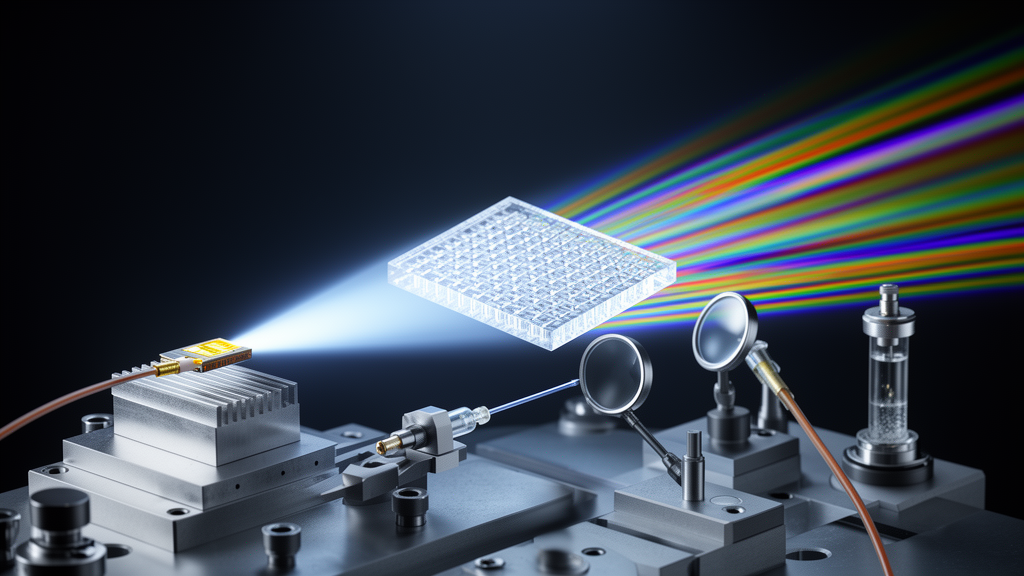
Physicists have built a laser source that trades the usual narrow, single-color beam of a stabilized diode laser for something quite different: a controlled, high-power sweep of light spanning roughly 2 cm⁻¹ of spectrum, all while remaining locked to a well-defined frequency window. The system, described in Applied Physics B, combines a tapered semiconductor amplifier with a volume Bragg grating in an extended external cavity, and it delivers up to 200 mW of optical power across the 14640–14670 cm⁻¹ range, corresponding to wavelengths near 682 nm. The team, led by Jaime Javier Borges Marquez and Luis Gustavo Marcassa, demonstrated the source by recording an absorption spectrum of molecular iodine and by verifying that its emission remains stable over more than a day of continuous operation.
The appeal of the design lies in how it reuses a familiar stabilization trick for an unfamiliar purpose. External-cavity tapered diode lasers are normally optimized to produce high-power, narrow-linewidth emission with near-diffraction-limited beam quality, which makes them workhorses for precision spectroscopy, nonlinear optics, and solid-state laser pumping. But for applications such as broadband molecular spectroscopy, optical pumping, and rovibrational control of molecules, narrow linewidth is not always desirable; what is needed instead is strong emission that covers many molecular transitions at once. The researchers showed that the same volume Bragg grating used to pin a laser’s frequency can, in a different operating regime, define a spectral window within which the tapered amplifier runs broadband.
The experimental arrangement is deliberately simple in concept. A 250 mW tapered amplifier module operating near 682 nm sits in an external cavity roughly 45 cm long, formed by a lens in a cat’s-eye configuration with a plane mirror at its focus. A reflective volume Bragg grating, designed for operation near 682 nm, is positioned about 25 cm from the amplifier output facet. The grating diffracts more than 92 percent of the light and has a spectral selectivity of 0.33 nm at an incidence angle of 6 degrees with respect to its normal. Only the wavelength satisfying the Bragg condition is efficiently reflected back into the amplifier; everything else passes through with low loss. Tilting the grating changes the reflected wavelength, so the angle of the grating sets the center of the emission band.
That tuning behavior was mapped out explicitly. In a preliminary experiment, the team scanned a single-frequency laser and measured the power reflected by the grating, adjusting the grating orientation to maximize reflection at each wavelength and recording the resulting Bragg-condition frequency as a function of the angle between incident and reflected beams. The broadband laser was then operated at angles of 18, 19, and 20 degrees, with the amplifier drive current held at 1000 mA. As expected from the Bragg condition, the central emission frequency shifted with the angle, while the output power remained nearly constant at approximately 200 mW and the emission bandwidth stayed on the order of 2 cm⁻¹, with slight variations attributable to the external cavity alignment.
One puzzle the researchers addressed directly is why the laser’s emission bandwidth is only about a third of the grating’s specified spectral selectivity. Removing the lens placed before the grating increased the emission bandwidth by roughly 85 percent, indicating that the lens reshapes the angular distribution of light striking the grating and therefore its spectral response. In addition, the reflective grating imposes two consecutive spectral filtering stages before light is reinjected into the amplifier, suppressing out-of-band components and narrowing the emission further. To test these ideas, the team replaced the tapered amplifier with the single-frequency laser and measured the spectral response of the feedback system under three conditions: a single pass through the grating, a double pass without the lens, and the double pass in the cat’s-eye configuration. The measured linewidth fell from about 6.0 cm⁻¹ for a single pass to 5.5 cm⁻¹ for the double pass without the lens and 3.2 cm⁻¹ in the cat’s-eye arrangement, with peak diffraction efficiency dropping from roughly 97 percent to 94 percent and then 69 percent. The cat’s-eye configuration, which earlier studies credit with lower sensitivity to transverse misalignment and better mechanical stability, clearly narrows the effective feedback bandwidth.
Characterizing such a source demands a spectrometer with enough resolution to resolve its fine structure, so the group built its own instrument based on a virtually imaged phased array, or VIPA. Light is focused onto a VIPA etalon operating in the 600–725 nm range with a free spectral range of 0.5 cm⁻¹ and a finesse of about 70. A cylindrical telescope then expands the beam onto a 2400 grooves/mm holographic diffraction grating, which spatially separates successive VIPA interference orders and removes their intrinsic frequency degeneracy. The resulting two-dimensional spectrogram is recorded on a CCD camera, with VIPA dispersion providing high spectral resolution along one axis and grating dispersion separating orders along the other. Because the dispersion axes are not perfectly parallel to the camera coordinates, the images are transformed into a rotated coordinate system before calibration, avoiding systematic frequency errors.
The calibration itself is a careful two-step affair. With the broadband feedback blocked and the amplifier seeded only by a single-frequency master laser monitored by a wavemeter, the team scanned the frequency over one VIPA free spectral range, recording a spectrogram at each step and tracking the centroid of the spectral spot. The vertical centroid coordinate traces a second-order polynomial in frequency, while the horizontal dispersion of the diffraction grating adds a linear contribution determined from the average separation between adjacent VIPA orders. In this implementation, about 28 spectral components can be resolved within each free spectral range, corresponding to an average resolvable interval of roughly 0.018 cm⁻¹. The constructed spectrum shows a periodic intensity modulation with the period of the VIPA free spectral range; the researchers showed this modulation arises from the Gaussian-like transmission profile of each VIPA interference order rather than from fluctuations in the laser itself, and they applied a Wiener deconvolution filter in the Fourier domain to partially recover the underlying spectrum.
The source also proved dependable over long timescales. The team recorded its spectrum every 3 hours over a 36-hour period, an interval considerably longer than typical optical pumping or absorption spectroscopy experiments require. Comparing each spectrum with the reference recorded at the start using the Pearson correlation coefficient, the researchers found values consistently above 0.97, while the optical power fluctuated by less than 3 percent throughout. At a fixed grating angle of 19 degrees, changing the amplifier drive current from 700 to 1000 mA kept the emission confined to the same spectral region while increasing the overall output power, although at low currents a multimode emission regime appeared. The team attributes this to self-heating of the amplifier and its collimating lenses, noting that the measured mode separation of 0.5 cm⁻¹ agrees with the spacing expected from the collimating lenses. Compared with other approaches in the literature, the system achieves the lowest optical power among the cited studies, a limitation inherent to the amplifier material required for 682 nm operation, but it delivers the broadest bandwidth among volume Bragg grating based configurations, possibly owing to its longer extended cavity.
As a demonstration, the researchers directed the broadband beam through a 60-mm iodine vapor cell heated to 90 °C to increase the vapor density, and recorded absorption spectra in the 14664.5–14666.5 cm⁻¹ interval using dark-frame and reference-image corrections according to the Lambert–Beer law. The measured absorption-line positions agreed well with transmittance spectra the group had reported previously in the 14400–14710 cm⁻¹ range, confirming both the accuracy of the frequency calibration and the resolving capability of the VIPA spectrometer. The authors position the source as a versatile platform for broadband molecular spectroscopy, particularly suited to applications requiring simultaneous addressing of multiple transitions, such as rovibrational optical pumping and the cooling of the translational, vibrational, and rotational degrees of freedom of diatomic molecules.
Subject of Research: A broadband external-cavity tapered amplifier laser stabilized with a volume Bragg grating for molecular spectroscopy
Article Title: Broadband light source using an extended cavity tapered laser with volume Bragg grating
Article References: Marquez, J. J. B., Fernández, D. R., Cardoso, M. R., Torres, M. A. L., & Marcassa, L. G. (2026). Broadband light source using an extended cavity tapered laser with volume Bragg grating. Applied Physics B, 132(11), Article 112. https://doi.org/10.1007/s00340-026-08727-9
Image Credits: AI Generated
DOI: 10.1007/s00340-026-08727-9
Keywords: broadband laser, tapered amplifier, volume Bragg grating, external cavity, VIPA spectrometer, iodine absorption spectroscopy, spectral stabilization, molecular cooling, optical pumping, spectroscopy, diode laser, Applied Physics B
News Source: Denise Maddox. (October 28, 2026). Tapered Laser with Volume Bragg Grating Delivers Broadband Light for Molecular Spectroscopy. Scienmag.