• HOME
  • NEWS
  • EXPLORE
    • CAREER
      • Companies
      • Jobs
    • EVENTS
    • iGEM
      • News
      • Team
    • PHOTOS
    • VIDEO
    • WIKI
  • BLOG
  • COMMUNITY
    • FACEBOOK
    • INSTAGRAM
    • TWITTER
Monday, October 5, 2026
BIOENGINEER.ORG
No Result
View All Result
  • Login
  • HOME
  • NEWS
  • EXPLORE
    • CAREER
      • Companies
      • Jobs
        • Lecturer
        • PhD Studentship
        • Postdoc
        • Research Assistant
    • EVENTS
    • iGEM
      • News
      • Team
    • PHOTOS
    • VIDEO
    • WIKI
  • BLOG
  • COMMUNITY
    • FACEBOOK
    • INSTAGRAM
    • TWITTER
  • HOME
  • NEWS
  • EXPLORE
    • CAREER
      • Companies
      • Jobs
        • Lecturer
        • PhD Studentship
        • Postdoc
        • Research Assistant
    • EVENTS
    • iGEM
      • News
      • Team
    • PHOTOS
    • VIDEO
    • WIKI
  • BLOG
  • COMMUNITY
    • FACEBOOK
    • INSTAGRAM
    • TWITTER
No Result
View All Result
Bioengineer.org
No Result
View All Result
Home NEWS Science News Chemistry

Taking a new tangent to control pesky waves in fusion plasmas

Bioengineer by Bioengineer
October 21, 2019
in Chemistry
Reading Time: 3 mins read
0
IMAGE
Share on FacebookShare on TwitterShare on LinkedinShare on RedditShare on Telegram

New theory could help overcome a significant barrier to achieving fusion power
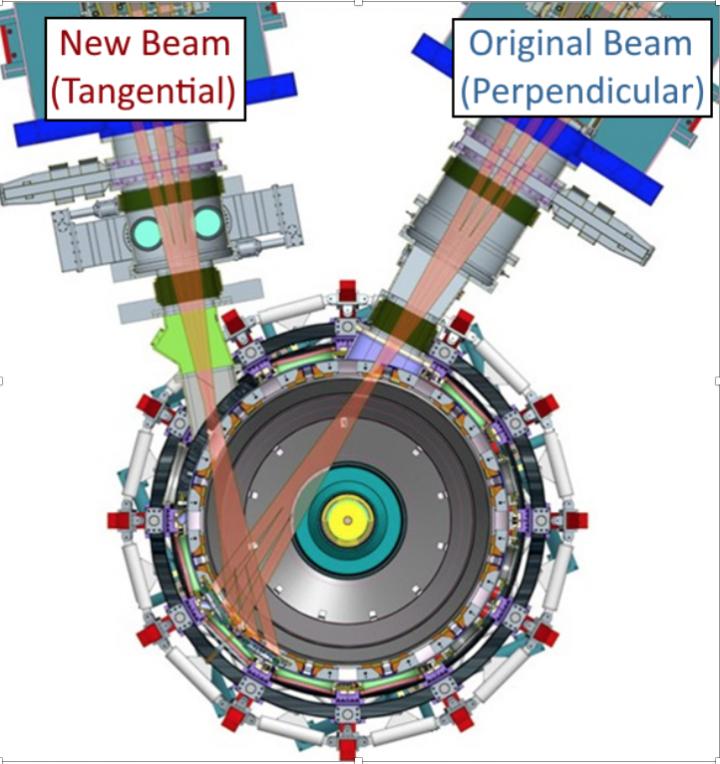
IMAGE

Credit: NSTX-U collaboration.


Fort Lauderdale, Fla.–Fusion combines light elements in the form of plasma–“the hot, charged state of matter composed of free electrons and atomic nuclei–“to generate massive amounts of energy. One of the ways that scientists help heat the plasma is by injecting beams of energetic particles into tokamaks to provide enough energy for plasma particles to overcome mutual repulsion and fuse together. The injected particles, however, can also produce waves that cause plasma energy to leak out of the magnetic fields that confine it, cooling the plasma and helping to quench the fusion reactions. It is therefore beneficial to the development of fusion energy to suppress these waves.

Researchers at the Princeton Plasma Physics Laboratory (PPPL) have developed new mathematical tools to forecast when the waves will be present and could cool the plasma. Importantly, the mathematical expressions predict that a second beam injected at a different angle from the original beam will suppress the undesired effect of the waves, providing new methods for maintaining the plasma’s confinement. Such a second beam (Figure 1) has been installed on the National Spherical Torus Experiment-Upgrade (NSTX-U) at PPPL.

The PPPL physicists ran detailed computer simulations to model the experiments in which the waves were observed. The results agreed with data from experiments on the predecessor of the NSTX-U.

“These results not only explain observations of the waves in past experiments, but also indicate how to avoid the negative impact of the waves using different mixtures of the two beams on NSTX-U that inject energetic particles at different angles,” says Jeff Lestz, a graduate student working on the project at PPPL.

PPPL scientists now plan to compare their predictions with other fusion experiments on tokamaks such as the DIII-D National Fusion Facility, on which beams are installed at different orientations and angles of injection. Without this detailed understanding, scientists cannot reliably predict how to effectively heat plasma, affecting the design of fusion facilities and potentially limiting fusion performance in tokamak fusion devices.

###

This research was supported by the U.S. Department of Energy via contracts DE-AC02-09CH11466 and DE-SC0011810.

Contacts: Jeff Lestz, Princeton University, [email protected]

Abstract:

Theory for control of sub-cyclotron Alfvén instabilities and implications for anomalous electron energy transport in tokamaks

9:30 AM – 12:30 PM, Thursday, October 24, 2019

Room: Floridian Ballroom AB

http://meetings.aps.org/Meeting/DPP19/Session/TI2.4

About APS/DPP:

The 61st Annual Meeting of the American Physical Society’s Division of Plasma Physics will take place from October 21-25, 2019 in Fort Lauderdale, Florida. All technical sessions will be located at the Fort Lauderdale/Broward County Convention Center, where over 1,900 papers will be presented by scientists from over 20 countries around the world.

The American Physical Society (APS) is a nonprofit membership organization working to advance and diffuse the knowledge of physics through its outstanding research journals, scientific meetings, and education, outreach, advocacy, and international activities. APS represents over 55,000 members, including physicists in academia, national laboratories, and industry in the United States and throughout the world.

Media Contact
Saralyn Stewart
[email protected]
512-694-2320

Tags: Chemistry/Physics/Materials Sciences
Share12Tweet8Share2ShareShareShare2

Related Posts

Why Ripe Chili Peppers Smell Fruitier: Ripening Links Heat and Aroma

Why Ripe Chili Peppers Smell Fruitier: Ripening Links Heat and Aroma

October 5, 2026
Electric Vehicle Fires, Wildfire Smoke and 3D Printing Take Center Stage as Exposure Scientists Gather in Vancouver

Electric Vehicle Fires, Wildfire Smoke and 3D Printing Take Center Stage as Exposure Scientists Gather in Vancouver

October 5, 2026

Greener HPLC Method Tracks Leukemia Drug and Anti-Nausea Partner in Blood Plasma

October 5, 2026

Linseed Oil and Cardanol Yield Isocyanate-Free Polyurethane Coatings

October 5, 2026
Please login to join discussion

POPULAR NEWS

  • Alloys That Shrink Their Own Grains: New PIX Mechanism Refines Metals With Heat Alone

    Alloys That Shrink Their Own Grains: New PIX Mechanism Refines Metals With Heat Alone

    29 shares
    Share 12 Tweet 7
  • Endurance Exercise Reshapes the Liver in Males and Females Through Distinct Molecular Routes

    29 shares
    Share 12 Tweet 7
  • Single Transcription Factor PU.1 Rapidly Converts Fibroblasts into Macrophage-Lineage Cells

    29 shares
    Share 12 Tweet 7
  • New Scale Measures How Ready Nurse Educators Really Are for the AI Era

    29 shares
    Share 12 Tweet 7

About

We bring you the latest biotechnology news from best research centers and universities around the world. Check our website.

Follow us

Recent News

Alloys That Shrink Their Own Grains: New PIX Mechanism Refines Metals With Heat Alone

Endurance Exercise Reshapes the Liver in Males and Females Through Distinct Molecular Routes

Single Transcription Factor PU.1 Rapidly Converts Fibroblasts into Macrophage-Lineage Cells

Subscribe to Blog via Email

Success! An email was just sent to confirm your subscription. Please find the email now and click 'Confirm' to start subscribing.

Join 85 other subscribers
  • Contact Us

Bioengineer.org © Copyright 2023 All Rights Reserved.

Welcome Back!

Login to your account below

Forgotten Password?

Retrieve your password

Please enter your username or email address to reset your password.

Log In
No Result
View All Result
  • Homepages
    • Home Page 1
    • Home Page 2
  • News
  • National
  • Business
  • Health
  • Lifestyle
  • Science

Bioengineer.org © Copyright 2023 All Rights Reserved.