• HOME
  • NEWS
  • EXPLORE
    • CAREER
      • Companies
      • Jobs
    • EVENTS
    • iGEM
      • News
      • Team
    • PHOTOS
    • VIDEO
    • WIKI
  • BLOG
  • COMMUNITY
    • FACEBOOK
    • INSTAGRAM
    • TWITTER
Sunday, October 4, 2026
BIOENGINEER.ORG
No Result
View All Result
  • Login
  • HOME
  • NEWS
  • EXPLORE
    • CAREER
      • Companies
      • Jobs
        • Lecturer
        • PhD Studentship
        • Postdoc
        • Research Assistant
    • EVENTS
    • iGEM
      • News
      • Team
    • PHOTOS
    • VIDEO
    • WIKI
  • BLOG
  • COMMUNITY
    • FACEBOOK
    • INSTAGRAM
    • TWITTER
  • HOME
  • NEWS
  • EXPLORE
    • CAREER
      • Companies
      • Jobs
        • Lecturer
        • PhD Studentship
        • Postdoc
        • Research Assistant
    • EVENTS
    • iGEM
      • News
      • Team
    • PHOTOS
    • VIDEO
    • WIKI
  • BLOG
  • COMMUNITY
    • FACEBOOK
    • INSTAGRAM
    • TWITTER
No Result
View All Result
Bioengineer.org
No Result
View All Result
Home NEWS Science News Chemistry

Tailor-made carbon helps pinpoint hereditary diseases and correct medication dosage

Bioengineer by Bioengineer
November 14, 2019
in Chemistry
Reading Time: 3 mins read
0
IMAGE
Share on FacebookShare on TwitterShare on LinkedinShare on RedditShare on Telegram

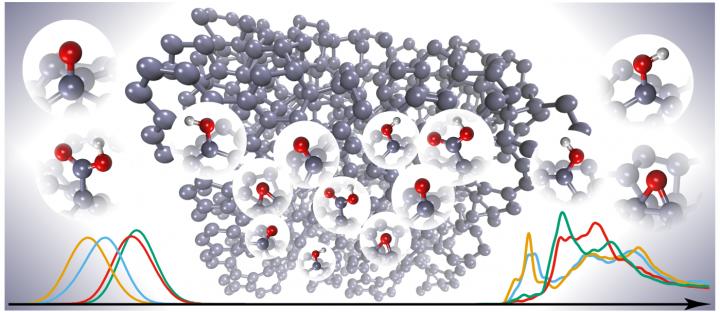
A new method of analysis is speeding up the research
IMAGE

Credit: Anja Aarva / Aalto University


Sensors manufactured with carbon-based materials can provide uniquely accurate and real-time information on hereditary diseases or the concentrations of drugs in the body. In addition to medicine, carbonaceous materials are used in batteries, solar cells and water purification.

Other elements, such as hydrogen and oxygen, are almost always present in carbon-based materials, which alters the materials’ properties. Therefore, modifying materials for desired applications requires atomic-level knowledge on carbon surface structures and their chemistry. Researchers at Aalto University, the University of Cambridge, the University of Oxford and Stanford University have now taken a significant new step forward in describing the atomic nature of carbonaceous materials.

Detailed information on carbon surfaces can be obtained by X-ray spectroscopy, but the spectrum it produces is challenging to interpret because it summarises information from several local chemical environments of the surface. The researchers have developed a new systematic analysis method that uses machine learning to integrate the computational model (density functional theory) with the experimental results of the carbon sample. The new methodology allows the experimental spectrum produced by X-ray spectroscopy to be separated into atomic-level data.

‘In the past, experimental results have been interpreted differently, based on varying literature references, but now we were able to analyse the results using only computational references. The new method gives us a much better understanding of carbon surface chemistry without human-induced bias’ says Anja Aarva, a doctoral student at Aalto University.

The new method expands knowledge of carbon-based materials

In a two-part study, the researchers initially studied how differently bound carbon affects the formation of the experimental spectrum qualitatively. The researchers then attempted to aggregate the measured spectrum with computational spectrum reference data to obtain a quantitative estimate of what the experimental spectrum consists of. This was to help them determine what the nature of the carbon sample at the atomic-level is. The new methodology is suitable for analysing the surface chemistry of various forms of carbon, such as graphene, diamond and amorphous carbon.

The study is a continuation of the work of Aalto University postdoctoral researcher Miguel Caro and professor Volker Deringer from Oxford University, which extensively mapped the structure and reactivity of amorphous carbon. The study utilises machine learning methods developed by professor Volker Deringer and professor Gabor Csányi from Cambridge University. Experimental measurements were carried out by Sami Sainio, an Aalto based postdoctoral researcher at Stanford University.

‘Next, we intend to use the methodology we have developed to predict, for example, what kind of carbon surface would be best for electrochemical identification of certain neurotransmitters, and then try to produce the desired surface. In this way, computational work would guide experimental work and not vice versa, as has typically been the case in the past,’ Tomi Laurila, professor at Aalto University said.

###

The study was published as a two-part article in the prestigious Chemistry of Materials publication.

Links to the articles:

https://pubs.acs.org/doi/abs/10.1021/acs.chemmater.9b02049

https://pubs.acs.org/doi/abs/10.1021/acs.chemmater.9b02050

More information

Anja Aarva

Doctoral student

Aalto University

[email protected]

Tomi Laurila

Professor

Aalto University

[email protected]

Media Contact
Anja Aarva
[email protected]

Related Journal Article

http://dx.doi.org/10.1021/acs.chemmater.9b02049

Tags: Chemistry/Physics/Materials SciencesMaterials
Share12Tweet8Share2ShareShareShare2

Related Posts

Porous Carbon Electrode Enables Iodide Sensing in Salty Waters

Porous Carbon Electrode Enables Iodide Sensing in Salty Waters

October 4, 2026
Pyrazole Chemistry Surges as New Wave of Bioactive Derivatives Emerges in 2025 and 2026

Pyrazole Chemistry Surges as New Wave of Bioactive Derivatives Emerges in 2025 and 2026

October 4, 2026

Earth-Abundant Metal Catalysts Close In on the Oxygen Evolution Bottleneck

October 4, 2026

Plant-Powered Nanoparticles Push Corrosion Protection Toward 99 Percent

October 4, 2026
Please login to join discussion

POPULAR NEWS

  • Alloys That Shrink Their Own Grains: New PIX Mechanism Refines Metals With Heat Alone

    Alloys That Shrink Their Own Grains: New PIX Mechanism Refines Metals With Heat Alone

    29 shares
    Share 12 Tweet 7
  • Endurance Exercise Reshapes the Liver in Males and Females Through Distinct Molecular Routes

    29 shares
    Share 12 Tweet 7
  • Single Transcription Factor PU.1 Rapidly Converts Fibroblasts into Macrophage-Lineage Cells

    29 shares
    Share 12 Tweet 7
  • New Scale Measures How Ready Nurse Educators Really Are for the AI Era

    29 shares
    Share 12 Tweet 7

About

We bring you the latest biotechnology news from best research centers and universities around the world. Check our website.

Follow us

Recent News

Alloys That Shrink Their Own Grains: New PIX Mechanism Refines Metals With Heat Alone

Endurance Exercise Reshapes the Liver in Males and Females Through Distinct Molecular Routes

Single Transcription Factor PU.1 Rapidly Converts Fibroblasts into Macrophage-Lineage Cells

Subscribe to Blog via Email

Enter your email address to subscribe to this blog and receive notifications of new posts by email.

Join 85 other subscribers
  • Contact Us

Bioengineer.org © Copyright 2023 All Rights Reserved.

Welcome Back!

Login to your account below

Forgotten Password?

Retrieve your password

Please enter your username or email address to reset your password.

Log In
No Result
View All Result
  • Homepages
    • Home Page 1
    • Home Page 2
  • News
  • National
  • Business
  • Health
  • Lifestyle
  • Science

Bioengineer.org © Copyright 2023 All Rights Reserved.