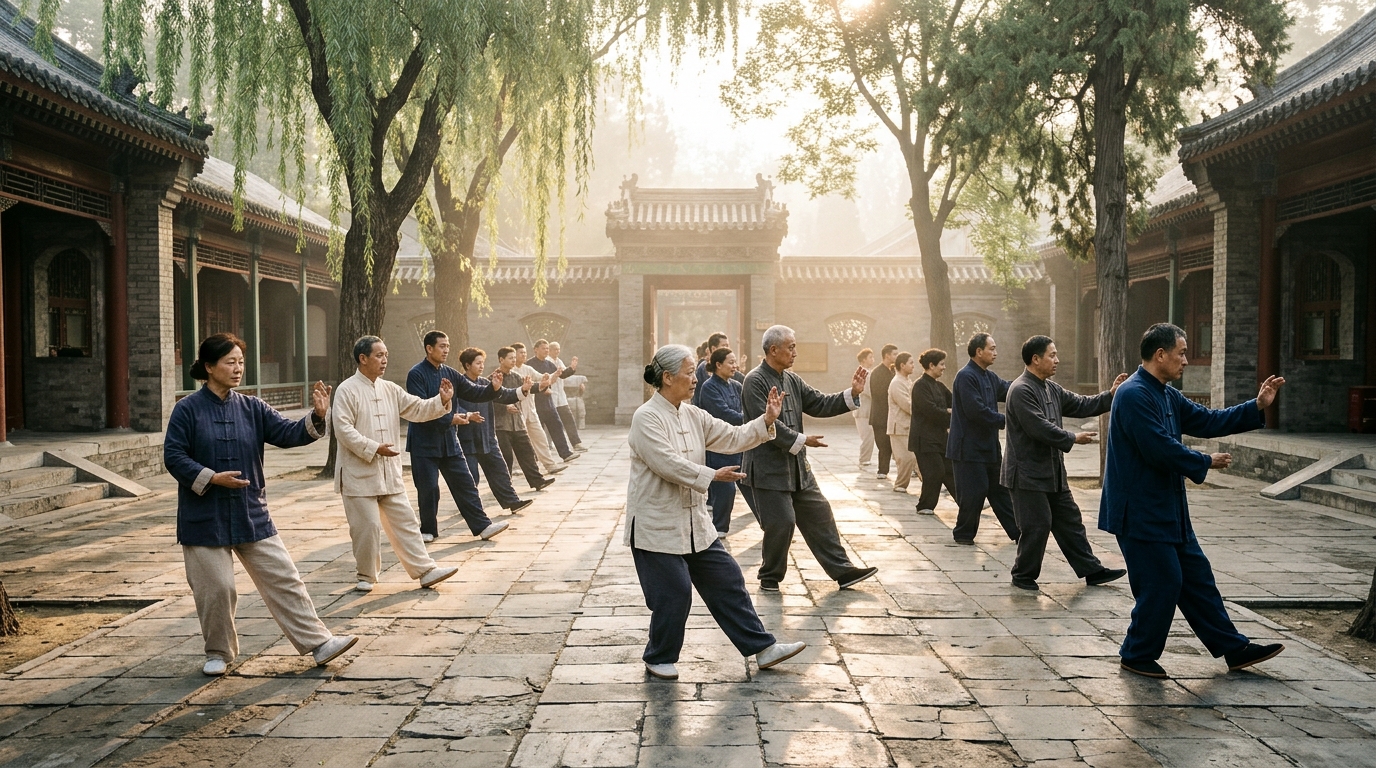
Community Tai Chi may look like a simple morning exercise routine, but a new qualitative study from Beijing suggests it functions as something far more intricate: a setting where older adults negotiate learning, friendship, identity, and belonging—without any of those outcomes being guaranteed. Researchers from Beijing Normal University interviewed eight practitioners aged 53 to 75 and one community worker in a university-affiliated residential community, using grounded theory-informed comparison of edited Chinese interview texts. Their analysis drew on 95 selected meaning units, 31 subcategories, and eight main categories, and it deliberately retained accounts that contradicted a tidy story of social integration. The result is a nuanced portrait of how organized physical activity can open doors to connection while leaving the depth and object of that connection entirely contingent on individual circumstances.
The study, published in Frontiers in Public Health, examined how bodily experience, relationships, and identification with groups and places were connected among people practicing Tai Chi in one bounded community. Rather than treating attendance as a proxy for integration, the researchers distinguished between practice acquaintances, team membership, university identification, and residential attachment. These turned out to be separable experiences. New acquaintances did not necessarily imply stronger community cohesion. Only two practitioners, R05 and R08, were identified as internal migrants to Beijing, and their accounts illustrated both opportunities for contact and constraints from caregiving and employment. The authors describe their framework—embodied, relational, and place-based embedding—as related interpretive dimensions rather than a demonstrated progression.
Participants entered practice through changing needs and opportunities. R02 sought an activity compatible with ongoing physical discomfort, while R04 searched for regular group practice after a serious health episode. R06 combined a wish to remain active with repeated encouragement from a former colleague. Retirement and care responsibilities reshaped the time available: R03 sought movement and social contact after retiring, and R05 began systematic Tai Chi in Hunan in 2019 before relocating to Beijing in 2023 to help care for a grandchild while his adult child worked there. R08, a domestic care worker, described gaining personal time when she shifted from live-in infant care to daytime work. Health, existing relationships, and the availability of an acceptable activity all shaped entry, but perceived suitability did not eliminate the difficulty of learning complex sequences or fitting practice around other obligations.
Learning itself demanded real bodily coordination. R06 initially doubted that a group of older practitioners was doing more than going through the motions, then struggled because, as he put it, when his hands caught up his feet did not, and when his feet caught up his hands did not. Demonstration and detailed explanation changed his appraisal of the activity. R02 valued specialist instruction because, as a beginner, she could learn without first unlearning a familiar routine. Participants used several strategies: R03 combined explanations, replayed demonstrations, and individual experimentation, while R08 recalled a disagreement about a fan movement that was clarified after a specialist demonstration. Access involved practical choices—R02 regarded optional paid lessons as worth the cost, while R04 questioned fees and the continuity of paid teaching.
Perceived bodily and emotional changes were reported through everyday comparisons rather than standardized assessments. R02 perceived better coordination and concentration; R05 compared his current ability to stand on one leg with his earlier performance; R08 felt her body had opened and stretched and that she slept more soundly; and R04 described more regular eating, sleep, and daily routines. These were perceived changes recalled in interviews, and no standardized health assessments were available to attribute change to Tai Chi. Attention to movement was also connected with emotional experience: R02 described a more balanced state of mind, R05 said he could settle down, and R07 distinguished the concentration possible when practicing alone from the persistence she associated with practicing alongside others, suggesting solitary and collective practice met different needs rather than successive levels of engagement.
Relational embedding emerged through recurring contact, but its texture varied considerably. R02 connected persistence with a regular group, saying that if it were just her she would never keep it up, and described peers noticing absence and asking after one another. Yet she drew a careful boundary: she would not call them friends, but practice friends. Regular contact did not necessarily become close friendship, although members noticed illness, medical appointments, and unusual absences. R07 described meeting people she had not known before and occasionally discussing worries with trusted peers, yet when asked whether Tai Chi improved community cohesion she replied simply that she just came to practice. R06 also reported few new friendships despite participating in public events. These accounts qualify any simple link between repeated interaction and wider belonging.
The two internal migrants illustrate how practice could offer contact without guaranteeing durable inclusion. R05, a retired teacher from Hunan, connected prior Tai Chi skill with entry into practice groups after moving for grandchild care, recalling that he asked whether he could join a park group and was welcomed, and that knowing a little Tai Chi helped him find friends quickly. His account supports his perception that a shared activity helped initiate contact, but does not establish that skill was tested or required for admission. His usual practice was at another site where an earlier schedule fitted family tasks. R08, who has spent 16 years in Beijing doing paid domestic care work, described belonging in the focal team as a feeling of having found a group to belong to, yet her contact at a second site near work was more limited—she had not really joined their group, just watched and copied some movements, because work took priority.
Public events made affiliation visible, but the object of identification varied. R01 described preparing to represent the university and taking pride in collective achievement, while R06 recalled compliments directed at the university team. Several participants already had university connections, so these accounts may express or reinforce an established affiliation rather than newly developed attachment to the residential community. Meanwhile, organizational conditions qualified participation throughout: R01 prepared teaching, coordinated events, contacted specialists, applied for projects, and organized publicity, while R02 described another member leading practice when R01 was absent. Access to university facilities depended on institutional permission—the community worker reported that residents without a university employment connection could encounter difficulties entering campus—and practice space was shared with dance, calligraphy, and other activities close enough to homes to generate noise complaints.
Constraints on continuity were concrete and varied. R05 preferred an earlier practice group because the focal team’s schedule conflicted with shopping and cooking. R08 used evenings, weekends, or spare time around employment. R04 declined a difficult new routine, saying he could not manage more than 50 new movements, demonstrating that selective refusal was compatible with continued membership. R06 initially resisted joining partly because of his impression that the group consisted mainly of older women, and feared public evaluation of his skill. Safety narratives also differed in evidentiary status: R06 recalled his own knee discomfort and later improvement following instruction, R07 described fear of injury without reporting having sustained it, and R08 recounted a care recipient’s knee problem attributed to intensive practice—an explanation that was not clinically assessed.
The study’s contribution lies in distinguishing conditional connections from an assumed progression toward community integration. The authors argue that attendance and public visibility provide incomplete indicators of inclusion, and that organizational proposals should be co-designed and evaluated in terms of who can participate, what relationships develop, which settings become meaningful, and whether volunteer responsibilities remain sustainable. They caution that shared skill may offer a portable social credential for initial contact, but the evidence does not establish lasting inclusion, a common migration pathway, or an effect independent of group organization. Recruitment through the team leader and routine practice favored established, cooperative participants, and no direct accounts from leavers, people declining to join, or rejected applicants were available. Retrospective self-reports cannot demonstrate causal effects or community-wide change, and the case concerns one university-affiliated community with established networks and access to specialist expertise—limits the authors present as integral to what their bounded account can honestly claim.
Subject of Research: A qualitative case study of how community Tai Chi practice in a Beijing community relates to embodied experience, social ties, and place-based belonging among older adults.
Article Title: Tai Chi practice and community belonging in active aging: embodied, relational, and place-based embedding in a Beijing community
Article References: Zhang, L., Liu, X., Jiang, J., Jiang, Z., Jia, F., & Qu, G. (2026). Tai Chi practice and community belonging in active aging: embodied, relational, and place-based embedding in a Beijing community. Frontiers in Public Health, 14, Article 1986641. https://doi.org/10.3389/fpubh.2026.1986641
Image Credits: AI Generated
DOI: 10.3389/fpubh.2026.1986641
Keywords: active aging, Tai Chi, community belonging, qualitative case study, internal migration, social participation, Beijing, place attachment, older adults, public health, practice, community
News Source: Ophelia Keating. (November 5, 2026). Tai Chi in a Beijing Community Offers Belonging, but Only on Its Own Terms. Scienmag.