• HOME
  • NEWS
  • EXPLORE
    • CAREER
      • Companies
      • Jobs
    • EVENTS
    • iGEM
      • News
      • Team
    • PHOTOS
    • VIDEO
    • WIKI
  • BLOG
  • COMMUNITY
    • FACEBOOK
    • INSTAGRAM
    • TWITTER
Wednesday, May 13, 2026
BIOENGINEER.ORG
No Result
View All Result
  • Login
  • HOME
  • NEWS
  • EXPLORE
    • CAREER
      • Companies
      • Jobs
        • Lecturer
        • PhD Studentship
        • Postdoc
        • Research Assistant
    • EVENTS
    • iGEM
      • News
      • Team
    • PHOTOS
    • VIDEO
    • WIKI
  • BLOG
  • COMMUNITY
    • FACEBOOK
    • INSTAGRAM
    • TWITTER
  • HOME
  • NEWS
  • EXPLORE
    • CAREER
      • Companies
      • Jobs
        • Lecturer
        • PhD Studentship
        • Postdoc
        • Research Assistant
    • EVENTS
    • iGEM
      • News
      • Team
    • PHOTOS
    • VIDEO
    • WIKI
  • BLOG
  • COMMUNITY
    • FACEBOOK
    • INSTAGRAM
    • TWITTER
No Result
View All Result
Bioengineer.org
No Result
View All Result
Home NEWS Science News Chemistry

T2K insight into the origin of the universe

Bioengineer by Bioengineer
April 15, 2020
in Chemistry
Reading Time: 3 mins read
0
IMAGE
Share on FacebookShare on TwitterShare on LinkedinShare on RedditShare on Telegram

IMAGE

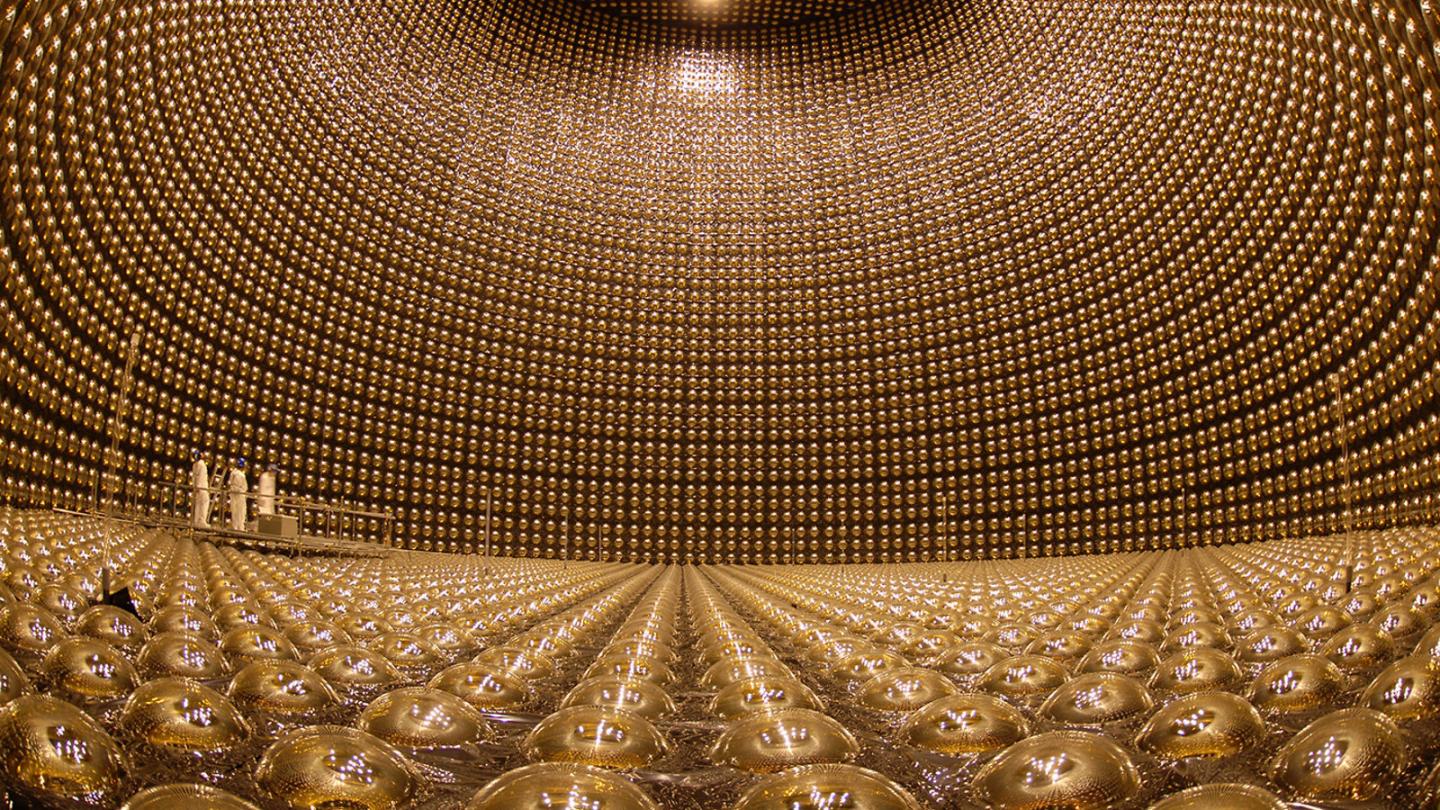
Credit: Kamioka Observatory, ICRR (Institute for Cosmic Ray Research), The University of Tokyo

Lancaster physicists working on the T2K major international experiment in Japan are closing in on the mystery of why there is so much matter in the Universe, and so little antimatter.

The Big Bang should have created equal amounts of matter and antimatter in the early Universe but instead the Universe is made of matter. One of the greatest challenges in physics is to determine what happened to the antimatter, or why we see an asymmetry between matter and antimatter.

Tokai to Kamioka (T2K) researchers have revealed in the journal Nature that almost half of the possible parameter values that determine matter-antimatter asymmetry in the Universe have been ruled out.

Dr Laura Kormos, Senior Lecturer in Physics at Lancaster University, head of Lancaster’s neutrino physics group and researcher at T2K, said: “Our data continue to suggest that Nature prefers almost the maximal value of asymmetry for this process. It would be just like Mother Nature to have these seemingly insignificant, difficult to study, tiny particles be the driver for the existence of the universe.”

The T2K experiment studies neutrinos, one of the fundamental particles that make up the Universe and one of the the least well understood. Yet every second trillions of neutrinos from the sun pass through your body. These tiny particles, produced copiously within the sun and other stars, come in three varieties or flavours, and may spontaneously change, or oscillate, from one to another.

Each flavour of neutrino has an associated antineutrino. If flavour-changing, or oscillations, are different for neutrinos and antineutrinos, it could help to explain the observed dominance of matter over antimatter in our Universe, a question that has puzzled scientists for a century.

For most phenomena, the laws of physics provide a symmetric description of the behaviour of matter and antimatter. However, this symmetry must have been broken soon after the Big Bang in order to explain the observation of the Universe, which is composed of matter with little antimatter.

A necessary condition is the violation of the so-called Charge-Parity (CP) symmetry. Until now, there has not been enough observed CP symmetry violation to explain the existence of our Universe.

T2K is searching for a new source of CP symmetry violation in neutrino oscillations that would manifest itself as a difference in the measured oscillation probability for neutrinos and antineutrinos.

The parameter governing the matter/antimatter symmetry breaking in neutrino oscillation, called the δcp phase, can take a value from -180º to 180º. For the first time, T2K has disfavoured almost half of the possible values at the 99.7% (3σ) confidence level, and is starting to reveal a basic property of neutrinos that has not been measured until now.

Dr Helen O’Keeffe, Senior Lecturer in Physics at Lancaster University and researcher at T2K, said: “This result will help shape future stages of T2K and the development of next-generation experiments. It is a very exciting outcome from many years of work.”

This is an important step on the way to knowing whether or not neutrinos and antineutrinos behave differently.

###

Media Contact
Gillian Whitworth
[email protected]

Related Journal Article

http://dx.doi.org/10.1038/s41586-020-2177-0

Tags: AstrophysicsAtomic/Molecular/Particle PhysicsChemistry/Physics/Materials SciencesParticle PhysicsPlanets/MoonsSpace/Planetary ScienceStars/The Sun
Share14Tweet9Share3ShareShareShare2

Related Posts

Harnessing Neural Networks for Advances in Nonlinear Optics — Chemistry

Harnessing Neural Networks for Advances in Nonlinear Optics

May 12, 2026
Innovative Method Unveiled to Detect Signs of Dark Matter — Chemistry

Innovative Method Unveiled to Detect Signs of Dark Matter

May 12, 2026

Illuminating the Science Behind Historical Featherwork Art

May 12, 2026

Humans and Zebra Finches Share Similar Speech Learning Techniques #ASA190

May 11, 2026
Please login to join discussion

POPULAR NEWS

  • Research Indicates Potential Connection Between Prenatal Medication Exposure and Elevated Autism Risk

    842 shares
    Share 337 Tweet 211
  • New Study Reveals Plants Can Detect the Sound of Rain

    728 shares
    Share 290 Tweet 182
  • Salmonella Haem Blocks Macrophages, Boosts Infection

    62 shares
    Share 25 Tweet 16
  • Breastmilk Balances E. coli and Beneficial Bacteria in Infant Gut Microbiomes

    57 shares
    Share 23 Tweet 14

About

We bring you the latest biotechnology news from best research centers and universities around the world. Check our website.

Follow us

Recent News

Mayo Clinic to Undergo Leadership Transition, Honoring Dr. Gianrico Farrugia’s Transformational Impact

Study Finds Sustained Weight Loss Possible by Transitioning from Injectable Obesity Drugs to Daily Oral Orforglipron (ATTAIN-MAINTAIN)

Weight Loss Maintained Seven Times More Effectively with Continued Maximum Dose of Tirzepatide, Study Finds

Subscribe to Blog via Email

Enter your email address to subscribe to this blog and receive notifications of new posts by email.

Join 82 other subscribers
  • Contact Us

Bioengineer.org © Copyright 2023 All Rights Reserved.

Welcome Back!

Login to your account below

Forgotten Password?

Retrieve your password

Please enter your username or email address to reset your password.

Log In
No Result
View All Result
  • Homepages
    • Home Page 1
    • Home Page 2
  • News
  • National
  • Business
  • Health
  • Lifestyle
  • Science

Bioengineer.org © Copyright 2023 All Rights Reserved.