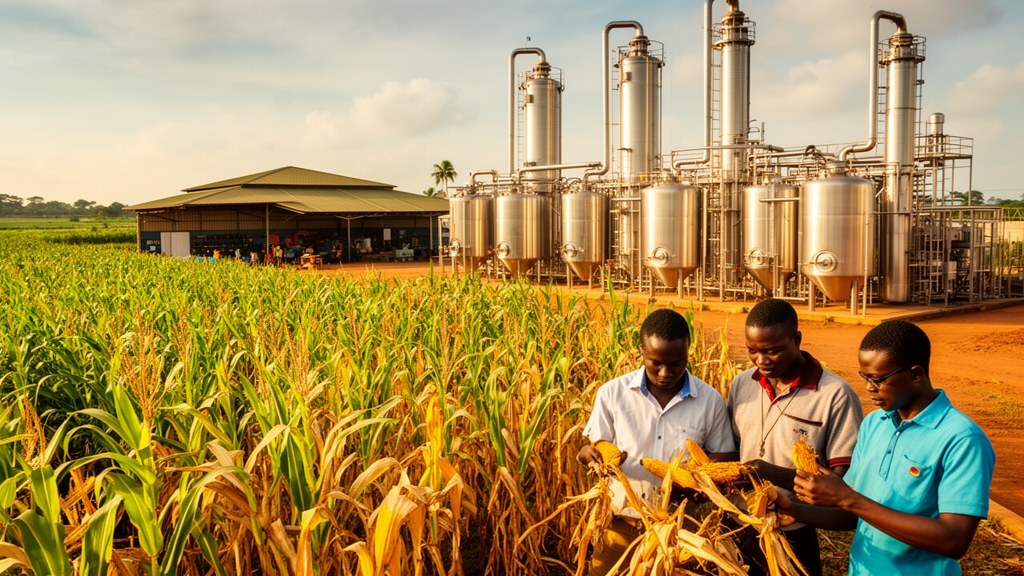
A systematic review comparing Ghana with eight African countries finds that the country has substantial bioethanol resources but converts only a small share of its theoretical potential into production. Ghana’s agricultural sector produces 22–38 tonnes of cassava per hectare, while cassava peels can yield an estimated 280–320 litres of ethanol per tonne. Sweet sorghum offers another major opportunity, with drought-resistant varieties yielding an estimated 300–340 litres per tonne without directly competing with staple-food production. The review estimates that agricultural residues alone could support 200 million litres of bioethanol annually, equivalent to clean cooking fuel for five million households, yet only about 5% of this potential is currently being used.
The review, published in Frontiers in Energy Research in 2026, assessed Ghana against Nigeria, Mali, Burkina Faso, Ethiopia, Kenya, Malawi, Mozambique and South Africa. It synthesized peer-reviewed studies, government documents and industry reports available through July 2025, then compared feedstock supply, policy implementation, technology, socioeconomic effects and environmental considerations. The authors describe the work as a systematic scoping review rather than a formal PRISMA meta-analysis because the underlying studies used heterogeneous evidence and reporting standards. Its country-level numerical comparisons should therefore be read as an evidence-informed policy synthesis, with uncertainty retained from the original sources.
Feedstock diversity is identified as Ghana’s clearest comparative strength. Nigeria has an estimated annual cassava output of 50 million tonnes, but less than 5% is used for bioethanol because fuel expansion has not been matched by safeguards against food-security pressures. Burkina Faso has planted about 70,000 jatropha trees since 2009 with European support, while Mali’s decentralized jatropha programme produces biodiesel rather than ethanol. Ghana’s proposed combination of cassava residues and sweet sorghum gives it a broader portfolio and reduces its exposure to a single crop, a market shift or competition for food. Residue-to-product ratios compiled in the review were 0.25:1 for cassava peels, 1.59:1 for maize stalk, 1.99:1 for sorghum straw, 0.50:1 for yam straw and 0.23:1 for sugarcane bagasse.
The principal constraint is not a lack of policy ambition but weak execution. Ghana’s 2010 Bioenergy Policy established a 10% biofuel-integration objective for 2020, subsequently extended to 20% by 2030, and national legislation and an Energy Transition Framework provide strategic direction. The review identifies no comparable dedicated enforcement body or sufficiently specific blending requirements. Nigeria offers a cautionary parallel: its technically comprehensive National Biofuel Policy has not removed uncertainty for investors because implementation mechanisms remain limited. By contrast, Malawi has maintained an E10 ethanol-blending policy since 1982, and Ethiopia’s 2009–2013 E10 programme blended about 38.54 million litres and was reported to save US$30.2 million in fossil-fuel imports.
Ethiopia also shows why enforcement must be paired with resilient supply. Its blending administration achieved measurable results, but bioethanol made from sugar-factory by-products competed with beverage demand, contributing to discontinuation of the programme. Reliance on sugarcane left the system exposed to the same crop used for food and beverages. The review instead highlights Ghana’s modeled 15% ethanol mandate for 2030 as having relatively small negative effects on food prices and imports than in some developed economies, a model-based projection rather than an observed policy result. Sweet sorghum, agricultural residues and cassava peels could give Ghana a route toward blending without diverting maize or intensifying cassava cultivation solely for fuel.
Technology and infrastructure remain the next bottleneck. Ghana has demonstrated technical feasibility through a sweet-sorghum refinery associated with Ecolinks and a cassava-to-ethanol plant operated by Caltech Ventures, but large biorefinery capacity remains limited. The country reportedly imports about 60% of the ethanol required for industrial needs, and second-generation conversion of lignocellulosic biomass is underdeveloped across West Africa. The review cites two sharply different estimates of Ghana’s annual residue-based potential—200 million litres in one estimate and 2.3 billion litres in another—without resolving that discrepancy. Such variation highlights why theoretical yield, residue availability, collection rates and plant capacity should not be treated as interchangeable quantities.
Kenya and Mozambique illustrate two possible architectures for closing the production gap. Kenya’s Giraffe Bioenergy project uses drought-resistant cassava on marginal land and decentralized refineries, with a stated target of 15 million litres per year by 2026 and 75 million litres by 2027; it remains a pilot-scale example rather than demonstrated operation at Ghana’s potential scale. Mozambique’s 2009 National Biofuels Policy prioritizes cassava peels and sugarcane bagasse, while an Eni partnership seeks to develop export-oriented residue-based production. For Ghana, the transferable element is therefore the infrastructure model rather than either country’s complete pathway: multiple northern units could supply local markets without displacing food crops, but an export-first strategy would require comparison with Ghana’s stated domestic clean-cooking objective.
Regional experience also shows that a viable bioethanol industry must include the people who currently gather conventional biomass. Across West Africa, women and children carry much of the responsibility for collecting firewood, yet they are often excluded from decisions about modern bioenergy projects. Mali’s NGO-supported jatropha networks have demonstrated community participation and locally retained fuel expenditure, although their governance model has not been tested at bioethanol scale. Burkina Faso’s women-centered biogas programs have linked renewable-energy training with stronger financial management and income generation, and the review proposes that similar institutional practices be adapted to Ghanaian cassava and sorghum value chains. It estimates that expansion of Ghana’s bioethanol industry could create more than 500,000 direct and indirect jobs, but treats that figure as a potential rather than an observed outcome.
The environmental case is promising but conditional. Replacing fossil fuels with bioethanol could reduce greenhouse-gas emissions by 40%–80%, according to figures cited in the review, and another cited estimate places the potential reduction at up to 70%. Those estimates depend on the feedstock, production process, land-use consequences and displaced fuel. Sweet sorghum’s tolerance of dry conditions makes it well suited to Ghana’s drought-prone northern and Upper East regions, and using residues can reduce pressure to clear land. Yet expanding monocultures without safeguards could reproduce the deforestation associated with some cassava expansion elsewhere. The review consequently presents no single regional template: Malawi and Ethiopia offer lessons on enforceable mandates, Mali and Burkina Faso on community and women’s participation, Kenya on decentralized marginal-land production, Mozambique on residue-based partnerships, and South Africa on protecting staple crops from diversion into fuel markets.
For Ghana, the review proposes a concrete next step: a pilot network of two or three decentralized sweet-sorghum-to-ethanol units in the Northern and Upper East regions, each with initial capacity of 5 million litres per year. The units would connect existing out-grower networks associated with Planting for Food and Jobs and use blended public–private financing modeled partly on international partnerships elsewhere in Africa. This proposal would test whether Ghana can move beyond single-plant demonstrations through a network that is monitorable, geographically suited to drought-prone zones and capable of developing without competing directly for maize. It would still require reliable collection, processing, transport, blending, financing and enforcement systems. With those constraints addressed, the comparative evidence indicates that Ghana’s strongest route to substantial bioethanol production is not a single crop or one imported model, but a diversified system anchored in enforceable policy, residue logistics, decentralized capacity and inclusive participation.
Subject of Research: Comparative review of Ghana’s bioethanol production potential, constraints and transferable African practices
Article Title: Comparative analysis of bioethanol production in Ghana and West Africa: capabilities, challenges, and transferable practices—a systematic review
Article References: Asiedu, F., Narra, M.-M., Dzagli, M. M., & Narra, S. (2026). Comparative analysis of bioethanol production in Ghana and West Africa: capabilities, challenges, and transferable practices—a systematic review. Frontiers in Energy Research, 14, Article 1817458. https://doi.org/10.3389/fenrg.2026.1817458
Image Credits: AI Generated
DOI: 10.3389/fenrg.2026.1817458
Keywords: bioethanol, Ghana, West Africa, agricultural residues, sweet sorghum, cassava, blending mandates, biorefineries, clean cooking, energy policy, Comparative, analysis
News Source: Denise Maddox. (October 22, 2026). Systematic review maps Ghana’s bioethanol gap and regional lessons. Scienmag.