• HOME
  • NEWS
  • EXPLORE
    • CAREER
      • Companies
      • Jobs
    • EVENTS
    • iGEM
      • News
      • Team
    • PHOTOS
    • VIDEO
    • WIKI
  • BLOG
  • COMMUNITY
    • FACEBOOK
    • INSTAGRAM
    • TWITTER
Tuesday, October 20, 2026
BIOENGINEER.ORG
No Result
View All Result
  • Login
  • HOME
  • NEWS
  • EXPLORE
    • CAREER
      • Companies
      • Jobs
        • Lecturer
        • PhD Studentship
        • Postdoc
        • Research Assistant
    • EVENTS
    • iGEM
      • News
      • Team
    • PHOTOS
    • VIDEO
    • WIKI
  • BLOG
  • COMMUNITY
    • FACEBOOK
    • INSTAGRAM
    • TWITTER
No Result
View All Result
Bioengineer.org
No Result
View All Result
Home NEWS Science News Health

Systematic review links robot-assisted gait training to walking gains in children with cerebral palsy

by
October 20, 2026
in Health
Reading Time: 2 mins read
0
Systematic review links robot-assisted gait training to walking gains in children with cerebral palsy

Robot-Assisted Gait Training Helps Children With Cerebral Palsy Walk Faster and Farther

Share on FacebookShare on TwitterShare on LinkedinShare on RedditShare on Telegram

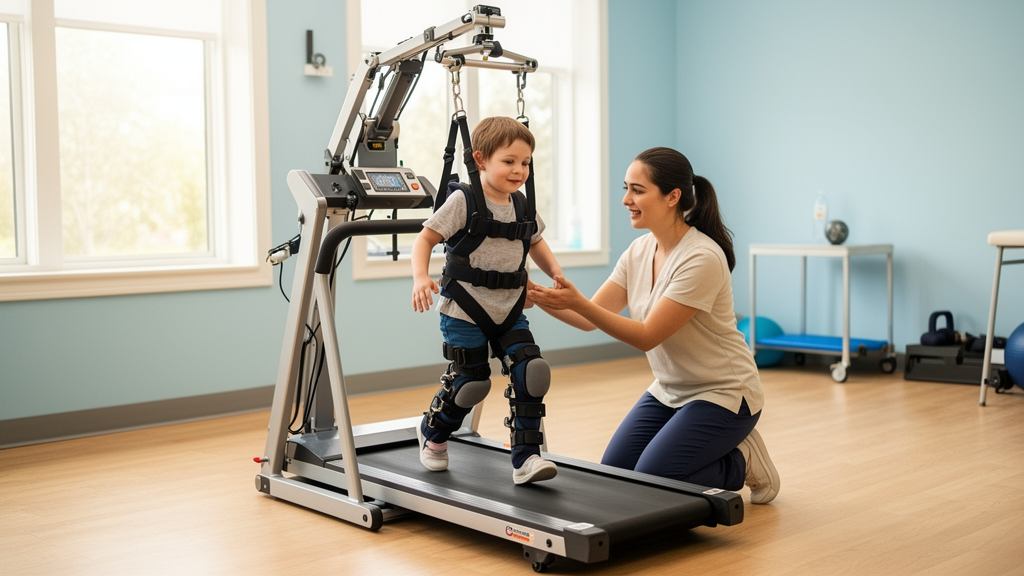
A systematic review and meta-analysis reported in the abstract of a BMC Pediatrics article found that robot-assisted gait training was associated with greater improvements in walking speed and 6-minute walk distance than conventional therapy among children with cerebral palsy. The pooled analysis included 22 randomized controlled trials involving 718 children aged 2–18 years. Twenty studies focused on cerebral palsy, two on spinal cord injury, and no studies involving acquired brain injury were identified.

The researchers searched PubMed, Embase, Web of Science, the Cochrane Library, CINAHL and ClinicalTrials.gov from their inception through 1 April 2026. Eligible studies were randomized trials comparing robot-assisted gait training with conventional therapy in children with cerebral palsy or other central nervous system impairments. Risk of bias and methodological quality were assessed with the Cochrane Risk of Bias 2 tool and the PEDro scale. Random-effects meta-analysis calculated mean differences or standardized mean differences, and GRADE was used to assess the certainty of evidence.

For walking speed, the pooled standardized mean difference was 0.58 (95% confidence interval, 0.18 to 0.98; P = 0.005). The 6-minute walk distance improved by a pooled mean difference of 38.68 metres (95% CI, 22.61 to 54.75; P < 0.00001). The abstract rated the evidence for both outcomes as high certainty. An exploratory analysis of two studies also suggested a reduction in the Physiological Cost Index, although the abstract did not report a pooled effect estimate for that measure. No statistically significant between-group differences were found for GMFM-88, balance, spasticity or functional independence.

Exploratory subgroup analyses suggested larger effects on walking speed when interventions lasted at least eight weeks. Robot type was associated with a significant subgroup difference for 6-minute walk distance, but not for walking speed; both subgroup observations were described as preliminary and requiring further validation. The evidence was concentrated overwhelmingly in children with cerebral palsy. The limited spinal cord injury evidence and absence of acquired brain injury studies prevented definitive conclusions for those populations. The abstract stated that additional high-quality trials using uniform outcome measures are needed to assess broader functional endpoints and establish whether the findings extend beyond cerebral palsy.

Subject of Research: Effects of robot-assisted gait training on walking and motor outcomes in children with central nervous system impairments

Article Title: Effects of robot-assisted gait training on walking capacity and gross motor function in children with central nervous system impairments: a systematic review and meta-analysis predominantly based on cerebral palsy studies

Article References: Wu, X., Li, X., Liang, J., Chen, Z., Zhang, J., Yang, X., Fan, Q., Guo, H., Liao, L., & Du, Q. (2026). Effects of robot-assisted gait training on walking capacity and gross motor function in children with central nervous system impairments: a systematic review and meta-analysis predominantly based on cerebral palsy studies. BMC Pediatrics. https://doi.org/10.1186/s12887-026-07359-4

Image Credits: AI Generated

DOI: 10.1186/s12887-026-07359-4

Keywords: robot-assisted gait training, cerebral palsy, pediatric rehabilitation, walking speed, 6-minute walk distance, systematic review, meta-analysis, spinal cord injury, gross motor function, GRADE evidence, Effects, robot-assisted

News Source: Denise Maddox. (October 20, 2026). Systematic review links robot-assisted gait training to walking gains in children with cerebral palsy. Scienmag.


Tags: 6-minute walk distancecerebral palsyeffectsGRADE evidencegross motor functionMeta-analysisPediatric Rehabilitationrobot-assistedrobot-assisted gait trainingSpinal Cord Injurysystematic reviewwalking speed
Share12Tweet7Share2ShareShareShare1

Related Posts

Uncontrolled retrospective study links structured sexual healthcare with improved sexual activity among women with gynaecological conditions

Uncontrolled retrospective study links structured sexual healthcare with improved sexual activity among women with gynaecological conditions

October 20, 2026
AI mobile simulation improves nurses’ drug-calculation scores in small Egyptian randomized trial

AI mobile simulation improves nurses’ drug-calculation scores in small Egyptian randomized trial

October 20, 2026

Persistent tinnitus preceded diagnosis of multifocal tuberculosis in a 32-year-old patient: case report

October 20, 2026

Mixed-methods study of 97 village health committees reports improved non-communicable disease screening in tribal Maharashtra

October 20, 2026

POPULAR NEWS

  • Uncontrolled retrospective study links structured sexual healthcare with improved sexual activity among women with gynaecological conditions

    Uncontrolled retrospective study links structured sexual healthcare with improved sexual activity among women with gynaecological conditions

    29 shares
    Share 12 Tweet 7
  • Four-gene model predicts biochemical recurrence in prostate adenocarcinoma in integrated study

    29 shares
    Share 12 Tweet 7
  • Deep reinforcement learning improves simulated short-video session duration and diversity

    29 shares
    Share 12 Tweet 7
  • Simulation study links hybrid machine learning to ring-foundation capacity in variable soils

    29 shares
    Share 12 Tweet 7

About

We bring you the latest biotechnology news from best research centers and universities around the world. Check our website.

Follow us

Recent News

Uncontrolled retrospective study links structured sexual healthcare with improved sexual activity among women with gynaecological conditions

Four-gene model predicts biochemical recurrence in prostate adenocarcinoma in integrated study

Deep reinforcement learning improves simulated short-video session duration and diversity

Subscribe to Blog via Email

Enter your email address to subscribe to this blog and receive notifications of new posts by email.

Join 85 other subscribers
  • Contact Us

Bioengineer.org © Copyright 2023 All Rights Reserved.

Welcome Back!

Login to your account below

Forgotten Password?

Retrieve your password

Please enter your username or email address to reset your password.

Log In
No Result
View All Result
  • Homepages
    • Home Page 1
    • Home Page 2
  • News
  • National
  • Business
  • Health
  • Lifestyle
  • Science

Bioengineer.org © Copyright 2023 All Rights Reserved.