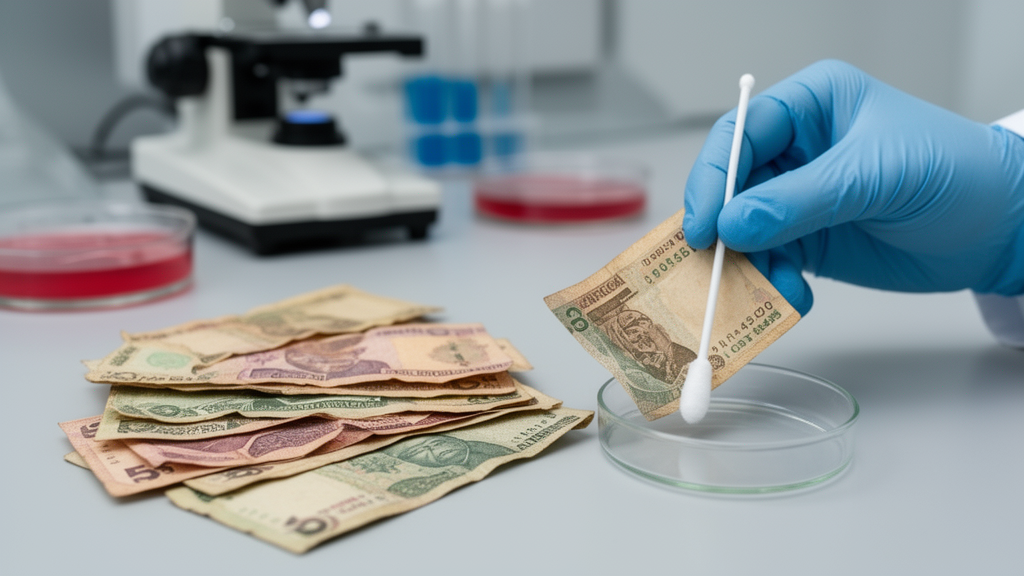
A systematic review and meta-analysis estimated that 79.3% of circulating currency notes examined in African studies were contaminated with bacteria, with a 95% confidence interval of 60.9% to 90.4%. The pooled estimate was based on 12 studies involving 2,003 notes, rather than all 46 studies included in the broader review.
The review synthesized 46 eligible studies conducted between 2007 and 2026 across 10 African countries. The evidence represented West, East, North, Central and Southern Africa, although it was geographically uneven: Nigeria contributed 28 studies, or 60.9% of the evidence, and Ethiopia contributed five, or 10.9%. Samples came from markets, food-vending sites, butcher shops, restaurants, hospitals, banks, universities, transportation systems and other community commercial settings.
Investigators searched PubMed, Scopus, Web of Science, African Journals Online and Google Scholar, with the final electronic search conducted on 20 April 2026. The review followed Preferred Reporting Items for Systematic Reviews and Meta-Analyses guidance. Eligible studies investigated bacterial contamination of circulating paper or polymer currency in African countries and reported microbiological isolation and identification of bacteria. Only English-language publications were eligible, and studies of non-circulating or experimentally inoculated currency and non-bacterial contaminants were excluded.
Across the 12 studies in the primary meta-analysis, 1,455 of 2,003 notes were contaminated, a crude aggregate proportion of 72.6%. A random-effects model combining study-specific estimates produced the pooled prevalence of 79.3%. Individual estimates ranged from 39.6% in a Nigerian study to 100% in studies from Ghana and South Sudan; the studies reporting complete contamination generally had relatively small samples. Results varied substantially between studies, with an I-squared value of 95.6%, Cochran’s Q of 252.06 and a p-value below 0.0001.
Differences in sampling, currency-circulation settings, laboratory methods and geographic conditions contributed to that heterogeneity. Leave-one-out analysis produced pooled estimates between 75.2% and 81.9%, while I-squared remained between 93.9% and 96.0%. The stable pooled estimate suggested that no single study disproportionately drove the result, although the continued heterogeneity showed that contamination estimates varied markedly among settings. Egger’s test did not find statistically significant evidence of small-study effects or publication bias.
Only Staphylococcus aureus and Escherichia coli had enough comparable species-specific data for organism-level pooling. Ten studies contributing 1,811 bacterial isolates produced a pooled S. aureus proportion of 31.2% (95% CI, 24.7% to 38.4%), while ten studies contributing 1,784 isolates produced an E. coli proportion of 24.0% (95% CI, 17.8% to 31.5%). These denominators represented bacterial isolates recovered from contaminated notes, not the number of notes examined. Klebsiella, Salmonella, Pseudomonas, Proteus and Shigella species were also frequently reported in the narrative synthesis.
Antimicrobial resistance was not a primary outcome, but several included studies reported multidrug-resistant, extensively drug-resistant and pan-drug-resistant isolates. Resistance to ampicillin, penicillin, tetracycline, cotrimoxazole, erythromycin and related beta-lactam antibiotics was commonly observed. Studies in Nigeria, Ghana, Ethiopia, Sudan and Egypt also reported methicillin-resistant S. aureus, multidrug-resistant enteric bacteria, resistant Klebsiella species and multidrug-resistant P. aeruginosa. These findings document resistant bacteria on currency rather than demonstrating currency-mediated transmission of resistance.
Contamination also varied with the characteristics and collection setting of currency. Lower-denomination and physically worn notes generally carried higher contamination burdens than higher-denomination or newer notes, and several studies reported lower contamination on polymer notes than on traditional paper currency. Notes collected from food vendors, butchers, slaughterhouses and meat handlers showed higher bacterial contamination than notes from transport operators, market traders and banking environments. The authors proposed that deteriorated paper may support microbial attachment and persistence, whereas reduced porosity may make polymer notes easier to clean; these mechanisms were not directly established by the pooled analysis.
The findings have important limitations, including very high statistical heterogeneity, inconsistent isolate reporting, selective publication that could not be completely excluded, limited representation of several African regions and the restriction to English-language literature. Detecting bacteria on currency also does not establish that infection was transmitted; the review noted that potential risk would depend on factors including microbial viability, inoculum size, survival duration, handling frequency, hygiene and host susceptibility. Within those bounds, the authors identified hand hygiene, avoiding simultaneous handling of food and money, improved currency management and closer integration of environmental reservoirs into antimicrobial-resistance surveillance as potential One Health approaches to reducing contamination and microbial dissemination.
Subject of Research: Systematic review and meta-analysis of bacterial contamination on circulating currency notes in Africa
Article Title: Currency as a mobile environmental reservoir of bacterial pathogens in Africa: a systematic review and meta-analysis
Article References: Anyanwu, C. N., Ugwu, P.-C. O., Neel, R., Terkimbi, S. D., Okon, M. B., Mohamed, Z. A. A., Bede-Ojimadu, O., & Anyanwu, E. G. (2026). Currency as a mobile environmental reservoir of bacterial pathogens in Africa: a systematic review and meta-analysis. Frontiers in Public Health, 14, Article 1921421. https://doi.org/10.3389/fpubh.2026.1921421
Image Credits: AI Generated
DOI: 10.3389/fpubh.2026.1921421
Keywords: bacterial contamination, banknotes, currency, Africa, systematic review, meta-analysis, antimicrobial resistance, environmental health, One Health, public health, mobile, environmental
News Source: Kristina Jarvis. (October 21, 2026). Systematic review finds bacterial contamination on 79.3% of African currency notes in pooled analysis. Scienmag.