WASHINGTON, June 22, 2021 — About 2.2 billion people globally lack reliable access to clean drinking water, according to the United Nations, and the growing impacts of climate change are likely to worsen this reality.
Solar steam generation (SSG) has emerged as a promising renewable energy technology for water harvesting, desalination, and purification that could benefit people who need it most in remote communities, disaster-relief areas, and developing nations. In Applied Physics Letters, by AIP Publishing, Virginia Tech researchers developed a synthetic tree to enhance SSG.
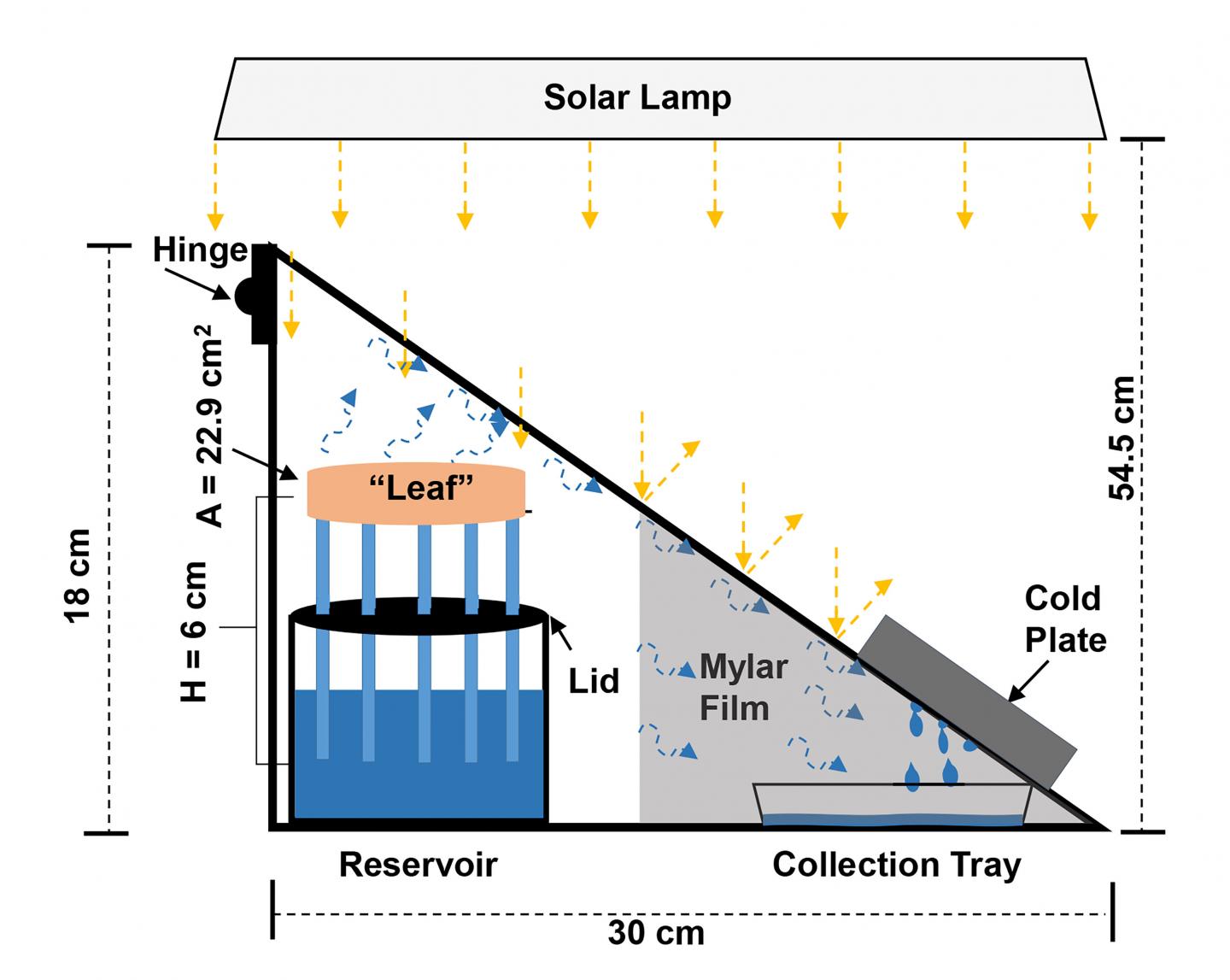
SSG turns solar energy into heat. Water from a storage tank continuously wicks up small, floating porous columns. Once water reaches the layer of photothermal material, it evaporates, and the steam is condensed into drinking water.
One major challenge in scaling up SSG technology is the limit in the capillary force beyond a certain column height, when the water cannot wick fast enough to keep up with the evaporation process. The capillary force, based on the surface tension that causes water to “climb” a porous paper towel, drives the water toward the evaporator.
Inspired by mangrove trees thriving along coastlines, the researchers bypassed this hurdle by creating a synthetic tree to replace the capillary action with transpiration, the process of water movement through a plant and its evaporation from leaves, stems, and flowers. Transpiration can pump water up insulating tubes of any desired height.
In real trees, transpiration begins at the roots, which suck up water through hollow vessels made from xylem tissue. As the water warms, it releases as vapor through pores on the underside of leaves.
The synthetic tree consists of a 19-tube array, covered by a nanoporous ceramic disk, which serves as the leaf. Each plastic tube, imitating the xylem conduits, is 6 centimeters high, just under 2.5 inches, with an inner diameter of 3.175 millimeters, about a tenth of an inch.
The setup enables the evaporating interface to thermally separate from the bulk water in the tank, so the evaporator does not dry out. Water evaporating from the disk is replenished by suction, which continuously pumps more water from a bottom tank up the tube array.
“We expect our tree-based solar steam generator will be of interest for applications in underground water extraction and purification,” author Jonathan Boreyko said. “The ultimate goal is to achieve a suction pressure strong enough to pull ocean water through a salt-excluding filter without requiring a mechanical pump, analogous to how mangrove trees are able to grow in ocean water.”
Future research could focus on fabricating taller trees, adding more leaves to increase the area over which evaporation occurs, and incorporating desalination membranes at the tube inlets to prevent salt buildup.
###
The article, “Synthetic trees for enhanced solar evaporation and water harvesting,” is authored by Ndidi Eyegheleme, Weiwei Shi, Lance H. De Koninck, Julia L. O’Brien, and Jonathan B. Boreyko. The article will appear in Applied Physics Letters on June 22, 2021 (DOI: 10.1063/5.0049904). After that date, it can be accessed at https:/
ABOUT THE JOURNAL
Applied Physics Letters features rapid reports on significant discoveries in applied physics. The journal covers new experimental and theoretical research on applications of physics phenomena related to all branches of science, engineering, and modern technology. See https:/
Media Contact
Larry Frum
[email protected]
Related Journal Article
http://dx.