Key synapse acts as a “smart teacher”, sending messages against the usual flow of information in the brain. – Paper published in Nature Communications
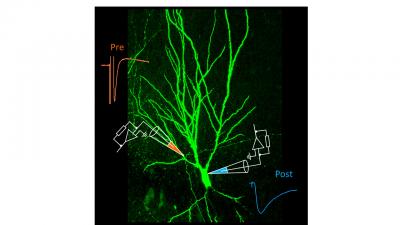
Credit: Nature Protocols, in press. / IST Austria
Information flows in a well-defined direction in the brain: Chemical and electrical signals are passed from one neuron to the other across the synapse, from the pre-synaptic to the post-synaptic neuron. Now, Peter Jonas and his group at the Institute of Science and Technology Austria (IST Austria) show that information also travels in the opposite direction at a key synapse in the hippocampus, the brain region responsible for learning and memory. At the so-called mossy fiber synapse, the post-synaptic CA3 neuron influences how the pre-synaptic neuron, the so-called mossy fiber neuron, fires. “We have shown, for the first time, that a retrograde information flow is physiologically relevant for pre-synaptic plasticity,” says Yuji Okamoto, a postdoc in the group of Peter Jonas at IST Austria and co-first author of the paper published in Nature Communications.
The mossy fiber synapse is crucial for information storage in the neuronal network. Synaptic transmission is plastic meaning that a variable amount of chemical signal, the so-called neurotransmitter, is released into the synapse. To understand the mechanism of plasticity at work in this synapse, Okamoto precisely stimulated the pre-synaptic terminal of the mossy fiber synapse in rats and at the same time recorded from the post-synaptic neuron. “We need to know the synapse’s exact properties – with the numerical values, e.g., for its conductance – to create an exact model of this synapse. With his exact measurements, Yuji managed to obtain these numbers,” adds Peter Jonas, co-corresponding author with postdoc David Vandael.
Smart teacher reacts to overloaded student
Unexpectedly, the researchers found that the post-synaptic neuron influences plasticity in the pre-synaptic neuron. Previously, the mossy fiber synapse was assumed to be a “teacher synapse” that induces firing in the post-synaptic neuron. “Instead, we find that this synapse acts like a ‘smart teacher’, who adapts the lessons when students are overloaded with information. Similarly, the pre-synaptic mossy fiber detects when the post-synaptic neuron can’t take more information: When activity increases in the post-synaptic neuron, the pre-synaptic neuron reduces the extent of plasticity,” explains Jonas.
This finding raises the question of how the post-synaptic neuron sends information about its activity status to the pre-synaptic neuron. Pharmacological evidence points to a role for glutamate, one of the key chemicals or neurotransmitters used by neurons to send signals to other cells. Glutamate is also the transmitter that is released from pre-synaptic mossy fiber terminals. When calcium levels increase in the post-synaptic neuron – a sign that the neuron is active – the post-synaptic neuron may release vesicles with glutamate into the synapse. The glutamate travels back to the pre-synaptic neuron against the usual flow of neuronal information. “This retrograde modulation of plasticity likely helps to improve information storage in the downstream hippocampal network,” says Jonas, and he adds: “Once again, exact measurements have shown that reality is more complex than a simplified model would suggest.”
###
Media Contact
Patrick Müller
[email protected]
Related Journal Article
http://dx.