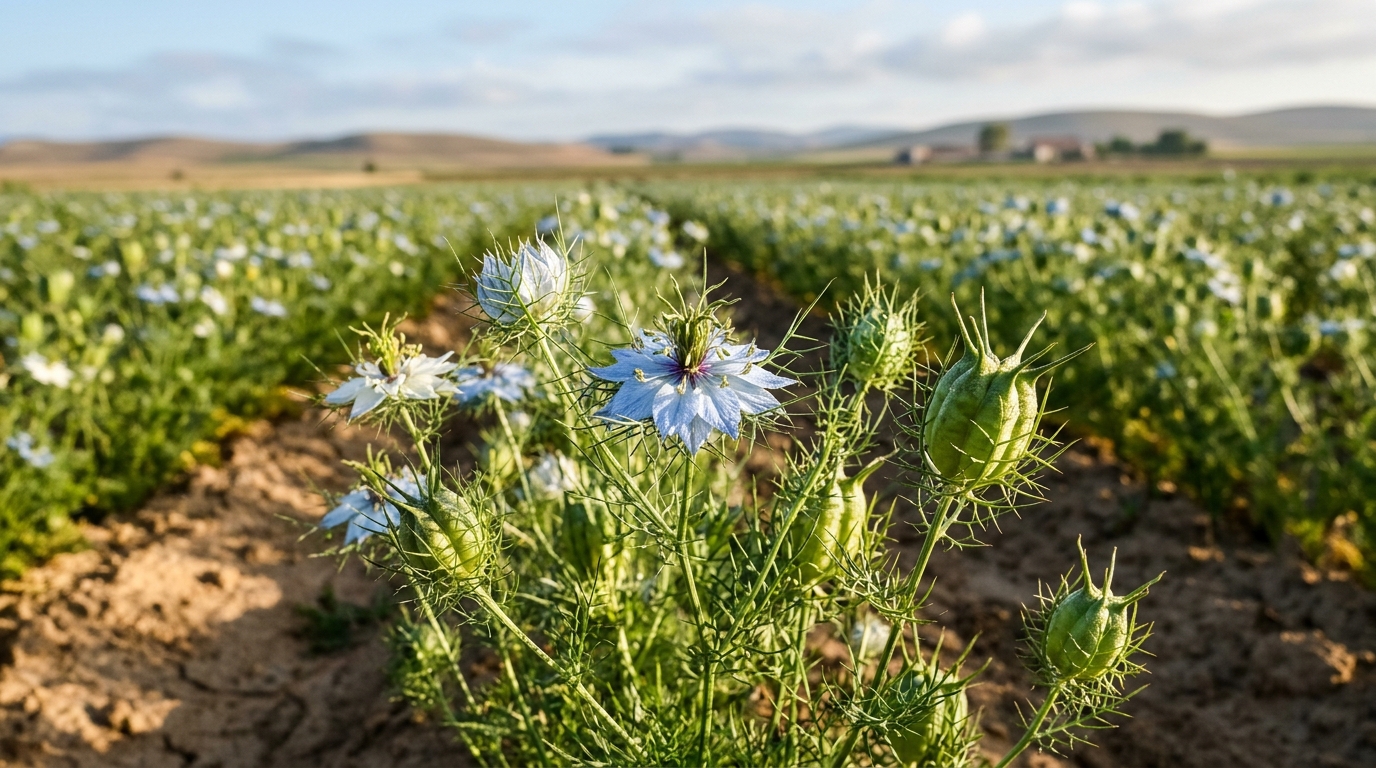
A two-year agronomic study of black cumin, scientifically known as Nigella sativa L., has demonstrated that low-level salinity stimulates seed production before higher salt concentrations trigger severe yield depression. Conducted by researchers at Mahatma Gandhi Central University in Motihari, India, the empirical investigation revealed that exposing the high-yielding line AN-1 to ten millimolar sodium chloride increased seed yield by twenty-six percent compared to non-saline controls. This pronounced yield enhancement illustrates hormesis, a biphasic biological phenomenon wherein modest exposure to an environmental stressor triggers beneficial physiological stimulation, whereas elevated exposure causes metabolic disruption. Beyond ten millimolar, however, increasing salt concentrations caused an abrupt downturn in plant productivity, culminating in a minimal seed yield of 0.049 grams per plant under acute one hundred millimolar salinity. Across two crop seasons, the research team analyzed morphological productivity alongside eight biochemical and antioxidant traits to determine specific selection criteria for developing salinity-tolerant black cumin varieties.
The study addresses a critical challenge facing agricultural production, as global soil salinization increasingly undermines crop productivity and arable land utility. More than twenty percent of cultivated farmland worldwide, encompassing approximately 1.4 billion hectares, suffers from excess soluble salts, with salinization affecting nearly fifty percent of all arable lands globally. In arid and semiarid agricultural regions, salinity impairs roughly twenty-five percent of irrigated cropland through hyperosmotic stress and ion toxicity. When plants absorb toxic concentrations of sodium and chloride ions, root water uptake becomes restricted, disrupting cellular equilibrium and triggering excessive generation of reactive oxygen species. These destructive molecules, including superoxide anions, hydrogen peroxide, singlet oxygen, and hydroxyl radicals, induce cellular injuries such as lipid peroxidation, protein denaturation, nucleic acid damage, and photosynthetic membrane disruption. Identifying resilient crop genotypes capable of activating protective antioxidant defense networks under moderate salinity is therefore vital for sustaining cultivation across marginal, salt-affected agricultural soils.
Nigella sativa, commercially cultivated across South and Southwest Asia as kalajira or kalonji, possesses substantial economic value in the food and pharmaceutical sectors. Its seeds provide sixteen to nineteen percent protein, seventeen to forty percent oil, carbohydrates, fiber, vitamins, and bioactive compounds including thymoquinone, thymohydroquinone, dithymoquinone, carvacrol, and thymol. Despite this commercial importance, selection criteria for breeding salinity-tolerant black cumin have remained scarce. To address this gap, the researchers conducted an initial field trial at Mahatma Gandhi Central University in Motihari, India, evaluating four germplasm lines: AN-1, Bihar, Odisha, and Haryana. Sown in late October under non-saline field conditions with full irrigation, the experimental soil exhibited a pH of 7.6, electrical conductivity of 1.21 decisiemens per meter, 24.71 percent moisture, 165 kilograms per hectare nitrogen, 0.35 percent organic carbon, and a texture of 63.33 percent sand, 16.67 percent silt, and 20.0 percent clay. Agronomic performance confirmed AN-1 as the superior seed-yielding genotype, selecting it for controlled salinity testing.
The subsequent pot experiment evaluated line AN-1 across two consecutive crop seasons during 2022–2023 and 2023–2024 under natural environmental conditions. Nigella sativa is cultivated as a fall crop in subtropical India, where seasonal temperatures range from 3 to 14 degrees Celsius at night and 19 to 29 degrees Celsius during the day. Seeds were surface-sterilized in seventy percent ethanol for ten seconds, rinsed with distilled water, and sown in late October. Thirty-day-old seedlings were transferred into pots filled with one kilogram of inert vermiculite, maintaining six plants per pot across three replications in a completely randomized design. Plants were irrigated with Hoagland’s Number 2 Basal Salt Mixture and treated with six sodium chloride levels: zero, five, ten, twenty, fifty, and one hundred millimolar. Treatments were delivered at three-day intervals for six total applications per season, allowing researchers to track physiological plasticity, foliar pigment alterations, secondary metabolic adjustments, and antioxidant enzyme activities through maturity.
Quantitative assessments revealed distinct concentration-dependent responses across foliar photosynthetic pigments under escalating salinity. Chlorophyll a concentrations ranged from 0.161 to 0.202 milligrams per gram with a mean of 0.189 milligrams per gram, while chlorophyll b varied from 0.109 to 0.153 milligrams per gram with an average of 0.135 milligrams per gram. Both chlorophyll forms increased at five and ten millimolar sodium chloride—rising by more than four percent for chlorophyll a and over forty percent for chlorophyll b compared to controls—before declining sharply above fifty millimolar, falling seventeen percent below control levels at one hundred millimolar. Leaf carotenoid concentrations ranged from 0.176 to 0.252 milligrams per gram with a mean of 0.232 milligrams per gram. Carotenoids rose by 6.33 percent at ten and twenty millimolar before declining steadily, showing a 25.74 percent reduction at one hundred millimolar. These losses reflect accelerated chlorophyllase activity, destabilization of pigment-protein complexes, and chloroplast membrane damage driven by reactive oxygen species.
Non-enzymatic secondary metabolites and soluble protein concentrations exhibited complex shifts across the salinity treatments. Total leaf phenolics ranged from 0.639 to 0.840 milligrams gallic acid equivalents per gram, averaging 0.743 milligrams per gram. Phenolic levels dropped 22.83 percent at ten millimolar compared to control plants before climbing at higher concentrations, peaking overall at five millimolar and reaching their second-highest level at one hundred millimolar. Flavonoid content ranged from 118.56 to 148.32 milligrams quercetin equivalents per gram with a mean of 128.65 milligrams per gram, increasing in a dose-dependent manner up to fifty millimolar before dropping by 10.56 percent at one hundred millimolar. Leaf protein ranged between 174.20 and 213.89 micrograms per milliliter, averaging 193.36 micrograms per milliliter. Protein concentrations rose at ten millimolar, declined at intermediate levels, and peaked at one hundred millimolar with a twenty-three percent increase above control values, reflecting stress-induced protein synthesis and decreased proteolysis under severe salinity.
Antioxidant enzyme kinetics highlighted a clear physiological threshold between protective upregulation and oxidative exhaustion under saline conditions. Leaf peroxidase activity ranged from 30.85 to 49.65 specific activity units per gram with a mean of 37.93 units per gram, increasing progressively to peak at fifty millimolar with a 47.78 percent increase over controls. While peroxidase activity moderated at one hundred millimolar, it remained thirty-six percent above control levels. Catalase activity ranged from 44.08 to 81.85 units per gram, averaging 69.52 units per gram. Catalase also reached maximum activity at fifty millimolar, rising twenty-five percent above non-saline controls before dropping 23.78 percent below control levels at one hundred millimolar. This biphasic pattern demonstrates that moderate salinity triggers adaptive hydrogen peroxide scavenging to maintain redox equilibrium, whereas acute salinity of one hundred millimolar overwhelms the defense system through ionic toxicity, oxidative enzyme inactivation, and cellular metabolic shutdown.
To resolve the multivariate relationships among traits, researchers analyzed the combined two-year datasets using principal component analysis in the Statistical Tool for Agricultural Research software. The first four principal components accounted for 96.49 percent of total trait variability across salinity treatments. The first principal component captured 51.34 percent of the variation, characterized by high positive loadings for peroxidase, flavonoids, and protein, contrasted against high negative loadings for chlorophyll a and carotenoids. The second principal component explained 22.61 percent of total variation, dominated by positive coefficients for phenolics and negative coefficients for flavonoids. The third component accounted for 17.22 percent of variability, distinguished by high positive loadings for protein content. Principal component biplots showed that low-salinity treatments clustered closely together, whereas fifty and one hundred millimolar treatments separated widely across quadrants, indicating that severe salt stress induces physiological divergence from control and low-salt growth regimes.
Biometrical analysis using OPSTAT software elucidated the genetic architecture and inheritance patterns of the evaluated characteristics. Phenotypic coefficients of variation slightly exceeded corresponding genotypic coefficients across traits, indicating predominant genetic control with minimal environmental variance. Phenotypic and genotypic coefficients were lowest for protein at 7.94 and 7.92, chlorophyll a at 8.17 and 8.12, and flavonoids at 9.66 and 9.65, while peroxidase showed identical phenotypic and genotypic values of 17.03 each. Broad-sense heritability exceeded ninety-eight percent across all traits, led by catalase at 99.991 percent, flavonoids at 99.78 percent, carotenoids at 99.76 percent, phenolics at 99.70 percent, and chlorophyll a at 98.66 percent. Genetic advance as a percentage of the mean was highest for peroxidase at 35.08 percent, catalase at 34.17 percent, and seed yield at 33.20 percent. Chlorophyll b was the only pigment combining high genotypic variation, high heritability, and high genetic advance with significant yield correlation.
Correlation and path coefficient analyses clarified direct and indirect causal pathways influencing seed yield under salinity stress. Genotypic correlations generally exceeded phenotypic values, with carotenoids exhibiting the strongest positive genotypic correlation with seed yield at 0.991. Seed yield correlated positively with photosynthetic pigments and catalase, but showed non-significant negative associations with phenolics, flavonoids, and protein, alongside negative correlation with peroxidase. Path analysis revealed that flavonoids had the strongest positive direct effect on seed yield at 1.146, followed by catalase at 0.597 and chlorophyll b at 0.260, whereas peroxidase and phenolics exerted strong negative direct effects of negative 1.994 and negative 0.864. The researchers concluded that catalase, peroxidase, and chlorophyll b constitute reliable biomarkers for screening salinity-tolerant black cumin genotypes in low-to-moderate salinity soils, while noting that evaluating broader germplasm diversity and separating non-additive genetic components represent essential priorities for future breeding efforts.
Subject of Research: Biochemical and genetic evaluation of salinity tolerance in Nigella sativa
Article Title: Evaluating biochemical traits and genetic parameters as selection criteria for salinity tolerance in Nigella sativa L.
Article References: Pandey, R., Kumari, B., Kumar, P., Pandey, B., Rajan, S., & Bhargava, A. (2026). Evaluating biochemical traits and genetic parameters as selection criteria for salinity tolerance in Nigella sativa L.. Discover Plants, 3(1), Article 539. https://doi.org/10.1007/s44372-026-00997-z
Image Credits: AI Generated
DOI: 10.1007/s44372-026-00997-z
Keywords: Nigella sativa, black cumin, salinity tolerance, seed yield, hormesis, catalase, peroxidase, chlorophyll b, carotenoids, flavonoids, phenolics, heritability, genetic advance, principal component analysis, path coefficient analysis, AN-1 germplasm, oxidative stress
News Source: Drew Townsend. (November 13, 2026). Mild Salinity Boosts Black Cumin Yield as Key Enzymes Guide Selection. Scienmag.