In montane ecosystems, steep environmental clines generate divergent selective pressures that can drive local adaptation even when adjacent populations remain physically connected. A genomic investigation of the montane bush cricket Isophya rizeensis demonstrates that spatially varying natural selection along an elevational gradient can sustain discrete male colour polymorphism and localized genomic divergence across short geographical distances despite high gene flow. Published in Heredity, the research provides empirical confirmation for clinal models of adaptation, demonstrating how strong environmental transitions counteract the homogenizing effects of ongoing genetic connectivity across continuous elevational transects.
Understanding how selection and gene flow interact across altitudinal gradients has historically presented a major challenge in evolutionary genetics, particularly across topographically complex landscapes where dispersal remains unhindered. To examine the genetic mechanisms underlying phenotypic divergence across continuous topography, researchers investigated an Isophya rizeensis population inhabiting the Fırtına Valley in Türkiye. Along this continuous mountain corridor, the species occupies an elevational range spanning from 450 metres to 2300 metres above sea level, providing an ideal natural experiment to evaluate how environmental heterogeneity structures adaptive genetic variation.
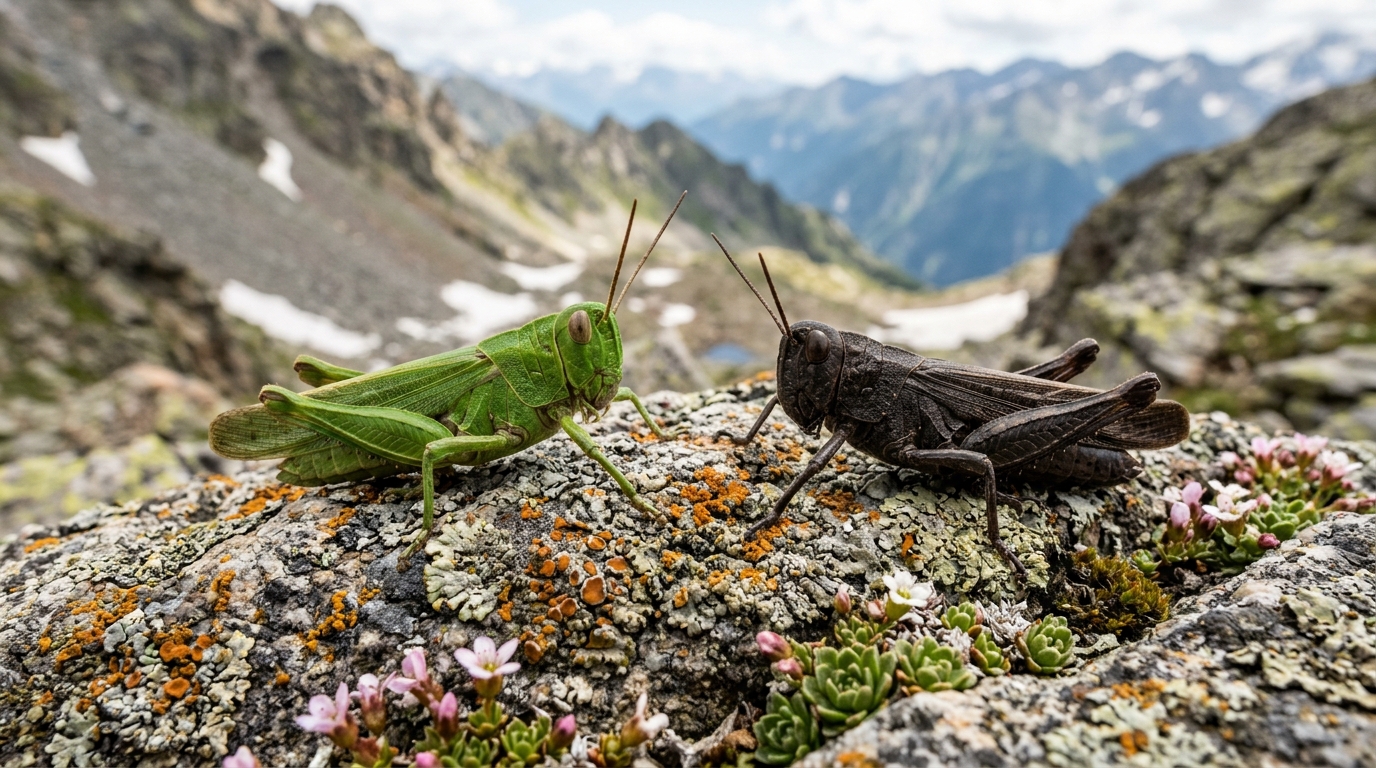
The study focused specifically on a striking phenotypic pattern observed in male bush crickets along the valley transect, where individuals exhibit a discrete colour polymorphism. Field observations documented a sharp spatial transition between distinct dark and pale morphs occurring near mid-elevations of the mountain slope. To characterize the genomic architecture underlying this phenotypic shift, the team established 11 sampling locations situated across the full 450 to 2300 metre elevational transect, gathering a representative cohort of 71 individual crickets to evaluate both genome-wide background variation and morph-specific divergence.
The authors performed genome-wide restriction site-associated DNA sequencing across the 71 sampled individuals, resolving more than 92,000 single nucleotide polymorphisms to reconstruct population structure and nucleotide diversity along the transect. Broad genomic analyses revealed weak overall population differentiation across the sampling locations, reflecting substantial connectivity and gene flow among crickets occupying different altitudes. However, despite this overarching demographic connectivity, loci identified as putatively adaptive displayed markedly stronger spatial differentiation along the valley than loci conforming to neutral genomic expectations.
Targeted genome-wide association analyses revealed 101 single nucleotide polymorphisms that exhibited significant statistical associations with altitude along the transect. These altitudinal loci demonstrated reciprocal allele-frequency shifts across the gradient, forming steep and narrow genetic clines concentrated over remarkably short elevational distances. Further discriminant analyses of principal components identified three loci of large effect that strongly differentiate the dark and pale male colour morphs. These primary phenotypic markers proved tightly linked to elevation, directly aligning the genetic basis of the colour trait with altitudinal position.
Together, these findings demonstrate that spatially varying selection across steep elevational clines can maintain discrete phenotypic polymorphism and preserve localized genomic divergence in the presence of extensive gene flow. By resolving both genome-wide connectivity and discrete large-effect loci linked to altitude in Isophya rizeensis, the study provides concrete empirical evidence that sharp ecological gradients can structure adaptive variation across continuous natural habitats without requiring geographical isolation.
Subject of Research: Genomic divergence and male colour polymorphism across an altitudinal gradient in Isophya rizeensis
Article Title: Genome-wide analysis reveals altitude-associated divergence in a colour-polymorphic insect
Article References: Topalan, U., Kuyucu, A. C., Farid, S. A., Çağlar, S. S., & Sağlam, İ. K. (2026). Genome-wide analysis reveals altitude-associated divergence in a colour-polymorphic insect. Heredity. https://doi.org/10.1038/s41437-026-00899-6
Image Credits: AI Generated
DOI: 10.1038/s41437-026-00899-6
Keywords: Isophya rizeensis, colour polymorphism, altitudinal gradient, Fırtına Valley, Türkiye, RAD sequencing, single nucleotide polymorphisms, gene flow, local adaptation, clinal variation, montane ecology, population genomics, discriminant analysis of principal components, bush crickets, spatially varying selection, elevational transect, Heredity
News Source: Gavin Prescott. (November 13, 2026). Altitude-Driven Selection Maintains Insect Colour Polymorphism Despite High Gene Flow. Scienmag.