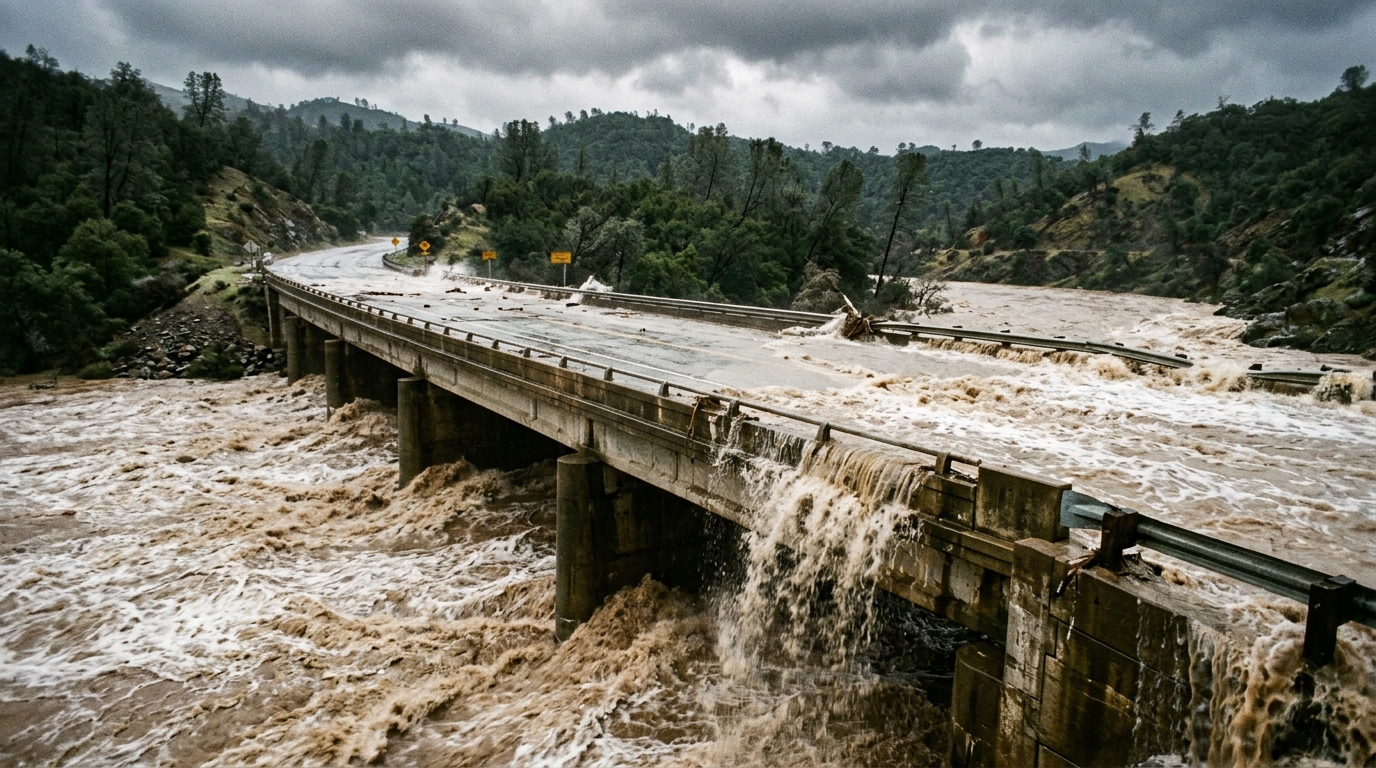
A detailed post-disaster field investigation into the catastrophic 2019 flood in Poldokhtar, located in Iran’s Lorestan Province, has revealed that floodwater rising above bridge deck elevations combined with unanchored superstructure connections served as the primary cause of widespread steel truss bridge collapses. Published in Advances in Bridge Engineering by researchers Saman Mansouri, Ilaria Venanzi, Filippo Ubertini, and Chiara Biscarini, the study evaluated the structural performance of eight steel truss bridges along the Kashkan River basin. The river basin, spanning approximately 9,500 square kilometers, experienced an overwhelming peak discharge of approximately 6,500 cubic meters per second during the extreme event, far surpassing the natural channel capacity of only 2,400 cubic meters per second. This massive volume generated severe overtopping and widespread hydraulic loading across the regional transportation network, where steel truss bridges represent roughly 57 percent of the crossing inventory.
The engineering team conducted systematic field surveys before, during, and after the disaster to document actual failure modes, combining photographic and video evidence with official hydrological records to classify structural damage into four distinct performance categories: slight, moderate, extensive, and complete collapse. Of the eight steel truss bridges examined in the study area—designated as STB1 through STB8—seven suffered total destruction, representing an 87.5 percent structural loss rate across the evaluated sample. Six of these collapsed spans, specifically bridges STB1, STB3, STB5, STB6, STB7, and STB8, failed directly from lateral deck displacement and overturning. Post-flood inspections of the support substructures, including the exposed cap beams and abutment surfaces, revealed virtually undamaged concrete and masonry contact planes, proving that the bridge decks had simply rested atop their supports without mechanical tie-down anchors or robust positive connection systems.
To overcome the acute scarcity of continuous hydraulic monitoring, detailed hydrological records, and complete structural drawings that typically impedes post-disaster engineering assessments, the authors introduced a simplified yet robust flood intensity measure defined as the ratio of floodwater height to deck elevation, denoted as Hw over Hd. This nondimensional parameter establishes three discrete hazard tiers: hazard level I where the intensity measure is below 0.75, hazard level II where the ratio falls between 0.75 and 1.0, and hazard level III where the ratio equals or exceeds 1.0, signifying complete deck submergence. This metric provides a practical, evidence-based proxy for hydraulic demand in data-constrained regions, allowing investigators to systematically compare structural vulnerability across diverse channel morphologies, variable topographies, and differing roadway clearance profiles.
The field findings demonstrated a stark behavioral divergence dictated by local topography and structural detailing, exemplified by the single surviving bridge, STB4, located in Domroud-Afrineh village. While seven bridges succumbed to flood forces, STB4 remained fully stable despite experiencing an intensity ratio greater than 1.0. Two decisive mechanisms explain its exceptional survival during the flood event. First, STB4 was uniquely situated within a low-slope plain setting, whereas the other seven bridges spanned steep, narrow mountainous terrain. In plain regions, unconfined floodwaters expand laterally across adjacent floodplains, dissipating kinetic energy and reducing concentrated hydrodynamic pressures. Second, structural inspection verified that STB4 featured robust, engineered mechanical connections securing the superstructure truss directly to its abutments, preventing hydrodynamic uplift, sliding, and rolling despite substantial submergence.
Conversely, the six collapsed truss bridges located in mountainous valleys experienced intense debris damming and debris impact on their upstream faces. Floating wood, uprooted trees, and transported vegetation accumulated rapidly against the triangular truss network, whose pinned structural members, configured in 3-meter horizontal bays and 3.6-meter vertical heights, acted as retention screens. As woody debris obstructed clear flow through the bridge cross-section, hydraulic discharge was severely restricted, elevating upstream water levels and exerting immense hydrodynamic drag, hydrostatic pressure, and buoyancy uplift on the superstructures. Because the trusses lacked anchorages to resist upward and lateral forces, the increased hydraulic loading cleanly separated the decks from the cap beams, sending the steel spans sliding and overturning directly into the Kashkan River.
The remaining bridge collapse, observed at bridge STB2 in Hayat-Algheyb village, demonstrated that bridge failure can also materialize at lower flood severities without deck submergence. Bridge STB2 collapsed entirely under hazard level I conditions, where the floodwater height remained below the superstructure elevation at an intensity measure under 0.75. Visual inspections confirmed that intense bed and bank scouring undermined, rotated, and deformed the supporting abutment foundation, causing structural instability that brought down the entire truss. This failure highlights that foundation scour represents an independent, critical failure mode capable of destroying crossing infrastructure long before hydrodynamic overtopping forces act directly on the bridge deck.
To formalize these empirical observations into predictive tools, the authors applied Kaplan-Meier survival analysis, treating the flood intensity measure Hw over Hd as an equivalent step-wise exposure variable. The survival probability, reflecting the likelihood of a bridge remaining below the collapse limit state, was modeled across the hazard range. At an intensity ratio of 0.75, the failure of STB2 reduced the survival probability from 1.0 to 0.875. As flood levels increased through hazard level II up to 1.0, no additional failures occurred, holding the estimated survival probability steady at 0.875. However, once the intensity index reached 1.2 within hazard level III, six bridges failed in rapid succession, precipitating a steep drop in survival probability down to 0.125. This sharp statistical threshold demonstrates that bridge survival declines precipitously the moment floodwaters rise high enough to engage the deck assembly.
Complementing the survival framework, the researchers developed empirical flood fragility curves using logistic regression to relate exceedance failure probabilities directly to continuous values of the intensity measure. The empirical fragility function indicated that at a low intensity ratio of 0.1, the modeled probability of steel truss bridge failure is merely 0.034 percent. As water levels approach and exceed deck elevation, failure probability escalates rapidly. At an intensity measure of 1.5, corresponding to water levels exceeding deck height by 0.01 to 1.8 meters, the failure probability reaches 97.4 percent. The resulting sigmoidal fragility relationship captures real-world irregularities observed during the 2019 flood that idealized monotonic models often overlook, providing transportation authorities with an objective, data-backed instrument to assess structural susceptibility when comprehensive hydraulic records are unavailable.
The study synthesizes several direct design and retrofit recommendations aimed at improving infrastructure resilience against climate change-induced flooding. Because deck inundation represents the dominant failure pathway, the researchers emphasize that bridge design standards must establish higher freeboard clearances that maintain deck elevations well above projected peak flood levels, especially across constrained mountainous corridors. Where vertical elevation cannot be increased, bridge superstructures must be retrofitted with robust positive hold-down anchorage systems designed to withstand combined uplift, lateral hydrodynamic drag, and debris-induced overturning forces. Furthermore, bed protection measures such as micropiles, deep pile foundations, and continuous scour monitoring systems are recommended around piers and abutments to prevent foundation rotation during moderate flood stages.
Addressing channel management, the authors note that watershed authorities should enforce regular maintenance protocols, including upstream clearing of loose vegetation and stabilizing riverbank soils to prevent excessive sediment loading and reduce debris dam formation against bridge trusses. While the single-parameter ratio of water height to deck height provides a practical, rapid assessment index under extreme post-disaster data constraints, the authors caution that it simplifies multi-dimensional hydraulic phenomena. The study concludes by noting that future iterations of the fragility framework should expand to incorporate multi-parameter indicators, integrating flood discharge ratios relative to natural channel and bridge outflow capacities, flow velocities, event durations, and quantitative upstream debris loads as monitoring data improve.
Subject of Research: Empirical flood fragility modeling and failure mechanisms of steel truss bridges under extreme flood conditions
Article Title: Advanced framework for post-flood assessment of steel truss bridges under data-constrained conditions: integrating engineering insights and empirical fragility models
Article References: Mansouri, S., Venanzi, I., Ubertini, F., & Biscarini, C. (2026). Advanced framework for post-flood assessment of steel truss bridges under data-constrained conditions: integrating engineering insights and empirical fragility models. Advances in Bridge Engineering, 7(1), Article 16. https://doi.org/10.1186/s43251-026-00206-7
Image Credits: AI Generated
DOI: 10.1186/s43251-026-00206-7
Keywords: steel truss bridges, flood fragility curves, bridge engineering, Poldokhtar flood, Kashkan River basin, debris damming, deck inundation, structural collapse, abutment scour, Kaplan-Meier survival analysis, hydraulic hazards, flood intensity measure, infrastructure resilience, logistic regression, bridge deck connections, post-disaster field survey
News Source: Denise Maddox. (November 13, 2026). Study Links Bridge Failures to Water Elevation and Deck Inundation. Scienmag.