• HOME
  • NEWS
  • EXPLORE
    • CAREER
      • Companies
      • Jobs
    • EVENTS
    • iGEM
      • News
      • Team
    • PHOTOS
    • VIDEO
    • WIKI
  • BLOG
  • COMMUNITY
    • FACEBOOK
    • INSTAGRAM
    • TWITTER
Sunday, May 10, 2026
BIOENGINEER.ORG
No Result
View All Result
  • Login
  • HOME
  • NEWS
  • EXPLORE
    • CAREER
      • Companies
      • Jobs
        • Lecturer
        • PhD Studentship
        • Postdoc
        • Research Assistant
    • EVENTS
    • iGEM
      • News
      • Team
    • PHOTOS
    • VIDEO
    • WIKI
  • BLOG
  • COMMUNITY
    • FACEBOOK
    • INSTAGRAM
    • TWITTER
  • HOME
  • NEWS
  • EXPLORE
    • CAREER
      • Companies
      • Jobs
        • Lecturer
        • PhD Studentship
        • Postdoc
        • Research Assistant
    • EVENTS
    • iGEM
      • News
      • Team
    • PHOTOS
    • VIDEO
    • WIKI
  • BLOG
  • COMMUNITY
    • FACEBOOK
    • INSTAGRAM
    • TWITTER
No Result
View All Result
Bioengineer.org
No Result
View All Result
Home NEWS Science News Chemistry

SwRI demonstrates balloon-based solar observatory

Bioengineer by Bioengineer
November 7, 2019
in Chemistry
Reading Time: 3 mins read
0
IMAGE
Share on FacebookShare on TwitterShare on LinkedinShare on RedditShare on Telegram

Low-cost option breaks down barriers to solar research
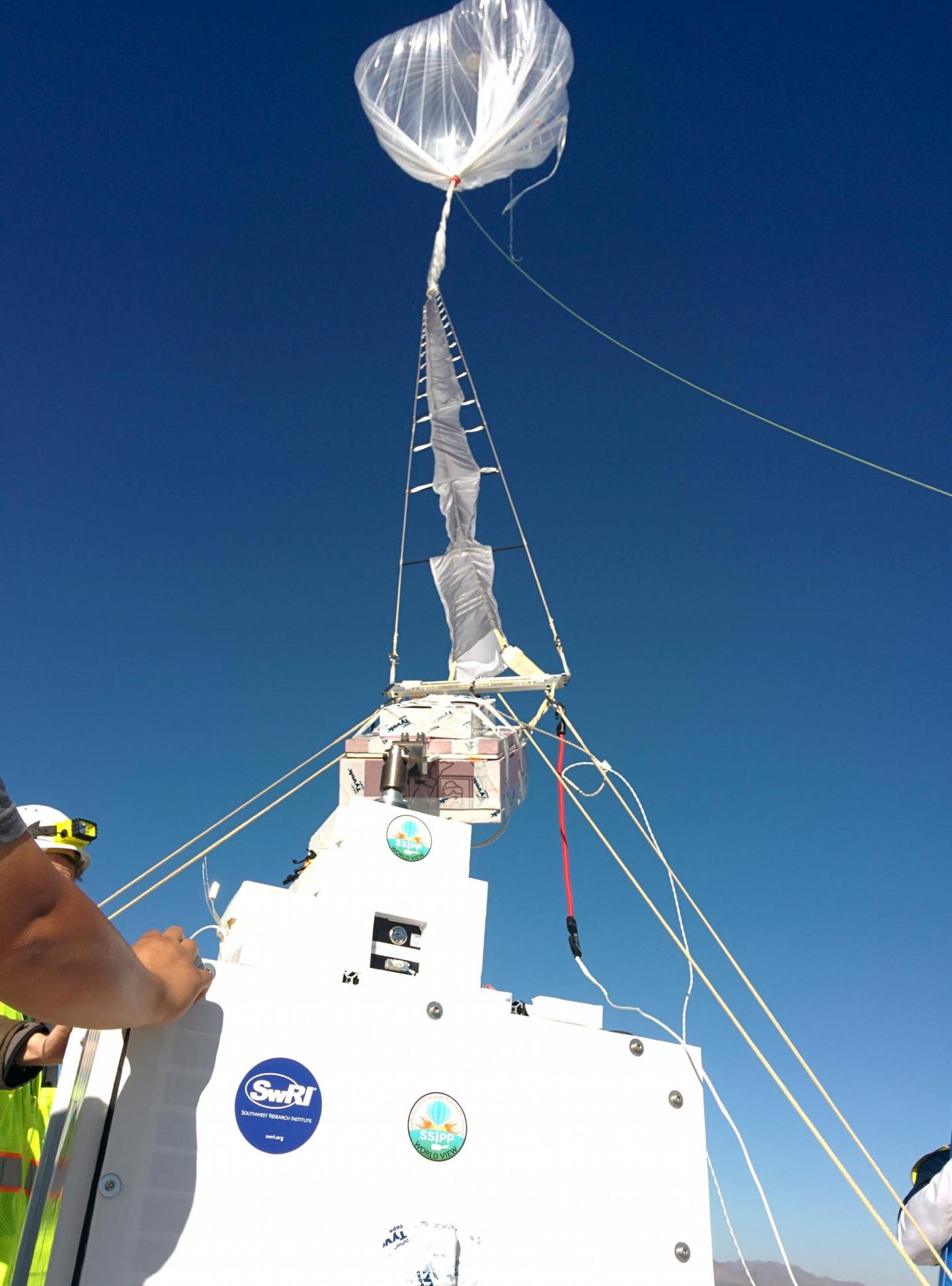
IMAGE

Credit: Southwest Research Institute


SAN ANTONIO — Nov. 7, 2019 — Southwest Research Institute successfully demonstrated a miniature solar observatory on a high-altitude balloon November 1. The SwRI Solar Instrument Pointing Platform (SSIPP) — a reusable, high-precision solar observatory about the size of a mini fridge and weighing 160 pounds — was carried by a stratospheric balloon, collecting 75 minutes of solar images in the proof-of-concept flight.

“SSIPP is a novel, low-cost observatory prototype,” said SwRI’s Dr. Craig DeForest, principal investigator of the NASA Flight Opportunities mission. “We are working to provide similar infrastructure and flexibility to a ground-based observatory, delivered to near-space.”

SSIPP collects solar data using infrared, ultraviolet or visible light instruments on an optical table, similar to those used in ground-based observatories but from a near-space environment. SSIPP is an arcsecond-class observatory, which provides optical precision equivalent to imaging a dime from a mile away. The platform supports the development of custom solar instruments. Collecting data from the edge of space — around 20 miles above the Earth’s surface — avoids image distortions caused by looking through the atmosphere.

“SSIPP could support the development of a range of new instruments for the near-space environment at relatively low cost,” DeForest said. SSIPP includes an “optical table,” a stable platform used to support optics in a laboratory environment. “Using a standard optical table platform increases flexibility, allowing scientists to develop new technologies without designing a custom observatory. For instance, scientists are interested in the cacophony produced by the roiling solar environment.”

While sound cannot travel through the vacuum of space, scientists can detect sound on the Sun by imaging the disturbances it creates in the solar atmosphere. During the demonstration flight, which imaged a special range of blue light called the “g band,” SwRI scientists Dr. Glenn Laurent and Dr. Derek Lamb demonstrated the platform’s pointing capability and will search the images for visible signatures of “high-frequency” solar sound waves, which are actually some eight octaves below the deepest audible notes. In comparison, the most studied sound waves in the Sun are five octaves deeper.

“The transfer of heat to the surface of our star is a violent and tremendously loud process,” DeForest said. “Sound waves can heat the solar atmosphere to extremely high temperatures, but it’s a poorly understood process. Existing measurements cannot account for all the energy required. The 10-second frequency range is very hard to measure from the ground, because Earth’s turbulent atmosphere confuses the signal.”

Because existing spaceborne assets are optimized for different science, the frequency range observed by SSIPP fills a gap in current measurements, highlighting the importance of new instruments to advance knowledge.

“Upon reaching the stratosphere, SSIPP immediately locked onto the solar disk using a novel two-stage pointing system,” Laurent said. “The next step for SSIPP is to partner with outside institutions to extend quick-turnaround solar flights to a range of scientific instrumentation.”

###

SSIPP launched aboard a World View stratospheric balloon, funded by NASA’s Flight Opportunities Program under the Space Technology Mission Directorate. The program is managed by NASA’s Armstrong Flight Research Center in Edwards, California.

For more information, visit: https://www.swri.org/heliophysics.

Release url: https://www.swri.org/press-release/balloon-based-solar-observatory-ssipp?utm_source=EurekAlert!&utm_medium=Distribution&utm_campaign=Balloon-PR

CLIENT SERVICE LINK : https://www.swri.org/heliophysics?utm_source=EurekAlert!&utm_medium=Distribution&utm_campaign=Balloon-PR

Media Contact
Deb Schmid
[email protected]
210-522-2254

Original Source

https://www.swri.org/press-release/balloon-based-solar-observatory-ssipp

Tags: AstronomyAstrophysicsComets/AsteroidsExperiments in SpaceMeteorologyPlanets/MoonsSatellite Missions/ShuttlesSpace/Planetary Science
Share13Tweet8Share2ShareShareShare2

Related Posts

Miniature Sensor Uses Light to Detect Touch — Chemistry

Miniature Sensor Uses Light to Detect Touch

May 8, 2026
Iron Minerals Determine Whether Dissolved Organic Matter Fuels Microbes or Becomes Long-Term Carbon Storage — Chemistry

Iron Minerals Determine Whether Dissolved Organic Matter Fuels Microbes or Becomes Long-Term Carbon Storage

May 8, 2026

Kate Evans Appointed Associate Lab Director for Biological and Environmental Systems Science at ORNL

May 8, 2026

Advancing Multiscale Modeling and Overcoming Operational Challenges in Autothermal COâ‚‚-to-Methanol Reactors

May 8, 2026
Please login to join discussion

POPULAR NEWS

  • Research Indicates Potential Connection Between Prenatal Medication Exposure and Elevated Autism Risk

    840 shares
    Share 336 Tweet 210
  • New Study Reveals Plants Can Detect the Sound of Rain

    727 shares
    Share 290 Tweet 181
  • Scientists Investigate Possible Connection Between COVID-19 and Increased Lung Cancer Risk

    68 shares
    Share 27 Tweet 17
  • Salmonella Haem Blocks Macrophages, Boosts Infection

    61 shares
    Share 24 Tweet 15

About

We bring you the latest biotechnology news from best research centers and universities around the world. Check our website.

Follow us

Recent News

Evaluating Digoxin Use in Patients with Symptomatic Rheumatic Heart Disease

Evaluating the Effectiveness and Safety of Digitalis Glycosides in Treating Heart Failure

Urdu Fall Risk Questionnaire Adapted for Elderly

Subscribe to Blog via Email

Success! An email was just sent to confirm your subscription. Please find the email now and click 'Confirm' to start subscribing.

Join 82 other subscribers
  • Contact Us

Bioengineer.org © Copyright 2023 All Rights Reserved.

Welcome Back!

Login to your account below

Forgotten Password?

Retrieve your password

Please enter your username or email address to reset your password.

Log In
No Result
View All Result
  • Homepages
    • Home Page 1
    • Home Page 2
  • News
  • National
  • Business
  • Health
  • Lifestyle
  • Science

Bioengineer.org © Copyright 2023 All Rights Reserved.