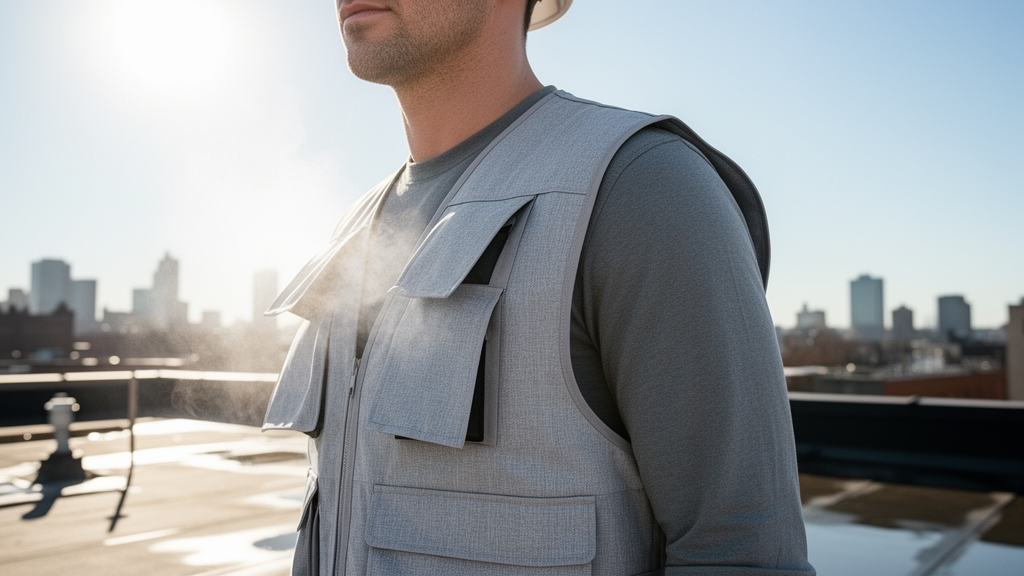
Researchers have built a garment that ventilates itself, opening small fabric flaps wherever sweat accumulates, without batteries, fans, or pumps. The system, described in the open-access journal Fashion and Textiles, relies on a composite textile that curls open in response to moisture, and a sweating thermal manikin test showed that the resulting ventilated garment improved localized evaporative heat release in several high-sweat body regions. The work was led by Hyeon-seon Cho, Soah Park, Hyukjoo Yang, Seungsin Lee, and Sumin Koo, and was published on 30 September 2026.
The core of the design is a bilayer moisture-responsive fabric modeled on hygromorphic structures found in nature, such as pinecones, which open and close as humidity fluctuates. In engineered bilayer actuators, a hydrophilic layer swells when it absorbs moisture while a hydrophobic outer layer resists that deformation, generating internal stress gradients that force the material to bend or curl. The team laminated two commercially available hydrophilic cotton fabrics, a plain-woven cotton designated CW and a single jersey knit designated CK, with a hydrophobic polyurethane nanofiber web, or PUN, produced by electrospinning from pure polyurethane. The nanoweb had a density of 19.72 grams per square meter and a thickness of 0.064 millimeters, and the layers were bonded with a roller laminating machine that heat-pressed the pre-attached stacks at 100 degrees Celsius at a processing speed of roughly 900 millimeters per minute.
Six composite fabrics were fabricated by applying one, two, or three layers of PUN to each of the two cotton substrates. Physical characterization showed that increasing the number of nanoweb layers gradually increased both thickness and weight. Among single-layer specimens, CW/PUN1 measured 0.24 millimeters thick and weighed 0.0438 grams, while CK/PUN1 was thicker at 0.33 millimeters but lighter at 0.0379 grams. Three-layer versions reached 0.33 millimeters for CW/PUN3 and 0.36 millimeters for CK/PUN3, with corresponding weights of 0.0599 and 0.0478 grams. Scanning electron microscopy confirmed that the electrospun nanofibers retained their straight, undamaged morphology after lamination, formed continuous hydrophobic zones across the fabric surface, and adhered strongly to the substrates with no evidence of delamination.
To quantify moisture responsiveness, the researchers floated rectangular specimens, measuring 2.5 by 1.3 centimeters, on distilled water in a Petri dish with the hydrophilic side facing downward. Surface tension kept the fabrics from sinking, and a camera recorded the spontaneous curling over ten minutes. Computer vision algorithms based on OpenCV converted the observed curvature from pixels to centimeters, using a conversion factor derived from the known specimen length. The results showed a clear trend: curling increased as more PUN layers were added, because the thicker hydrophobic outer web amplified the swelling mismatch between the layers. Curvature radii fell from 0.37 centimeters for CW/PUN1 to 0.28 centimeters for CW/PUN3, and from 0.22 centimeters for CK/PUN1 to 0.16 centimeters for CK/PUN3, with smaller radii indicating stronger deformation.
The knitted composites consistently outperformed their woven counterparts. The researchers attribute this to the looped structure of the knit, which offers higher porosity and greater flexibility than the woven structure, allowing moisture to diffuse more readily and allowing localized swelling to translate into global curl-up deformation. The knit’s loops also compressed more during lamination, which explains why CK-based specimens gained less thickness than CW-based ones as layers were added. On the strength of these results, CK/PUN3, with the smallest curvature radius and therefore the strongest moisture response, was selected as the functional fabric for the garment.
The ventilated garment was designed as a long-sleeve hoodie, a choice informed by earlier findings that agricultural workers favor long sleeves and head coverage during summer fieldwork. The base garment was made from a stretchable knit of 87 percent polyester and 13 percent polyurethane, weighing 246.85 grams, and was first visualized in CLO 3D software before being physically prototyped. Ten uniformly sized CK/PUN3 flaps were integrated into regions of high sweat production identified from published human sweat distribution data: three flaps in the bra triangle area of the front torso and seven across the upper back. Mesh panels of 100 percent polyester were added along the center of the hood and the underarm areas to further improve airflow. The flaps are designed to open when exposed to moisture, enhancing ventilation precisely where the wearer sweats most.
Performance was evaluated on a sweating thermal manikin with 20 independently controlled segments, following the ASTM F2370 protocol in a climate-controlled chamber set to 35 degrees Celsius with 40 percent relative humidity and air velocity below 0.3 meters per second. Distilled water was supplied to each segment at 1000 milliliters per square meter per hour to simulate a fully soaked skin surface, and each garment condition was tested in duplicate. Compared with an unmodified control garment, the ventilated garment reduced intrinsic evaporative resistance by 7.50 percent, from 6.93 to 6.41 square meters pascals per watt, and total evaporative resistance by 2.17 percent, from 24.00 to 23.48 square meters pascals per watt.
Regional heat flux measurements across nine body regions revealed more pronounced localized gains. Heat flux rose by 26.78 percent in the abdominal region, from 65.54 to 83.09 watts per square meter, and by 18.59 percent in the chest, reaching 153.77 watts per square meter, both areas covered by the moisture-responsive flaps. The head region showed a 7.68 percent increase, to 223.31 watts per square meter, which the authors attribute to the mesh panel in the hood. The back, where the flaps were applied directly, showed only a 4.14 percent increase, possibly because close contact between the garment and the manikin restricted air movement. Heat flux was higher for the ventilated garment in every region tested except the right upper arm.
The authors are careful to frame these results as preliminary laboratory evidence rather than proof of real-world performance. The manikin was static, so the tests did not capture human thermoregulatory responses, body movement, or the effects of motion on flap opening, garment displacement, and air exchange. No human wear trials were conducted, meaning subjective comfort, perceived ventilation, fit, and mobility could not be assessed. The duplicate testing also limits statistical reliability, and the study covered only an upper-body garment with specific ventilation zones. Durability questions, including washing stability and long-term performance after repeated moisture-response cycles, remain unexamined, and the authors call for future studies addressing these gaps along with wearer trials under varied temperature, humidity, and activity conditions.
Even so, the study demonstrates a passive, energy-free alternative to existing personal cooling systems. Air-cooled, liquid-cooled, and phase-change garments typically depend on external power, added components, or added weight, which limits their practicality for outdoor workers in agriculture and construction who face prolonged heat exposure and risks including heat stroke, dehydration, and reduced work efficiency. The ventilated garment’s value, the authors argue, lies not in a large whole-garment reduction in evaporative resistance but in a low-burden, supplementary ventilation strategy that targets localized heat release in high-sweat regions while maintaining the coverage of long-sleeved workwear. Future work is planned to extend the responsive design to other body regions, evaluate long-term usability through participant-based trials, and investigate performance changes after repeated use and washing.
Subject of Research: Development of moisture-responsive composite fabrics and a passive ventilated garment for cooling workers in high-temperature environments
Article Title: Development of moisture-responsive fabrics and ventilated garments in high-temperature field environments
Article References: Cho, H.-S., Park, S., Yang, H., Lee, S., & Koo, S. (2026). Development of moisture-responsive fabrics and ventilated garments in high-temperature field environments. Fashion and Textiles, 13(1), Article 35. https://doi.org/10.1186/s40691-026-00487-6
Image Credits: AI Generated
DOI: 10.1186/s40691-026-00487-6
Keywords: moisture-responsive fabrics, ventilated garment, polyurethane nanofiber web, hygromorphic textiles, passive cooling, thermal comfort, sweating thermal manikin, evaporative resistance, heat stress, occupational workwear, electrospinning, cotton-polyurethane laminate
News Source: Denise Maddox. (October 28, 2026). Sweat-Powered Fabric Flaps Open to Cool Workers in Extreme Heat Without Electricity. Scienmag.