As the world confronts the escalating threats posed by climate change, one of the foremost challenges remains the sustainability of global food production. Increasing temperatures and intensified heatwaves jeopardize the growth and yields of staple crops like wheat, maize, rice, and barley, raising urgent questions about how best to adapt agricultural systems to maintain productivity. In groundbreaking research published in Nature Food, scientists He and Rosa present a rigorous analysis combining global crop distribution, irrigation patterns, and climate projections, revealing critical limitations and potential strategies for mitigating climate impacts on agriculture through irrigation expansion.
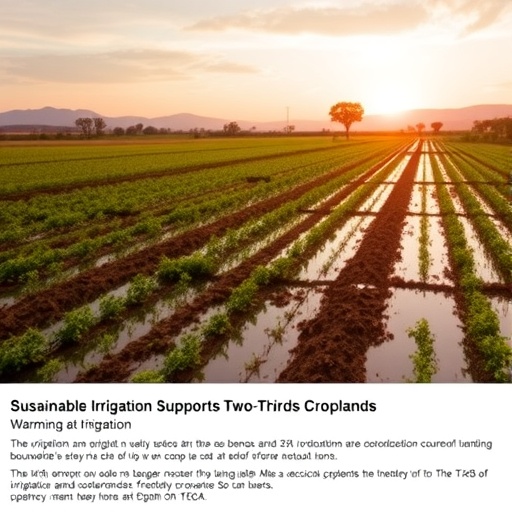
This comprehensive study delves into the feasibility of sustaining crop yields under two warming trajectories aligned with international climate targets and current emissions trends: 1.5 degrees Celsius, representative of ambitious global efforts, and 3 degrees Celsius, reflecting business-as-usual scenarios. Through sophisticated climate models integrated with detailed global datasets, the researchers quantify the irrigation area needed worldwide to secure production of these key cereals despite increasing heat stress. They estimate that achieving sustenance under 1.5°C warming demands an additional 25 million hectares—an expansion of 13%—while 3°C warming requires a far more substantial 94 million hectares, a 47% increase in irrigated cropland globally.
The study’s implications extend beyond mere scale, as it probes the sustainability of this irrigation expansion in terms of freshwater availability. Despite the significant land area identified as necessary to shield crops from temperature-driven yield losses, only about 60% of these new or expanded irrigated sites can feasibly obtain sufficient water without triggering detrimental water scarcity or depleting local freshwater resources. This critical insight underscores a key trade-off between adaptation and resource constraints, suggesting that unabated warming could impose insurmountable pressure on already vulnerable water systems, potentially exacerbating competition between agricultural and other human and ecological demands.
Through high-resolution mapping, the research pinpoints geographic disparities in adaptation needs, highlighting how certain regions would face disproportionate demands for irrigation infrastructure under warming scenarios. Such spatial differentiation carries profound implications for global food security and equity. Areas with inadequate water resources risk being unable to adopt irrigation-based adaptations, thereby amplifying regional vulnerabilities and inequalities in agricultural resilience. Conversely, regions with sufficient freshwater could serve as critical nodes for future food production under climate stress.
The authors emphasize that their findings serve as a sobering reminder of the urgency of limiting global temperature rise to 1.5°C rather than allowing scenarios closer to 3°C to materialize. The steep increase in irrigation demand and water resource strain under the higher warming trajectory illustrates the nonlinear risks of delayed climate action. By demonstrating the differential impacts and irrigation needs under these scenarios, the study provides a quantified blueprint that policymakers and stakeholders can leverage to prioritize investments in water infrastructure, conservation measures, and agricultural innovation.
Technically, this investigation represents an advance in the integration of climate modelling with agricultural and hydrological data. Leveraging datasets that detail the global distribution of wheat, maize, rice, and barley, alongside current irrigation extents and freshwater availability, the researchers employed ensemble climate projections to simulate heat stress impacts on crop yield. By translating yield losses into irrigation needs, they effectively bridge the gap between climate risk assessment and practical adaptation pathways, offering policymakers actionable insights grounded in rigorous empirical analysis.
Moreover, the study points to the complex interplay between climate impacts, crop physiology, and irrigation technology. While irrigation can abate heat stress through soil moisture regulation and transpiration cooling, the water demand intensifies pressure on freshwater systems already strained by competing sectors and climate variability. This underscores the need for integrated water resource management approaches that consider crop water demand, local hydrology, and socioeconomic factors to optimize irrigation deployment without compromising ecological integrity or equity.
The authors also recognize that irrigation expansion alone will not suffice to ensure food security under warming climates. Complementary strategies such as the breeding of heat-tolerant crop varieties, improved water-use efficiency technologies, changes in cropping patterns, and enhanced soil moisture conservation practices will be essential components of multifaceted adaptation frameworks. Their work, however, provides a crucial quantification of the physical extent and limits of irrigation as a central pillar of such strategies.
By illuminating areas where irrigation could realistically be expanded without depleting freshwater supplies, the study assists in identifying priority regions for climate-resilient agricultural investment. These geospatial insights can guide infrastructure development, water policy formulation, and agricultural planning at local to global scales. Notably, the finding that two-fifths of required irrigation expansion areas are unsustainable from a water resources perspective signals urgent challenges for regions where water scarcity already constrains agricultural productivity.
Equally important is the broader message about the unequal burden posed by climate change adaptation. The unequal geographical distribution of irrigation feasibility hints at wider systemic disparities in agricultural resilience between countries and regions. Developing nations, particularly those with limited water resources and infrastructure capacity, may face heightened risks and diminished adaptation options, exacerbating food insecurity and socio-economic vulnerabilities. International cooperation and financial mechanisms to support sustainable irrigation development will thus be vital.
The research further underscores the critical need to prioritize maintaining freshwater resources as a global common good under climate change. Protecting aquifers, implementing efficient irrigation technologies, and promoting water recycling can enhance the capacity of agricultural systems to absorb warming impacts without sacrificing environmental sustainability. The authors advocate for a holistic perspective that balances production goals with ecosystem preservation and equitable resource access.
As global food systems grapple with compounding pressures—from climate variability to population growth and changing diets—this study’s findings remind us that adaptation choices must be informed by comprehensive assessments of resource constraints and climate trajectories. Achieving climate-resilient agriculture demands a coordinated approach blending scientific insights, technological innovation, and governance reforms tailored to varied local conditions.
In conclusion, He and Rosa’s work establishes a pivotal benchmark in the science of climate adaptation for agriculture, quantifying the scale and limits of irrigation expansion under plausible warming futures. It highlights the feasibility boundary set by global freshwater resources and spotlights the critical role of limiting warming to 1.5°C to avoid untenable resource competition. Their high-resolution spatial analysis empowers decision-makers to craft targeted, sustainable, and equitable adaptation policies vital for securing future food supplies amid unprecedented climatic challenges.
This research contributes a vital piece to the complex puzzle of climate-smart agriculture. By setting practical boundaries on irrigation-based adaptation, it encourages complementary innovation and holistic water resource management to ensure that global cereal production withstands the twin pressures of rising temperatures and finite water supplies. As climate change continues to reshape agricultural landscapes worldwide, such integrative and forward-looking analyses will be essential to safeguarding the food systems that sustain humanity.
Subject of Research: Agricultural adaptation strategies and irrigation feasibility under climate change.
Article Title: Sustainable global irrigation expansion could support only two-thirds of croplands under 1.5 °C and 3 °C warming.
Article References:
He, L., Rosa, L. Sustainable global irrigation expansion could support only two-thirds of croplands under 1.5 °C and 3 °C warming. Nat Food (2026). https://doi.org/10.1038/s43016-026-01338-9
Image Credits: AI Generated
DOI: https://doi.org/10.1038/s43016-026-01338-9
Tags: adaptation strategies for heat stress in cropsclimate change impact on crop yieldsclimate models for agricultureglobal crop distribution and irrigationglobal warming and crop productionirrigation area increase under climate changeirrigation demands at 1.5 and 3 degrees warmingirrigation expansion for food securitymitigating climate risks in agriculturesustainable food production under warmingsustainable irrigation in agriculturewheat maize rice barley yield protection