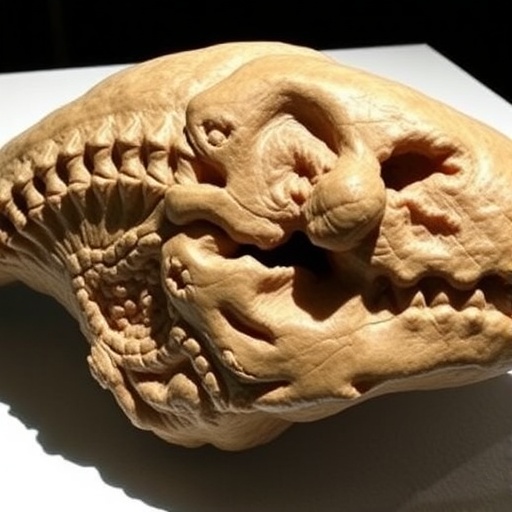
In a groundbreaking study, researchers from Flinders University have unveiled new insights into the evolutionary transition from aquatic to terrestrial life by examining one of the earliest creatures to make this monumental shift more than 380 million years ago. This remarkable investigation focused on the fossilized remains of Koharalepis jarviki, a Devonian tetrapodomorph fish whose lineage represents a crucial stage in vertebrate evolution. Utilizing advanced neutron imaging technology, scientists were able to non-destructively peer inside the skull and braincase of the sole known specimen, shedding unprecedented light on its neuroanatomy and skeletal structure.
The fossil, discovered in the freshwater deposits of Antarctica’s Lashly Mountains, is a rare window into the Age of Fishes, a pivotal geological period characterized by an explosion of diversity among lobe-finned fishes (Sarcopterygii). These fishes are of particular significance because they are closely related to the earliest tetrapods — the vertebrates that first ventured onto land. The biological group Canowindridae, to which Koharalepis belongs, is especially notable for its distribution across what was once East Gondwana, providing key evidence for ancient continental linkages between Australia and Antarctica.
Dr. Alice Clement, a research fellow at Flinders University and coauthor of the study, emphasizes the importance of studying fossils like Koharalepis to understand vertebrates’ aquatic-to-terrestrial transition. The specimen’s extraordinary preservation, particularly of internal skull bones rarely seen in Canowindridae, provides a unique perspective on the morphology and functional adaptations that may have facilitated early terrestrial locomotion and survival.
The research team employed synchrotron-based tomography combined with neutron imaging to generate high-resolution, three-dimensional models of the internal cranial anatomy without damaging the precious fossil. This methodological innovation enabled them to analyze the morphology of the braincase, shoulder girdle, and parts of the vertebral column. These data, unattainable through traditional paleontological techniques, have illuminated details about sensory capabilities and physiological adaptations that Koharalepis exhibited.
Intriguingly, the imaging revealed openings in the top of the skull consistent with adaptations for enhanced air intake, an indication of life in shallow water or near-surface aquatic environments. Moreover, the structure of the brain contained evidence of a pineal organ, which is associated with light detection and circadian rhythm regulation — critical functions for an organism navigating fluctuating light conditions near water surfaces.
Lead author Corinne Mensforth, a doctoral candidate in the Flinders Palaeontology Lab, points out that Koharalepis, growing to about one meter in length, was likely an ambush predator. Its relatively small eyes suggest a reliance on sensory modalities other than vision, perhaps mechanoreception or chemoreception, for detecting prey. Such an ecological niche underscores the complex behaviors and adaptations early tetrapodomorph fishes developed as they exploited new environments.
The significance of this research extends beyond paleobiology into understanding the environmental pressures and anatomical innovations that set the stage for vertebrates’ dramatic leap onto land. Flinders University Emeritus Professor John Long, a veteran paleontologist and coauthor, remarks that these newly acquired internal anatomical details enrich our comprehension of the evolutionary pathways from lobe-finned fishes to the first tetrapods approximately 385 million years ago.
This discovery also highlights the potential of modern non-invasive imaging methodologies to revolutionize studies of rare and delicate fossils, offering fresh perspectives on the internal structure of organisms that have remained enigmatic for decades. The interdisciplinary collaboration among paleontologists and imaging specialists, including contributions from the Australian Nuclear Science and Technology Organisation (ANSTO), exemplifies the future of evolutionary research.
The study, titled “New data on the sarcopterygian Koharalepis jarviki (Tetrapodomorpha; Canowindridae) from the Late Devonian of Antarctica, revealed via synchrotron and neutron tomography,” was published in the journal Frontiers in Ecology and Evolution. It presents detailed anatomical descriptions, comparative analyses with related taxa, and discussions on the implications for understanding the neuroanatomical evolution associated with the water-to-land transition.
These findings underscore the dynamic evolutionary landscape of the Devonian, where environmental changes and the rise of predatory niches drove morphological innovations. The ability of Koharalepis to regulate air intake and its neural adaptations indicate complex behaviors and physiological processes that presaged terrestrial vertebrate life.
Financial support from the Australian Research Council and collaborative efforts with institutions like the Australian Museum and ANSTO facilitated this research, ensuring access to essential specimens and cutting-edge scanning technology. Such multidisciplinary and cross-institutional efforts are vital for unraveling mysteries embedded in deep time.
Ultimately, this work enhances our understanding of vertebrate evolution by providing a glimpse into the internal workings of a species at the cusp of terrestrial adaptation. The refined anatomical data of Koharalepis jarviki enriches the fossil record with crucial evidence, bridging gaps in our knowledge about how the earliest tetrapodomorphs functioned and interacted with their environments during one of Earth’s most transformative epochs.
Subject of Research: Animals
Article Title: New data on the sarcopterygian Koharalepis jarviki (Tetrapodomorpha; Canowindridae) from the Late Devonian of Antarctica, revealed via synchrotron and neutron tomography
News Publication Date: 16-Apr-2026
Web References:
https://www.frontiersin.org/journals/ecology-and-evolution/articles/10.3389/fevo.2026.1765271/full
http://dx.doi.org/10.3389/fevo.2026.1765271
References: Corinne L Mensforth, John A Long, Joseph J Bevitt, Alice M Clement. (2026). New data on the sarcopterygian Koharalepis jarviki (Tetrapodomorpha; Canowindridae) from the Late Devonian of Antarctica, revealed via synchrotron and neutron tomography. Frontiers in Ecology and Evolution. DOI: 10.3389/fevo.2026.1765271.
Image Credits: Flinders University, original painting by Thomas Turner
Tags: Age of Fishes biodiversityancient Gondwana fossil discoveryCanowindridae fossil distributionDevonian tetrapodomorph fishearly vertebrate evolution AntarcticaEast Gondwana continental linkagesevolutionary transition aquatic to terrestrialfreshwater Devonian depositsKoharalepis jarviki neuroanatomylobe-finned fishes Sarcopterygiineutron imaging fossil analysispaleontological research Antarctic fossils