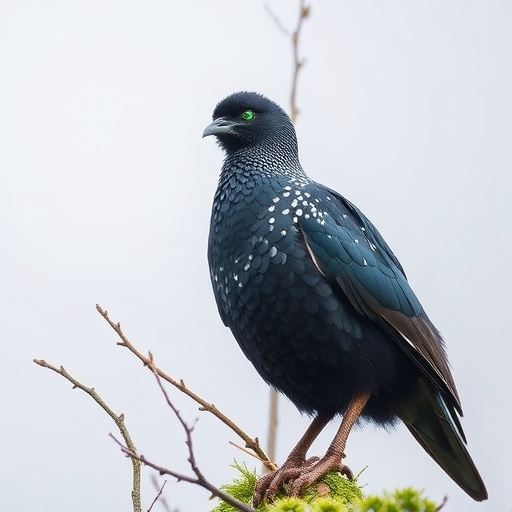
In the serene expanse of the French Alps, a hidden and deadly hazard has been identified that strikes an unsuspecting victim each year: the ski lift cables. For over six decades, these seemingly innocuous wires have been responsible for nearly 600 fatal collisions with local landfowl populations, with black grouse (Lyrurus tetrix) bearing the brunt of this toll. Accounting for approximately 70% of these recorded deaths, the plight of the black grouse brings into sharp focus a grave conservation concern that had previously flown under the radar.
The alarming frequency of these incidents prompted wildlife conservationists working within the Parc national de la Vanoise to prioritize understanding the perceptual capabilities of the black grouse. Their objective was to devise a scientifically informed mitigation strategy—specifically, the design of visual markers on cables that would be clearly distinguishable to these birds in flight, thereby reducing fatal collisions. To achieve this, a multidisciplinary team of researchers was assembled, bringing together expertise from independent French scientist Simon Potier and his colleagues Jean-Marc Lassance and Marjorie Liénard from the University of Liège, Belgium.
Their groundbreaking research, soon to be published in the Journal of Experimental Biology, reveals startling new insights into the visual world of the black grouse, including a critical discovery: these birds are incapable of perceiving dark red hues. This counterintuitive finding overturns prior assumptions that red markers—commonly used in safety equipment—would be effective deterrents. Furthermore, the research confirms that black grouse have notably poor visual acuity compared to many raptors, a sensitivity parameter essential for detecting obstacles from a distance.
To unravel the sensory capabilities of the black grouse, the researchers undertook a meticulous experimental protocol starting with extensive retinal imaging. Using advanced photographic techniques, they captured comprehensive views of the birds’ retinas from multiple angles—frontal, lateral, and posterior—facilitating the construction of a detailed visual field map. Intriguingly, the black grouse demonstrated one of the widest visual fields recorded in terrestrial birds, spanning an impressive 353 degrees. This almost panoramic vision is punctuated only by a narrow 7-degree blind spot at the back of the head and a specialized 28-degree frontal region capable of stereoscopic, or 3D, vision which aids depth perception.
While the breadth of visual coverage is outstanding, the sharpness of their vision tells a more concerning story. Measurement of ocular parameters, particularly the depth of their eyes—a correlate for spatial resolution—confirmed that the black grouse’s visual precision is relatively poor. Their acuity aligns with that observed in other ground-dwelling avian species but pales in comparison to the razor-sharp vision of eagles, specifically the wedge-tail eagle, which achieves extraordinary object resolution at great distances.
This modest visual acuity has practical consequences for the birds’ ability to detect obstacles in their flight path. Calculations performed by the research team estimated the smallest object a flying black grouse could discern from a distance of 32 meters to be approximately 3 centimeters in size. From a human perspective, this threshold is sizeable—it is four to five times larger than what humans can detect at the same range. Consequently, this finding underscores the necessity for cable markers that are large enough and conspicuous enough to be noticed in time for the bird to execute evasive maneuvers successfully.
Color perception studies further complicated the picture. The team discovered that black grouse vision is largely blind to dark red shades, a revelation that runs counter to the stark red combs they sport above their eyes that humans perceive vividly. This suggests that the birds’ photoreceptor constructs lack sensitivity to longer wavelengths in the red spectrum. In contrast, black grouse appear to exhibit enhanced sensitivity to blue hues, potentially extending into ultraviolet wavelengths—a domain invisible to the human eye. This spectral bias suggests a visual ecology attuned to their habitat, where blues and greens predominate.
An analysis of the birds’ abilities to perceive shades of gray—visual contrast sensitivity—added another layer to the challenge. Researchers found that black grouse struggle to distinguish dark cables against the backdrop of dense green forests or white markers against snow cover in winter months. This poor contrast sensitivity means that markers simply relying on brightness differences in a monochrome spectrum are insufficient to guarantee visibility.
Synthesizing their findings, the researchers propose an evidence-based design for cable markers that balances size, shape, and coloration for optimal detectability. In conditions of bright daylight, a marker measuring approximately 9 by 9 centimeters, constructed from a pattern of 3-centimeter squares, emerges as the optimal configuration. By alternating strongly contrasting black and white squares, such markers provide maximal chromatic and luminance contrast visible to black grouse under a range of lighting conditions.
This insight holds far-reaching implications for conservation efforts in the French Alps and potentially other regions where cable-related bird fatalities occur. Employing markers designed to the sensory capabilities of black grouse can significantly mitigate the risk of collision. This research not only informs practical solutions but also exemplifies the value of integrating molecular and behavioral biology with field conservation.
Conservationist and researcher Simon Potier emphasized the integral role of collaboration in this endeavor, notably the cooperation with Belgian breeder Frank Grosemans, whose expertise was instrumental in maintaining the calm necessary for researchers to conduct precise ocular examinations. The study highlights the subtleties of interspecies perception and the importance of tailoring human interventions to the unique sensory worlds of wildlife.
As ski resorts continue to expand and human infrastructure extends into natural habitats, the intersection of technology, ecology, and animal behavior research gains critical importance. This study serves as a potent reminder of the nuanced challenges in safeguarding biodiversity in shared landscapes. Moving forward, the knowledge gleaned from these visual system explorations promises to shape safer environments where black grouse and other avian species can coexist with human recreational activities.
In sum, the black grouse’s visual system—a panorama of expansive fields of view but modest resolution and distinctive color sensitivities—has been revealed in unprecedented detail. The consequences are clear: mitigation designs for ski lift cables must abandon conventional red markers and instead adopt stark black and white patterns sized appropriately to the birds’ perceptual limits. This pioneering work marks a significant advance in our ability to reduce avian fatalities linked to infrastructure, spotlighting how the integration of experimental and molecular techniques can illuminate the unseen challenges faced by wildlife.
Subject of Research: Animals
Article Title: Exploring the visual system of the black grouse (Lyrurus tetrix): combining experimental and molecular approaches to inform strategies for reducing collisions
News Publication Date: 23-Apr-2026
Web References: http://dx.doi.org/10.1242/jeb.250727
References: Potier, S., Lassance, J.-M., Blary, C., Coulombier, J., Berthillot, S., Cavailhes, J., Buisson, C., Dos Santos, V. M., Andraud, C., Liénard, M. A. (2026). Exploring the visual system of the black grouse (Lyrurus tetrix): combining experimental and molecular approaches to inform strategies for reducing collisions. Journal of Experimental Biology, 229, jeb250727. doi:10.1242/jeb.250727
Keywords: Black grouse, visual system, ski lift cable collisions, color vision, avian conservation, visual acuity, retinal mapping, obstacle avoidance, animal perception, wildlife mitigation, ski resort impact, molecular biology
Tags: avian visual perception researchbird collision preventionbird flight safety measuresblack grouse conservationexperimental biology in conservationLyrurus tetrix protectionmultidisciplinary conservation researchParc national de la Vanoise wildlifepower cable bird strikesski lift cable hazardsvisual marker design for birdswildlife mitigation strategies