Credit: Kobe University
Childhood nephrotic syndrome is the most frequently occurring chronic kidney disease among children. A Japanese research team has identified a group of genes that are strongly related to the development of childhood nephrotic syndrome. The results of this study could shed light on the underlying mechanism for this disease. These findings were published on July 16 in the online edition of Journal of the American Society of Nephrology.
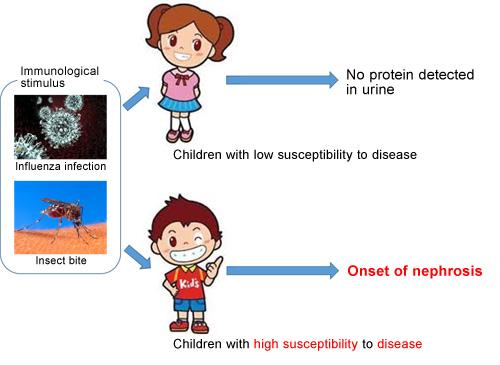
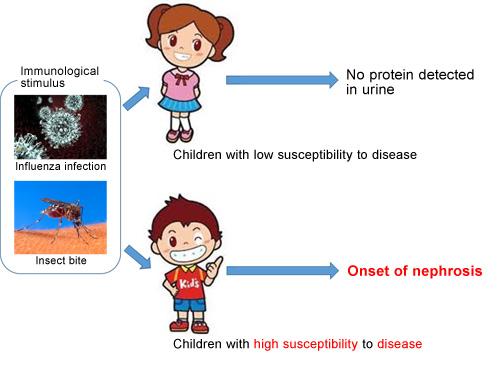
Also known as nephrosis, childhood nephrotic syndrome is an incurable disease with an unknown cause, characterized by large amounts of protein leaving the body in the patient's urine, and protein levels in the bloodstream becoming extremely low. The majority of patients develop steroid-sensitive nephrotic syndrome that responds to steroids and immune-suppressing drugs, and go into remission, but at least 20% of cases are resistant strains that recur repeatedly during adulthood. It is thought that people who are genetically predisposed develop the syndrome when exposed to an immunological stimulus such as infection. This study aimed to identify the genes that make Japanese infants susceptible to steroid-sensitive nephrotic syndrome.
Researchers collected genetic DNA from 1,300 sufferers of childhood nephrotic syndrome in Japan. The study targeted 224 of the samples with childhood steroid-sensitive nephrotic syndrome and a control group of 419 healthy Japanese people, to perform a genome-wide association study (GWAS) using the Affymetrix Japonica Array. This enabled them to identify SNPs with a significant genome-wide association in the HLA-DR/DQ area of the short arm of human chromosome 6. They then identified the HLA haplotypes (gene groups) with the lowest and highest risks of developing the syndrome. They confirmed this result with a different cohort of 213 samples of infant steroid-sensitive nephrotic syndrome and a control group of 710 healthy Japanese individuals.
The HLA haplotype showing the highest risk of development is HLA-DRB1*08:02-HLA-DQB1*03:02 (odds ratio: 3.60) and the HLA haplotype showing the lowest risk of development is HLA-DRB1*13:02-HLA-DQB1*06:04 (odds ratio: 0.10). This is the first time these haplotypes have been identified to such a high degree of precision.
This research was carried out by a team led by Professor Kazumoto Iijima, Associate Professor Kandai Nozu and Ms. Tomoko Horinouchi (Kobe University Graduate School of Medicine); in collaboration with Professor Katsushi Nokunaga, Assistant Professor Yuki Hitomi and Xiaoyuan Jia (Tokyo University Graduate School of Medicine); and Professor Masao Nagasaki and Assistant Professor Yosuke Kawai (Tohoku Medical Megabank Organization).
The research team is currently carrying out a genome-wide association study using the Japonica Array that targets 1,152 samples from infant nephrotic syndrome sufferers and a control group of 2,807 healthy Japanese individuals.
"With this study there is a high possibility that we will be able to identify other susceptible genes," comments Professor Iijima. "In the future we would like to engage in international collaboration to confirm whether the susceptible genes are the same for people worldwide."
###
Media Contact
Eleanor Wyllie
[email protected]
@KobeU_Global
http://www.kobe-u.ac.jp/en/
Original Source
http://www.kobe-u.ac.jp/research_at_kobe_en/NEWS/news/2018_07_26_01.html http://dx.doi.org/10.1681/ASN.2017-08-0859