Recently, morning omelets and holiday dinners have gotten more expensive. One likely cause is bird flu, outbreaks of which led to the deaths of millions of chickens and turkeys from infection or culling in 2022, according to the U.S. Department of Agriculture, and which still demands rigorous monitoring of wild populations. Now, reporting in Environmental Science & Technology Letters, researchers have developed a method that detected infectious bird flu virus in wetlands frequented by waterfowl.
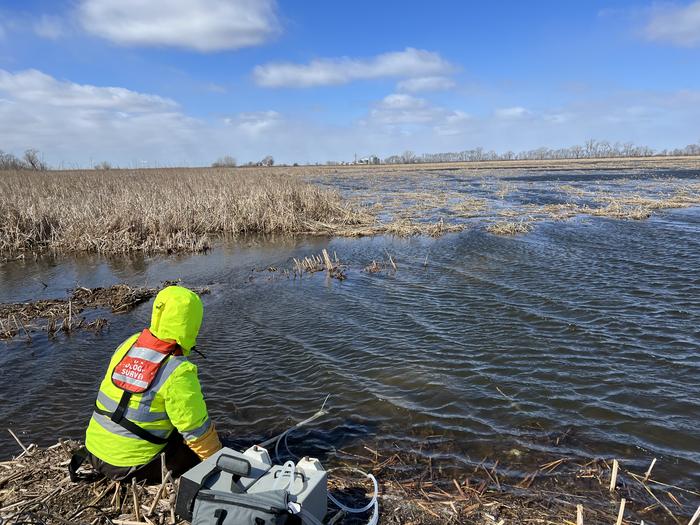
Credit: Adapted from Environmental Science & Technology Letters 2023, DOI: 10.1021/acs.estlett.3c00668
Recently, morning omelets and holiday dinners have gotten more expensive. One likely cause is bird flu, outbreaks of which led to the deaths of millions of chickens and turkeys from infection or culling in 2022, according to the U.S. Department of Agriculture, and which still demands rigorous monitoring of wild populations. Now, reporting in Environmental Science & Technology Letters, researchers have developed a method that detected infectious bird flu virus in wetlands frequented by waterfowl.
Wild birds represent a significant reservoir of avian influenza virus. While some viral strains don’t cause disease, the highly pathogenic avian influenza (HPAI) form can spread quickly and is often fatal. It spreads from wild birds that shed the pathogen through their feces into the environment, including the wetlands they inhabit. Detecting bird flu in these waters has proven challenging because infectious virus concentrations are often too low to be detected by most methods, leaving a significant gap in our understanding of viral transmission. To address this problem, Laura Hubbard at the U.S. Geological Survey and colleagues devised a multistep process to concentrate and identify infectious virus in environmental samples.
They tested their protocols on surface water samples taken twice in the spring of 2022 from four wetlands and a lake in Iowa. The team identified strains of infectious virus in samples from all four wetland sites in April, but not from the lake. Detection rates were significantly lower, however, when they tested the water samples for viral RNA (11.1%) using standard diagnostic protocols than when the same samples were inoculated into eggs and avian influenza virus was isolated and confirmed (66.7%). The researchers say these results highlight the need for improved RNA detection techniques to reduce the risk of false negatives.
Sequencing showed that most of the detected viral strains present in the water samples had low pathogenicity. One sample included HPAI, however, marking the first time this strain has been detected in a U.S. waterway, the researchers say. Just five weeks later, though, they did not detect avian influenza virus in any samples from the same sites despite previous research that demonstrated viral persistence for months in similar environments. The researchers suggest that the apparent absence of virus could be due to many environmental factors, including fewer waterfowl being present in May and substantially warmer water temperatures influencing virus survival.
Although further research is required to better understand the persistence and potential transmissibility of bird flu in wetlands, the researchers say the detection of HPAI virus and other strains highlights possible risks to wild and domestic fowl, other animals and even humans, who use these waterways recreationally. They also suggest that regular monitoring and early detection could help mitigate costly viral transmission and the rising cost of eggs and poultry.
The authors acknowledge funding from the U.S. Geological Survey through the Biological Threats and Environmental Health Programs of the Ecosystems Mission Area and from the Centers for Disease Control and Prevention, Influenza Division.
The paper’s abstract will be available on Nov. 15 at 8 a.m. Eastern time here: http://pubs.acs.org/doi/abs/10.1021/acs.estlett.3c00668
The American Chemical Society (ACS) is a nonprofit organization chartered by the U.S. Congress. ACS’ mission is to advance the broader chemistry enterprise and its practitioners for the benefit of Earth and all its people. The Society is a global leader in promoting excellence in science education and providing access to chemistry-related information and research through its multiple research solutions, peer-reviewed journals, scientific conferences, eBooks and weekly news periodical Chemical & Engineering News. ACS journals are among the most cited, most trusted and most read within the scientific literature; however, ACS itself does not conduct chemical research. As a leader in scientific information solutions, its CAS division partners with global innovators to accelerate breakthroughs by curating, connecting and analyzing the world’s scientific knowledge. ACS’ main offices are in Washington, D.C., and Columbus, Ohio.
To automatically receive news releases from the American Chemical Society, contact [email protected].
Follow us: Twitter | Facebook | LinkedIn | Instagram
Journal
Environmental Science & Technology Letters
DOI
10.1021/acs.estlett.3c00668
Article Title
Environmental Surveillance and Detection of Infectious Highly Pathogenic Avian Influenza Virus in Iowa Wetlands
Article Publication Date
15-Nov-2023