• HOME
  • NEWS
  • EXPLORE
    • CAREER
      • Companies
      • Jobs
    • EVENTS
    • iGEM
      • News
      • Team
    • PHOTOS
    • VIDEO
    • WIKI
  • BLOG
  • COMMUNITY
    • FACEBOOK
    • INSTAGRAM
    • TWITTER
Saturday, September 26, 2026
BIOENGINEER.ORG
No Result
View All Result
  • Login
  • HOME
  • NEWS
  • EXPLORE
    • CAREER
      • Companies
      • Jobs
        • Lecturer
        • PhD Studentship
        • Postdoc
        • Research Assistant
    • EVENTS
    • iGEM
      • News
      • Team
    • PHOTOS
    • VIDEO
    • WIKI
  • BLOG
  • COMMUNITY
    • FACEBOOK
    • INSTAGRAM
    • TWITTER
  • HOME
  • NEWS
  • EXPLORE
    • CAREER
      • Companies
      • Jobs
        • Lecturer
        • PhD Studentship
        • Postdoc
        • Research Assistant
    • EVENTS
    • iGEM
      • News
      • Team
    • PHOTOS
    • VIDEO
    • WIKI
  • BLOG
  • COMMUNITY
    • FACEBOOK
    • INSTAGRAM
    • TWITTER
No Result
View All Result
Bioengineer.org
No Result
View All Result
Home NEWS Science News Chemistry

Surprise twist suggests stars grow competitively

Bioengineer by Bioengineer
April 16, 2021
in Chemistry
Reading Time: 2 mins read
0
IMAGE
Share on FacebookShare on TwitterShare on LinkedinShare on RedditShare on Telegram

IMAGE

Credit: Takemura et al.

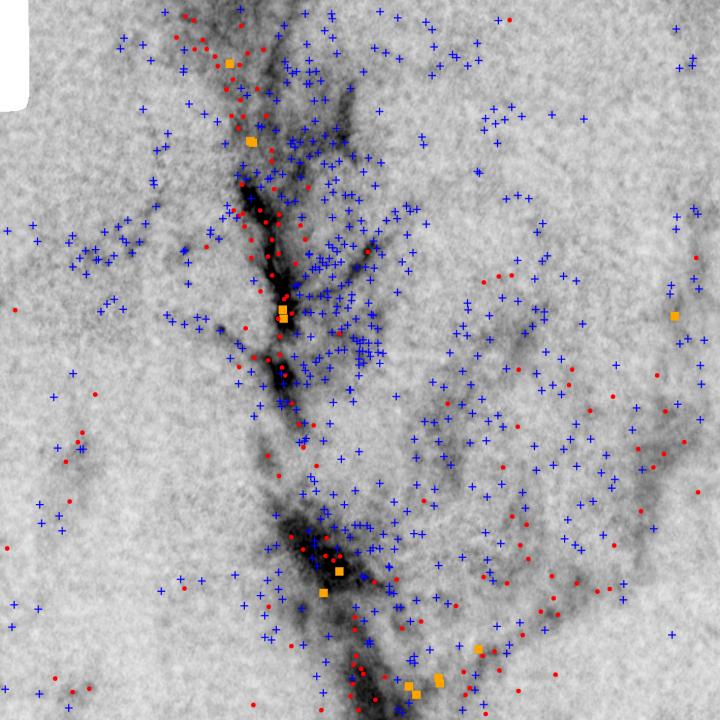
A survey of star formation activity in the Orion Nebula Cluster found similar mass distributions for newborn stars and dense gas cores, which may evolve into stars. Counterintuitively, this means that the amount of gas a core accretes as it develops, and not the initial mass of the core, is the key factor in deciding the final mass of the produced star.

The Universe is populated with stars of various masses. Dense cores in clouds of interstellar gas collapse under their own gravity to form stars, but what determines the final mass of the star remains an open question. There are two competing theories. In the core-collapse model, larger stars form from larger cores. In the competitive accretion model, all cores start out about the same mass but accrete different amounts of gas from the surroundings as they grow.

To distinguish between these two scenarios, a research team led by Hideaki Takemura at the National Astronomical Observatory of Japan created a map of the Orion Nebula Cluster where new stars are forming, based on data from the American CARMA interferometer and NAOJ’s own Nobeyama 45-m Radio Telescope. Thanks to the unprecedent high resolution of the map, the team was able to compare the masses of the newly formed stars and gravitationally collapsing dense cores. They found that the mass distributions are similar for the two populations. They also found many smaller cores which don’t have strong enough gravity to contract into stars.

One would think that similar mass distributions for prestellar cores and newborn stars would favor the core-collapse model, but actually because it is impossible for a core to impart all of its mass to a new star, this shows that continued gas inflow is an important factor, favoring the competitive accretion model.

Now the team will expand their map using additional data from CARMA and the Nobeyama 45-m Radio Telescope to see if the results from the Orion Nebula Cluster hold true for other regions.

###

These results appeared as Takemura et al. “The Core Mass Function in the Orion Nebula Cluster Region: What Determines the Final Stellar Masses?” in the Astrophysical Journal Letters on March 22, 2021.

Media Contact
Dr. Kenzo Kinugasa
[email protected]

Original Source

https://www.nao.ac.jp/en/news/science/2021/20210416-nro.html

Related Journal Article

http://dx.doi.org/10.3847/2041-8213/abe7dd

Tags: AstronomyAstrophysicsSpace/Planetary ScienceStars/The Sun
Share13Tweet8Share2ShareShareShare2

Related Posts

Pulsed Nickel Coating on Titanium Delivers a Durable, pH-Universal Hydrogen Catalyst

Pulsed Nickel Coating on Titanium Delivers a Durable, pH-Universal Hydrogen Catalyst

September 26, 2026
Cow Dung Yields Fulvic Acid That Kills E. coli in Early Lab Tests

Cow Dung Yields Fulvic Acid That Kills E. coli in Early Lab Tests

September 26, 2026

Century-Old Solvent Dichloromethane Emerges as Surprising Coupling Reagent for Amide Synthesis

September 26, 2026

Where the Vacancy Sits Decides Everything: Iron-Doped Ceria Cracks the Nitrogen Oxide Puzzle

September 26, 2026
Please login to join discussion

POPULAR NEWS

  • Rare-Earth Doping Turns Humble Perovskite Ceramic Into Water Purifier and Energy Storage Star

    29 shares
    Share 12 Tweet 7
  • Salt Marsh Microbes Hold Steady Through Day-Night Swings, Venice Lagoon Study Finds

    29 shares
    Share 12 Tweet 7
  • New Protocol Reveals Millions of Microplastic Clues Hidden in Greenhouse Soils

    29 shares
    Share 12 Tweet 7
  • Lanthanum Nanorods Deliver New Drug Candidate That Kills Parasitic Worms

    29 shares
    Share 12 Tweet 7

About

We bring you the latest biotechnology news from best research centers and universities around the world. Check our website.

Follow us

Recent News

Rare-Earth Doping Turns Humble Perovskite Ceramic Into Water Purifier and Energy Storage Star

Salt Marsh Microbes Hold Steady Through Day-Night Swings, Venice Lagoon Study Finds

New Protocol Reveals Millions of Microplastic Clues Hidden in Greenhouse Soils

Subscribe to Blog via Email

Enter your email address to subscribe to this blog and receive notifications of new posts by email.

Join 85 other subscribers
  • Contact Us

Bioengineer.org © Copyright 2023 All Rights Reserved.

Welcome Back!

Login to your account below

Forgotten Password?

Retrieve your password

Please enter your username or email address to reset your password.

Log In
No Result
View All Result
  • Homepages
    • Home Page 1
    • Home Page 2
  • News
  • National
  • Business
  • Health
  • Lifestyle
  • Science

Bioengineer.org © Copyright 2023 All Rights Reserved.