• HOME
  • NEWS
  • EXPLORE
    • CAREER
      • Companies
      • Jobs
    • EVENTS
    • iGEM
      • News
      • Team
    • PHOTOS
    • VIDEO
    • WIKI
  • BLOG
  • COMMUNITY
    • FACEBOOK
    • INSTAGRAM
    • TWITTER
Wednesday, August 19, 2026
BIOENGINEER.ORG
No Result
View All Result
  • Login
  • HOME
  • NEWS
  • EXPLORE
    • CAREER
      • Companies
      • Jobs
        • Lecturer
        • PhD Studentship
        • Postdoc
        • Research Assistant
    • EVENTS
    • iGEM
      • News
      • Team
    • PHOTOS
    • VIDEO
    • WIKI
  • BLOG
  • COMMUNITY
    • FACEBOOK
    • INSTAGRAM
    • TWITTER
  • HOME
  • NEWS
  • EXPLORE
    • CAREER
      • Companies
      • Jobs
        • Lecturer
        • PhD Studentship
        • Postdoc
        • Research Assistant
    • EVENTS
    • iGEM
      • News
      • Team
    • PHOTOS
    • VIDEO
    • WIKI
  • BLOG
  • COMMUNITY
    • FACEBOOK
    • INSTAGRAM
    • TWITTER
No Result
View All Result
Bioengineer.org
No Result
View All Result
Home NEWS Science News Chemistry

Support drives fate of protected gold nanoclusters as catalysts

Bioengineer by Bioengineer
June 16, 2020
in Chemistry
Reading Time: 3 mins read
0
IMAGE
Share on FacebookShare on TwitterShare on LinkedinShare on RedditShare on Telegram

IMAGE

Credit: The University of Jyväskylä

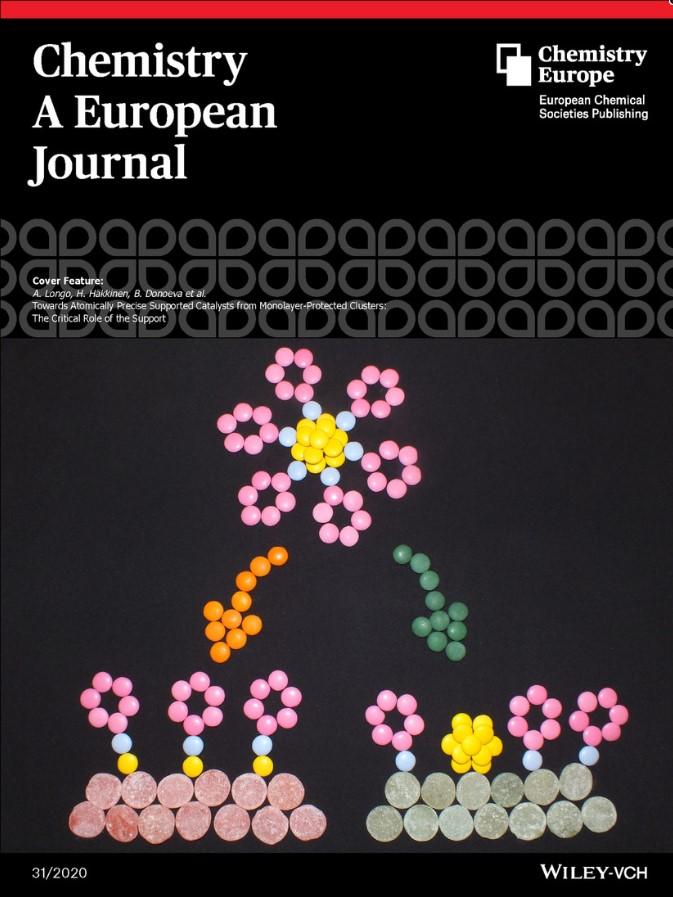
In collaboration with experimentalists from Ghent University, Belgium and Utrecht University, Netherlands, researchers at the Nanoscience Center (NSC) at the University of Jyväskylä, have recently discovered that the choice of a support material for model catalysts, made from gold nanoclusters protected by organic molecules, may have drastic effects on the structure of the catalyst. On certain supports, the clusters completely disintegrate, while on others, the organic protective layer peels away leaving behind the intact metallic nanoclusters that can act as catalysts for a desired reaction. The research was published in Chemistry-A European Journal (2020).

Catalysts are important to produce chemicals used in our daily lives. They save a lot of energy and make chemical reactions faster as compared to their uncatalysed counterparts.

Nanomaterials, especially metallic nanoclusters are widely used owing to their high efficiency and are generally placed on an inactive oxide support for these applications. However, these nanoclusters are at times less stable, and are protected hence with a layer of organic molecules. The present study is an important step towards the design, control, and synthesis of atomically precise supported catalysts with tailored physical and chemical properties.

Gold nanoclusters (Aun) of different sizes protected by phosphine organic molecules were deposited on four different supports and their properties were measured using X-ray absorption spectroscopy. On Bronsted acid supports (surfaces that have the tendency to give away protons), the clusters were completely fragmented breaking up the Au cluster, while on Lewis acid supports (surfaces that have the tendency to gain electrons) the phosphine organic layer peeled away leaving the metallic Aun cluster preserving the original size of the cluster.

The theoretical models developed in Jyväskylä explained the experimental observations by studying the charge transfer between the support and the clusters.

This study was published in the international publication series Chemistry-A European Journal and recognized as a “hot” paper. An image describing the work was also selected as a cover feature in the journal’s recent issue of June 2, 2020.

In Jyväskylä, post doctoral researcher Nisha Mammen, Professor Karoliina Honkala, and Academy Professor Hannu Häkkinen were responsible for the theoretical part of the work. The research was supported by the Academy of Finland. The computer simulations in the study were carried out in the local university supercomputers as well as those of the CSC – IT Center for Science.

###

Link to the research in Chemistry-A European Journal:
https://chemistry-europe.onlinelibrary.wiley.com/doi/full/10.1002/chem.202000637

Website for Academy Professor Hannu Häkkinen’s research group:
https://www.jyu.fi/science/en/nanoscience-center/research/nanoclusters

Website for Professor Karoliina Honkala’s research group:
https://www.jyu.fi/science/en/chemistry/research/computational-chemistry-and-spectroscopy/catalysis

Graphics in cover image: Nisha Mammen/the University of Jyväskylä

For further information:

Academy Professor Hannu Häkkinen, tel. +358 400 247 973, [email protected]

Communications Specialist Tanja Heikkinen, [email protected], tel. 358 50 581 8351

The Faculty of Mathematics and Science:

https://www.jyu.fi/science/en

FB: jyuscience Twitter: jyscience

Media Contact
Hannu Häkkinen
[email protected]

Original Source

https://www.jyu.fi/en/current/archive/2020/06/support-drives-fate-of-protected-gold-nanoclusters-as-catalysts

Related Journal Article

http://dx.doi.org/10.1002/chem.202000637

Tags: Chemistry/Physics/Materials SciencesComputer ScienceMolecular PhysicsNanotechnology/Micromachines
Share12Tweet8Share2ShareShareShare2

Related Posts

Dynamic duo weaves hierarchical DNA materials using two classes of biomolecular nanomachines

Dynamic duo weaves hierarchical DNA materials using two classes of biomolecular nanomachines

August 19, 2026
Generating and transferring nitrenes enables unnatural biosynthesis in living cells

Generating and transferring nitrenes enables unnatural biosynthesis in living cells

August 19, 2026

KAIST Transforms Troublesome Protons into Battery Energy-Storage Resources

August 19, 2026

Tuning Endergonic Triplet Photosensitization Enables Bicyclo[1.1.0]butane–Alkene Cycloadditions

August 19, 2026
Please login to join discussion

POPULAR NEWS

  • New necroferrins strategy simultaneously targets necroptosis and ferroptosis

    29 shares
    Share 12 Tweet 7
  • Delayed Bioorthogonal-Like STING Activation Enhances mRNA Vaccine Antitumor Immunity

    29 shares
    Share 12 Tweet 7
  • Flowering Plants’ Taxonomic Traits Reveal a Globally Consistent Biogeographic Pattern

    29 shares
    Share 12 Tweet 7
  • Cortical thinning precedes high amyloid levels by at least seven years

    29 shares
    Share 12 Tweet 7

About

We bring you the latest biotechnology news from best research centers and universities around the world. Check our website.

Follow us

Recent News

New necroferrins strategy simultaneously targets necroptosis and ferroptosis

Delayed Bioorthogonal-Like STING Activation Enhances mRNA Vaccine Antitumor Immunity

Flowering Plants’ Taxonomic Traits Reveal a Globally Consistent Biogeographic Pattern

Subscribe to Blog via Email

Enter your email address to subscribe to this blog and receive notifications of new posts by email.

Join 85 other subscribers
  • Contact Us

Bioengineer.org © Copyright 2023 All Rights Reserved.

Welcome Back!

Login to your account below

Forgotten Password?

Retrieve your password

Please enter your username or email address to reset your password.

Log In
No Result
View All Result
  • Homepages
    • Home Page 1
    • Home Page 2
  • News
  • National
  • Business
  • Health
  • Lifestyle
  • Science

Bioengineer.org © Copyright 2023 All Rights Reserved.