• HOME
  • NEWS
  • EXPLORE
    • CAREER
      • Companies
      • Jobs
    • EVENTS
    • iGEM
      • News
      • Team
    • PHOTOS
    • VIDEO
    • WIKI
  • BLOG
  • COMMUNITY
    • FACEBOOK
    • INSTAGRAM
    • TWITTER
Friday, June 26, 2026
BIOENGINEER.ORG
No Result
View All Result
  • Login
  • HOME
  • NEWS
  • EXPLORE
    • CAREER
      • Companies
      • Jobs
        • Lecturer
        • PhD Studentship
        • Postdoc
        • Research Assistant
    • EVENTS
    • iGEM
      • News
      • Team
    • PHOTOS
    • VIDEO
    • WIKI
  • BLOG
  • COMMUNITY
    • FACEBOOK
    • INSTAGRAM
    • TWITTER
  • HOME
  • NEWS
  • EXPLORE
    • CAREER
      • Companies
      • Jobs
        • Lecturer
        • PhD Studentship
        • Postdoc
        • Research Assistant
    • EVENTS
    • iGEM
      • News
      • Team
    • PHOTOS
    • VIDEO
    • WIKI
  • BLOG
  • COMMUNITY
    • FACEBOOK
    • INSTAGRAM
    • TWITTER
No Result
View All Result
Bioengineer.org
No Result
View All Result
Home NEWS Science News Biology

Superfood for Mesozoic herbivores? Emerging data on extreme digestibility of equisetum and implications for young, growing herbivorous sauropods

Bioengineer by Bioengineer
November 8, 2019
in Biology
Reading Time: 2 mins read
0
IMAGE
Share on FacebookShare on TwitterShare on LinkedinShare on RedditShare on Telegram

IMAGE

Credit: C.T. Gee


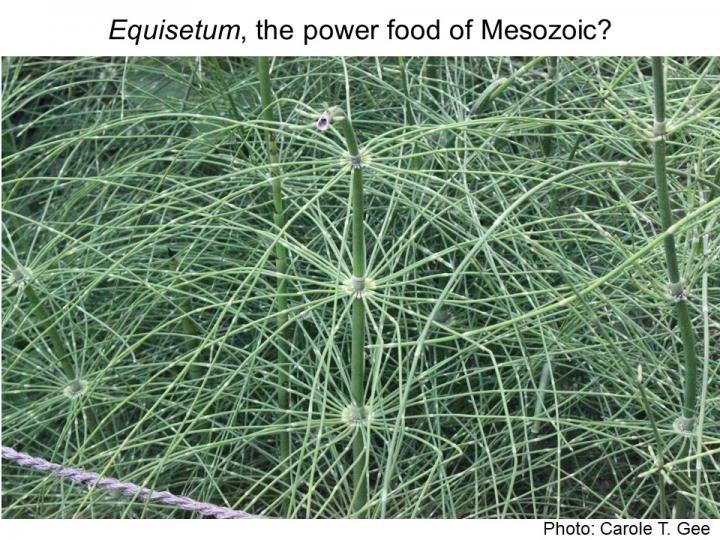
The long-necked, big bodied sauropod dinosaurs comprise some of the largest terrestrial vertebrates to walk the earth. These behemoths were herbivores that survived solely on plant material. There has been long speculation as to what food resources could have supported their size, particularly when young and growing fast. New research being presented at this year’s annual meeting of the Society of Vertebrate Paleontology held this year in Brisbane, Australia by lead author, Carole Gee, University of Bonn, Germany, points to a plant commonly known as the horsetail.

Equisetum is a spore-bearing plant commonly known as the “scouring rush” or “horsetail,” and close relatives of the modern genus are known in the fossil record as far back as the Triassic. Gee and co-authors studied the digestive fermentation and comparative calorie yield of seven extant species of Equisetum for living herbivores using a standardized feed evaluation test. Their data confirm earlier studies that suggest Equisetum was an important, highly digestible, nutritious, and therefore preferred food source for herbivorous dinosaurs in Mesozoic times. “My approach to understanding the paleobiology of ancient plants and deep-time plant-animal interactions is not only to look at paleontology, but also to include studies of living plants and their ecology, as well as the dietary habits of living animals,” says Gee.

In this study, Gee and her colleagues turn their attention to the diets of hatchling and young sauropods, as well as other small-stature herbivorous dinosaurs. “Up to now, plants used as likely food resources have only been studied for fully-grown sauropods,” Dee stated. Young and growing sauropods grow very quickly, recognizing the value of Equisetum as a major food source for young and growing sauropods is extremely important in learning more about their growth. Gee and her colleagues began research on the comparative value of the nearest living relatives of the Jurassic flora as dinosaur fodder about a decade ago within the framework of a Research Unit on the Biology of the Sauropod Dinosaurs, funded by the German Research Foundation.

###

About the Society of Vertebrate Paleontology

Founded in 1940 by thirty-four paleontologists, the Society now has more than 2,300 members representing professionals, students, artists, preparators, and others interested in VP. It is organized exclusively for educational and scientific purposes, with the object of advancing the science of vertebrate paleontology.
Journal Web site: Society of Vertebrate Paleontology: http://www.vertpaleo.org

Media Contact
Serena Weisman
[email protected]
301-634-7036

Tags: BiologyPaleontology
Share16Tweet10Share3ShareShareShare2

Related Posts

Natural Hallucinogens: Evolution’s Ecological Tools, Not Mere Chemical Byproducts

June 25, 2026

This Famous Butterfly Revealed: Three Distinct Species Hidden in One

June 25, 2026

Scientists Attack Soybean Cyst Nematode by Starving Its Food Source

June 25, 2026

Decoding the Secret Code of a Crucial Immune Sensor

June 24, 2026
Please login to join discussion

POPULAR NEWS

  • Saying Goodbye to PGY-6: Pediatric Fellowship Realities

    103 shares
    Share 41 Tweet 26
  • Multi-Hospital Study Reveals Long Covid Burden Is Twice as High as Current Estimates

    92 shares
    Share 36 Tweet 23
  • Detection of EDCs in Breast Milk and Infant Urine Up to Six Months Highlights Early Exposure Risks

    77 shares
    Share 31 Tweet 19
  • New Drug Candidate Developed at McMaster Shows Potential for Treating Brain Cancer

    58 shares
    Share 23 Tweet 15

About

We bring you the latest biotechnology news from best research centers and universities around the world. Check our website.

Follow us

Recent News

Tracking Lanthanide-Labeled Microplastics in Plants

POSTECH Researchers Slash Cost of Reconstituted Cell-Free Systems by 95%

AI and Physics Collaborate to Design Advanced Hydrogen Storage Materials

Subscribe to Blog via Email

Success! An email was just sent to confirm your subscription. Please find the email now and click 'Confirm' to start subscribing.

Join 82 other subscribers
  • Contact Us

Bioengineer.org © Copyright 2023 All Rights Reserved.

Welcome Back!

Login to your account below

Forgotten Password?

Retrieve your password

Please enter your username or email address to reset your password.

Log In
No Result
View All Result
  • Homepages
    • Home Page 1
    • Home Page 2
  • News
  • National
  • Business
  • Health
  • Lifestyle
  • Science

Bioengineer.org © Copyright 2023 All Rights Reserved.