• HOME
  • NEWS
  • EXPLORE
    • CAREER
      • Companies
      • Jobs
    • EVENTS
    • iGEM
      • News
      • Team
    • PHOTOS
    • VIDEO
    • WIKI
  • BLOG
  • COMMUNITY
    • FACEBOOK
    • INSTAGRAM
    • TWITTER
Saturday, June 6, 2026
BIOENGINEER.ORG
No Result
View All Result
  • Login
  • HOME
  • NEWS
  • EXPLORE
    • CAREER
      • Companies
      • Jobs
        • Lecturer
        • PhD Studentship
        • Postdoc
        • Research Assistant
    • EVENTS
    • iGEM
      • News
      • Team
    • PHOTOS
    • VIDEO
    • WIKI
  • BLOG
  • COMMUNITY
    • FACEBOOK
    • INSTAGRAM
    • TWITTER
  • HOME
  • NEWS
  • EXPLORE
    • CAREER
      • Companies
      • Jobs
        • Lecturer
        • PhD Studentship
        • Postdoc
        • Research Assistant
    • EVENTS
    • iGEM
      • News
      • Team
    • PHOTOS
    • VIDEO
    • WIKI
  • BLOG
  • COMMUNITY
    • FACEBOOK
    • INSTAGRAM
    • TWITTER
No Result
View All Result
Bioengineer.org
No Result
View All Result
Home NEWS Science News Chemistry

Supercomputers use graphics processors to solve longstanding turbulence question

Bioengineer by Bioengineer
July 25, 2019
in Chemistry
Reading Time: 2 mins read
0
IMAGE
Share on FacebookShare on TwitterShare on LinkedinShare on RedditShare on Telegram

IMAGE

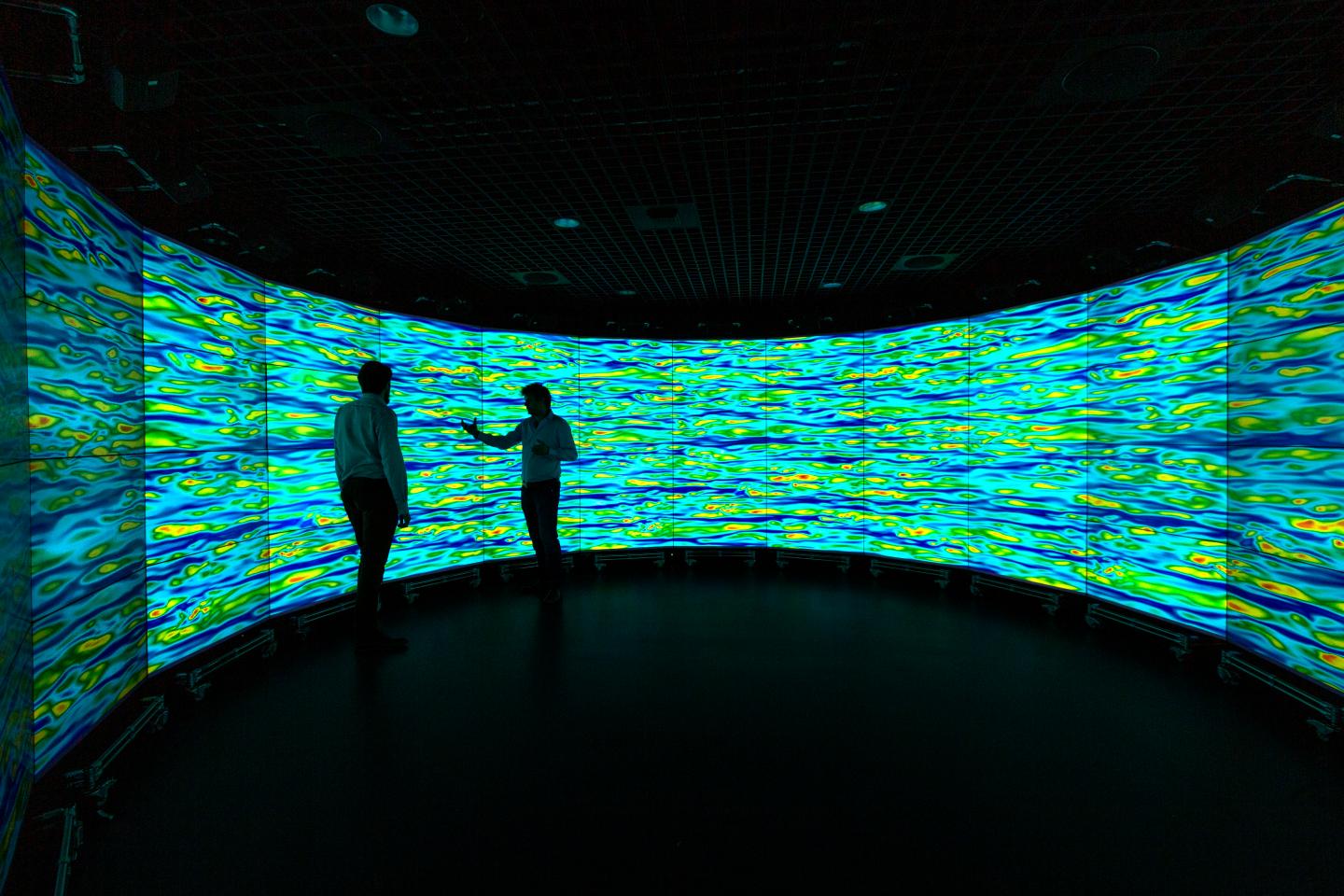
Credit: Thomas Angus / Imperial College London

Advanced simulations have solved a problem in turbulent fluid flow that could lead to more efficient turbines and engines.

When a fluid, such as water or air, flows fast enough, it will experience turbulence – seemingly random changes in velocity and pressure within the fluid.

Turbulence is extremely difficult to study but is important for many fields of engineering, such as air flow past wind turbines or jet engines.
Understanding turbulence better would allow engineers to design more efficient turbine blades, for example, or make more aerodynamic shapes for Formula 1 cars.

However, current engineering models of turbulence often rely upon ’empirical’ relationships based on previous observations of turbulence to predict what will happen, rather than a full understanding of the underlying physics.

This is because the underlying physics is immensely complicated, leaving many questions that seem simple unsolved.

Now, researchers at Imperial College London have used supercomputers, running simulations on graphics processors originally developed for gaming, to solve a longstanding question in turbulence.

Their result, published today in the Journal of Fluid Mechanics, means empirical models can be tested and new models can be created, leading to more optimal designs in engineering.

Co-author Dr Peter Vincent, from the Department of Aeronautics at Imperial, said: “We now have a solution for an important fundamental flow problem. This means we can check empirical models of turbulence against the ‘correct’ answer, to see how well they are describing what actually happens, or if they need adjusting.”

The question is quite simple: if a turbulent fluid is flowing in a channel and it is disturbed, how does that disturbance dissipate in the fluid? For example, if water was suddenly released from a dam into a river and then shut off, what affect would that pulse of dam water have on the flow of the river?

To determine the overall ‘average’ behaviour of the fluid response, the team needed to simulate the myriad smaller responses within the fluid. They used supercomputers to run thousands of turbulent flow simulations, each requiring billions of calculations to complete.

Using these simulations, they were able to determine the exact parameters that describe how the disturbance dissipates in the flow and determined various requirements that empirical turbulence models must satisfy.

Co-author Professor Sergei Chernyshenko, from the Department of Aeronautics at Imperial, said: “From my first days studying fluid mechanics I had some fundamental questions that I wanted to know the answers to. This was one of them, and now after 40 years I have the answer.”

###

Media Contact
Hayley Dunning
[email protected]

Original Source

https://www.imperial.ac.uk/news/192147/supercomputers-graphics-processors-solve-longstanding-turbulence/

Related Journal Article

http://dx.doi.org/10.1017/jfm.2019.520

Tags: Calculations/Problem-SolvingChemistry/Physics/Materials SciencesHardwareTechnology/Engineering/Computer Science
Share12Tweet8Share2ShareShareShare2

Related Posts

Catalytic Endo-Stereoselective [2+2] Norbornadiene-Alkyne Cycloaddition — Chemistry

Catalytic Endo-Stereoselective [2+2] Norbornadiene-Alkyne Cycloaddition

June 6, 2026
Cyclophane Shields Singly Dispersed Graphene Nanoribbons — Chemistry

Cyclophane Shields Singly Dispersed Graphene Nanoribbons

June 6, 2026

Satellite X-ray Telescopes Set to Map Lunar Surface Chemistry Within Years

June 6, 2026

Divergent, Precise Alkaloid Remodelling via Few Reactions

June 5, 2026
Please login to join discussion

POPULAR NEWS

  • ESMO 2025: mRNA COVID Vaccines Enhance Efficacy of Cancer Immunotherapy

    322 shares
    Share 129 Tweet 81
  • Multi-Hospital Study Reveals Long Covid Burden Is Twice as High as Current Estimates

    89 shares
    Share 35 Tweet 22
  • Saying Goodbye to PGY-6: Pediatric Fellowship Realities

    80 shares
    Share 32 Tweet 20
  • Common Food Preservatives Associated with Elevated Blood Pressure and Increased Heart Disease Risk

    57 shares
    Share 23 Tweet 14

About

We bring you the latest biotechnology news from best research centers and universities around the world. Check our website.

Follow us

Recent News

Frontal Aslant Tract Evolution Shapes Primate Speech

3D Transient Thermal Barcode Identifies Waste Plastic

Pain and Neuropsychiatric Symptoms in Dementia Patients

Subscribe to Blog via Email

Enter your email address to subscribe to this blog and receive notifications of new posts by email.

Join 82 other subscribers
  • Contact Us

Bioengineer.org © Copyright 2023 All Rights Reserved.

Welcome Back!

Login to your account below

Forgotten Password?

Retrieve your password

Please enter your username or email address to reset your password.

Log In
No Result
View All Result
  • Homepages
    • Home Page 1
    • Home Page 2
  • News
  • National
  • Business
  • Health
  • Lifestyle
  • Science

Bioengineer.org © Copyright 2023 All Rights Reserved.