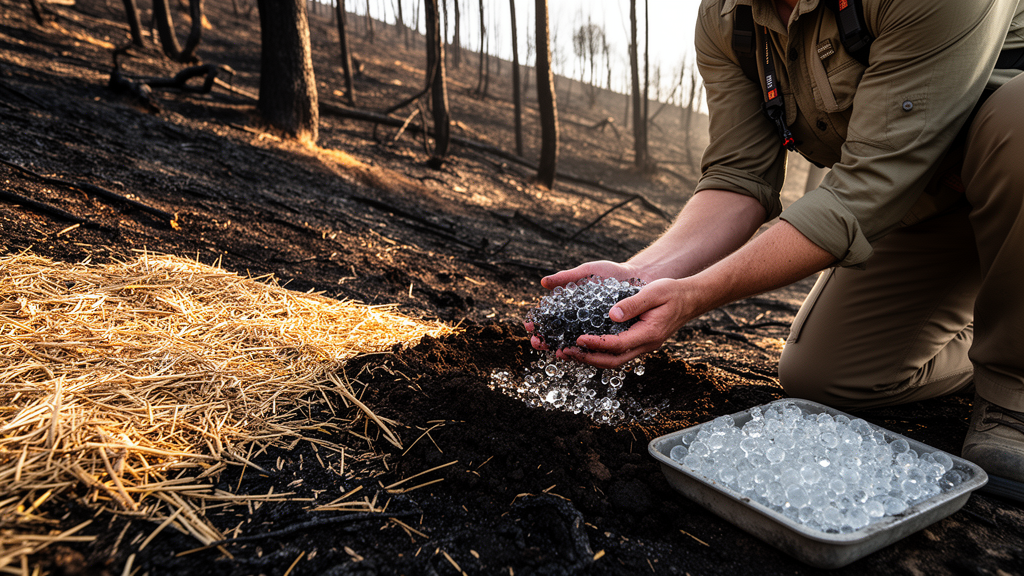
Superabsorbent polymers, widely promoted as soil amendments to help plants survive drought, deliver a strikingly mixed performance in one of the harshest environments for revegetation: land scarred by coalfield fires. A new peer-reviewed study reports that while the polymers substantially boost how much water soil can hold, they extend the time that water remains available by only one to two days, and repeated wetting and drying permanently degrades their absorbing capacity, especially in saline conditions.
The research, published open access in Geomechanics and Geophysics for Geo-Energy and Geo-Resources on 14 October 2026, tested three superabsorbent polymers, labelled A, B and C, at concentrations of 0%, 0.1%, 0.3%, 0.5% and 1%. The team evaluated effects on soil hydraulic properties, the soil-water characteristic curve, soil aggregate microstructure and resistance to skidding or sliding.
Revegetating arid coalfield fire areas is difficult for several compounding reasons: water is scarce, salinity is high, and soil erosion is severe. Superabsorbent polymers are generally effective soil improvers elsewhere, but their behaviour in this specific environment had been under-researched, which motivated the systematic laboratory comparison.
On the positive side of the ledger, the polymers significantly increased the soil’s largest water-holding ratio, by amounts ranging from 4.41% to 68.82%, a result the authors report as statistically significant at p < 0.05. When matric suction was below the permanent wilting point of 1500 kPa, the treated soils retained between 19.99% and 248.09% more water than untreated controls, again with statistical significance.
Yet the gains in water availability proved short-lived. The extension of water retention time amounted to only one to two days. The study also documented a hidden cost: each cycle of water absorption and loss caused a permanent reduction in the polymers’ water absorption capacity, ranging from 5.61% to 30.60%, and salinity worsened this deterioration.
The polymers improved soil aggregate formation and anti-sliding performance, raising the critical sliding angle from 45 degrees to 60 degrees. The Type B treatment group showed significantly less sliding than the control, suggesting a genuine role for these materials in holding fragile fire-damaged slopes in place.
Framing their results through what the authors call a water-structure-mechanics multi-dimensional perspective, the study identifies two core dilemmas of traditional superabsorbent polymers in extreme environments: short water retention time and structural deterioration of the polymer itself. At the same time, it confirms a strengthening effect that could support soil and water conservation on unstable slopes.
From these findings the authors propose a design concept for a new class of material: a salt-resistant and structurally stable superabsorbent polymer. Such a product would need to withstand repeated absorption-desorption cycles without losing capacity and resist the chemical attack of saline soils, addressing precisely the weaknesses documented in the current tests.
The work is presented as a theoretical basis and technical reference for developing and engineering ecological restoration materials for coalfield fire areas. Because the reported results come from controlled testing of three polymer types at defined concentrations, field performance in actual fire-affected terrain remains to be demonstrated, and the published version notes that this early-release article is subject to further edits before the final version of record.
For land managers, the practical message is one of tempered expectations. The study’s paradox, that the same material both disappoints on water supply and excels on mechanical reinforcement, now sets a clear specification for the next generation of restoration polymers.
Subject of Research: Effects of superabsorbent polymers on soil water retention and slope stability in coalfield fire areas
Article Title: Paradoxical effects of superabsorbent polymers on coalfield fire area slopes: water retention limitations versus mechanical reinforcement
Article References: Zheng, Q., Kong, D., Wang, Y., Jin, J., Wu, J., Li, Z., Wang, S., Zeng, Q., & Li, C. (2026). Paradoxical effects of superabsorbent polymers on coalfield fire area slopes: water retention limitations versus mechanical reinforcement. Geomechanics and Geophysics for Geo-Energy and Geo-Resources. https://doi.org/10.1007/s40948-026-01261-0
Image Credits: AI Generated
DOI: 10.1007/s40948-026-01261-0
Keywords: superabsorbent polymers, coalfield fires, soil water retention, slope stability, soil-water characteristic curve, salinity, soil aggregates, revegetation, soil erosion, matric suction, arid soils, ecological restoration
News Source: Denise Maddox. (October 28, 2026). Superabsorbent Polymers Hold Water Briefly but Strengthen Fire-Area Slopes. Scienmag.