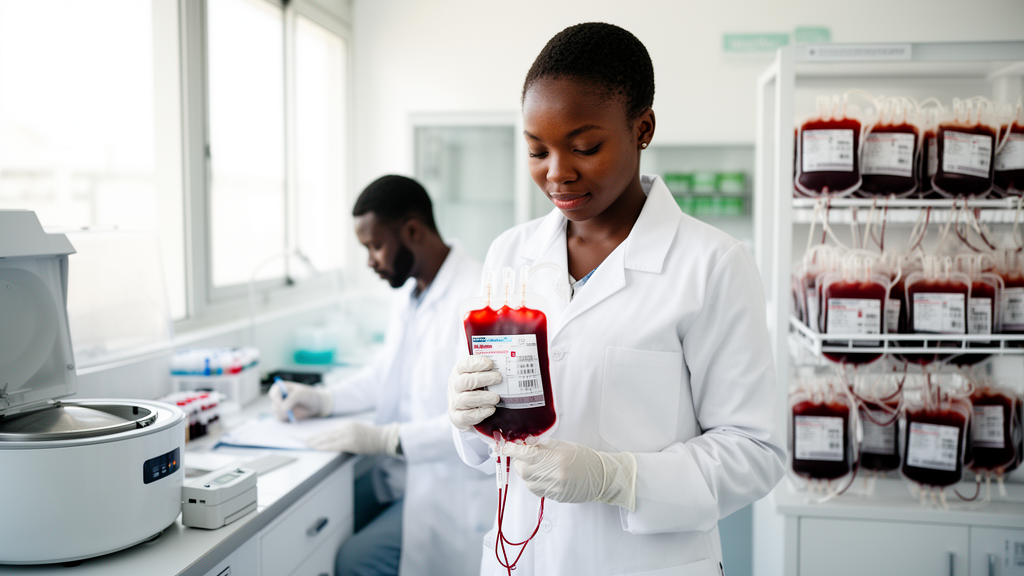
A national blood service in sub-Saharan Africa has mapped, minute by minute, how long it takes to turn a donated unit of blood into a finished component ready for patients. The time-driven process mapping study, published in BMC Health Services Research, breaks the production cycle into four sequential stages: donor recruitment, blood collection, blood processing and testing, and storage and dispatch.
The scale of the complexity is striking. At the donor recruitment stage alone, the researchers enumerated 31 distinct client pathways, a figure that reflects how many different routes a prospective donor can take through mobilization approaches and collection sites before ever reaching a donation chair.
Timing varied widely at that first stage. Active organization time for donor recruitment ranged from 6 to 148 minutes, depending on the mobilization approach and the site. That spread, the authors note, is a key source of variability in the overall system, since recruitment is the entry point for every unit that follows.
Once donors arrive, the process becomes more predictable. Blood collection followed a consistent patient flow regardless of site, with an optimal completion time of approximately 31 minutes. The e-Delphyn blood donor management system supported data capture at both static and mobile collection sites, allowing the team to record active process times guided by a time-driven data collection framework.
Downstream, the clock slows again. Under minimum batch conditions, blood processing and testing required a minimum of 113 minutes. This stage depends on batching, meaning that smaller batches cannot compress the time needed for processing and testing below that floor.
The production of individual components showed the widest range of any stage. Packed red blood cells prepared via platelet-rich plasma extraction took as little as 15 minutes, while cryoprecipitate required a minimum of 555 minutes, nearly nine and a half hours, from start to finish.
By embedding these measured process times into the mapping framework, the study demonstrates how variability at each stage shapes overall system efficiency. A delay at recruitment, a slow collection session, or a long cryoprecipitate production run each propagates differently through the cycle, and the granular timings make those differences visible for the first time in this setting.
The authors describe their results as the first granular, evidence-based foundation for informing efficiency analysis and resource allocation across blood services in sub-Saharan Africa and other low- and middle-income countries. The work was conducted within a non-remunerated volunteer donor-based system, and the mapping covers the full production cycle from donor recruitment through storage and dispatch.
As a single-service process mapping exercise, the study documents planned and observed operational times rather than testing interventions to improve them. Its value lies in the baseline: with 31 recruitment pathways, a 31-minute collection optimum, a 113-minute processing minimum, and component times spanning 15 to 555 minutes, blood services in the region now have a quantified reference point against which their own operational efficiency can be measured and improved.
Subject of Research: Time-driven process mapping of blood component production times at a national blood service in sub-Saharan Africa
Article Title: Operational efficiency in blood component production: time-driven process mapping study from a national blood service in sub-Saharan Africa
Article References: Nyamasve, J. G., Mapako, T., Mutenherwa, M., Chikwereti, R., Marowa, L. M., Saira, T., Zuze, M., Mashinya, E., Nkomo, S., & Shamu, S. (2026). Operational efficiency in blood component production: time-driven process mapping study from a national blood service in sub-Saharan Africa. BMC Health Services Research. https://doi.org/10.1186/s12913-026-15964-3
Image Credits: AI Generated
DOI: 10.1186/s12913-026-15964-3
Keywords: blood service, blood components, process mapping, donor recruitment, blood collection, blood processing, cryoprecipitate, packed red blood cells, operational efficiency, sub-Saharan Africa, LMIC, health services research
News Source: Ophelia Keating. (October 28, 2026). Mapping the clock: how long blood production really takes in an African blood service. Scienmag.