• HOME
  • NEWS
  • EXPLORE
    • CAREER
      • Companies
      • Jobs
    • EVENTS
    • iGEM
      • News
      • Team
    • PHOTOS
    • VIDEO
    • WIKI
  • BLOG
  • COMMUNITY
    • FACEBOOK
    • INSTAGRAM
    • TWITTER
Sunday, May 10, 2026
BIOENGINEER.ORG
No Result
View All Result
  • Login
  • HOME
  • NEWS
  • EXPLORE
    • CAREER
      • Companies
      • Jobs
        • Lecturer
        • PhD Studentship
        • Postdoc
        • Research Assistant
    • EVENTS
    • iGEM
      • News
      • Team
    • PHOTOS
    • VIDEO
    • WIKI
  • BLOG
  • COMMUNITY
    • FACEBOOK
    • INSTAGRAM
    • TWITTER
  • HOME
  • NEWS
  • EXPLORE
    • CAREER
      • Companies
      • Jobs
        • Lecturer
        • PhD Studentship
        • Postdoc
        • Research Assistant
    • EVENTS
    • iGEM
      • News
      • Team
    • PHOTOS
    • VIDEO
    • WIKI
  • BLOG
  • COMMUNITY
    • FACEBOOK
    • INSTAGRAM
    • TWITTER
No Result
View All Result
Bioengineer.org
No Result
View All Result
Home NEWS Science News Chemistry

Subaru Telescope helps find dark matter is not made up of tiny black holes

Bioengineer by Bioengineer
April 2, 2019
in Chemistry
Reading Time: 3 mins read
0
IMAGE
Share on FacebookShare on TwitterShare on LinkedinShare on RedditShare on Telegram

IMAGE

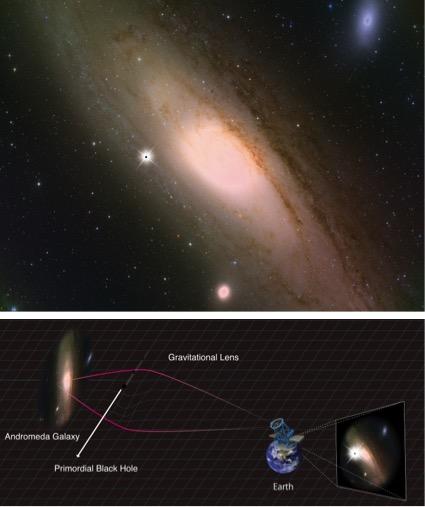
Credit: Kavli IPMU

An international team of researchers has put a theory speculated by the late Stephen Hawking to its most rigorous test to date, and their results have ruled out the possibility that primordial black holes smaller than a tenth of a millimeter make up most of dark matter. Details of their study have been published in this week’s Nature Astronomy.

Scientists know that 85 per cent of the matter in the Universe is made up of dark matter. Its gravitational force prevents stars in our Milky Way from flying apart. However, attempts to detect such dark matter particles using underground experiments, or accelerator experiments including the world’s largest accelerator, the Large Hadron Collider, have failed so far.

This has led scientists to consider Hawking’s 1974 theory of the existence of primordial black holes, born shortly after the Big Bang, and his speculation that they could make up a large fraction of the elusive dark matter scientists are trying to discover today.

An international team of researchers, led by Kavli Institute for the Physics and Mathematics of the Universe Principal Investigator Masahiro Takada, PhD candidate student Hiroko Niikura, Professor Naoki Yasuda, and including researchers from Japan, India and the US, have used the gravitational lensing effect to look for primordial black holes between Earth and the Andromeda galaxy. Gravitational lensing, an effect first suggested by Albert Einstein, manifests itself as the bending of light rays coming from a distant object such as a star due to the gravitational effect of an intervening massive object such as a primordial black hole. In extreme cases, such light bending causes the background star to appear much brighter than it originally is.

However, gravitational lensing effects are very rare events because it requires a star in the Andromeda galaxy, a primordial black hole acting as the gravitational lens, and an observer on Earth to be exactly in line with one another. So to maximize the chances of capturing an event, the researchers used the Hyper Suprime-Cam digital camera on the Subaru telescope in Hawaii, which can capture the whole image of the Andromeda galaxy in one shot. Taking into account how fast primordial black holes are expected to move in interstellar space, the team took multiple images to be able to catch the flicker of a star as it brightens for a period of a few minutes to hours due to gravitational lensing.

From 190 consecutive images of the Andromeda galaxy taken over seven hours during one clear night, the team scoured the data for potential gravitational lensing events. If dark matter consists of primordial black holes of a given mass, in this case masses lighter than the moon, the researchers expected to find about 1000 events. But after careful analyses, they could only identify one case. The team’s results showed primordial black holes can contribute no more than 0.1 per cent of all dark matter mass. Therefore, it is unlikely the theory is true.

The researchers are now planning to further develop their analysis of the Andromeda galaxy. One new theory they will investigate is to find whether binary black holes discovered by gravitational wave detector LIGO are in fact primordial black holes.

###

Media Contact
Motoko Kakubayashi
[email protected]

Original Source

https://www.ipmu.jp/en/20190402-PridmordialBlackHole

Related Journal Article

http://dx.doi.org/10.1038/s41550-019-0723-1

Tags: AstronomyAstrophysicsSpace/Planetary ScienceStars/The Sun
Share12Tweet8Share2ShareShareShare2

Related Posts

Miniature Sensor Uses Light to Detect Touch — Chemistry

Miniature Sensor Uses Light to Detect Touch

May 8, 2026
Iron Minerals Determine Whether Dissolved Organic Matter Fuels Microbes or Becomes Long-Term Carbon Storage — Chemistry

Iron Minerals Determine Whether Dissolved Organic Matter Fuels Microbes or Becomes Long-Term Carbon Storage

May 8, 2026

Kate Evans Appointed Associate Lab Director for Biological and Environmental Systems Science at ORNL

May 8, 2026

Advancing Multiscale Modeling and Overcoming Operational Challenges in Autothermal COâ‚‚-to-Methanol Reactors

May 8, 2026
Please login to join discussion

POPULAR NEWS

  • Research Indicates Potential Connection Between Prenatal Medication Exposure and Elevated Autism Risk

    840 shares
    Share 336 Tweet 210
  • New Study Reveals Plants Can Detect the Sound of Rain

    727 shares
    Share 290 Tweet 181
  • Scientists Investigate Possible Connection Between COVID-19 and Increased Lung Cancer Risk

    68 shares
    Share 27 Tweet 17
  • Salmonella Haem Blocks Macrophages, Boosts Infection

    61 shares
    Share 24 Tweet 15

About

We bring you the latest biotechnology news from best research centers and universities around the world. Check our website.

Follow us

Recent News

Evaluating Digoxin Use in Patients with Symptomatic Rheumatic Heart Disease

Evaluating the Effectiveness and Safety of Digitalis Glycosides in Treating Heart Failure

Urdu Fall Risk Questionnaire Adapted for Elderly

Subscribe to Blog via Email

Enter your email address to subscribe to this blog and receive notifications of new posts by email.

Join 82 other subscribers
  • Contact Us

Bioengineer.org © Copyright 2023 All Rights Reserved.

Welcome Back!

Login to your account below

Forgotten Password?

Retrieve your password

Please enter your username or email address to reset your password.

Log In
No Result
View All Result
  • Homepages
    • Home Page 1
    • Home Page 2
  • News
  • National
  • Business
  • Health
  • Lifestyle
  • Science

Bioengineer.org © Copyright 2023 All Rights Reserved.