• HOME
  • NEWS
  • EXPLORE
    • CAREER
      • Companies
      • Jobs
    • EVENTS
    • iGEM
      • News
      • Team
    • PHOTOS
    • VIDEO
    • WIKI
  • BLOG
  • COMMUNITY
    • FACEBOOK
    • INSTAGRAM
    • TWITTER
Monday, May 11, 2026
BIOENGINEER.ORG
No Result
View All Result
  • Login
  • HOME
  • NEWS
  • EXPLORE
    • CAREER
      • Companies
      • Jobs
        • Lecturer
        • PhD Studentship
        • Postdoc
        • Research Assistant
    • EVENTS
    • iGEM
      • News
      • Team
    • PHOTOS
    • VIDEO
    • WIKI
  • BLOG
  • COMMUNITY
    • FACEBOOK
    • INSTAGRAM
    • TWITTER
  • HOME
  • NEWS
  • EXPLORE
    • CAREER
      • Companies
      • Jobs
        • Lecturer
        • PhD Studentship
        • Postdoc
        • Research Assistant
    • EVENTS
    • iGEM
      • News
      • Team
    • PHOTOS
    • VIDEO
    • WIKI
  • BLOG
  • COMMUNITY
    • FACEBOOK
    • INSTAGRAM
    • TWITTER
No Result
View All Result
Bioengineer.org
No Result
View All Result
Home NEWS Science News Chemistry

Studying the sun as a star to understand stellar flares and exoplanets

Bioengineer by Bioengineer
October 12, 2020
in Chemistry
Reading Time: 2 mins read
0
IMAGE
Share on FacebookShare on TwitterShare on LinkedinShare on RedditShare on Telegram

IMAGE

Credit: ISAS/NAOJ

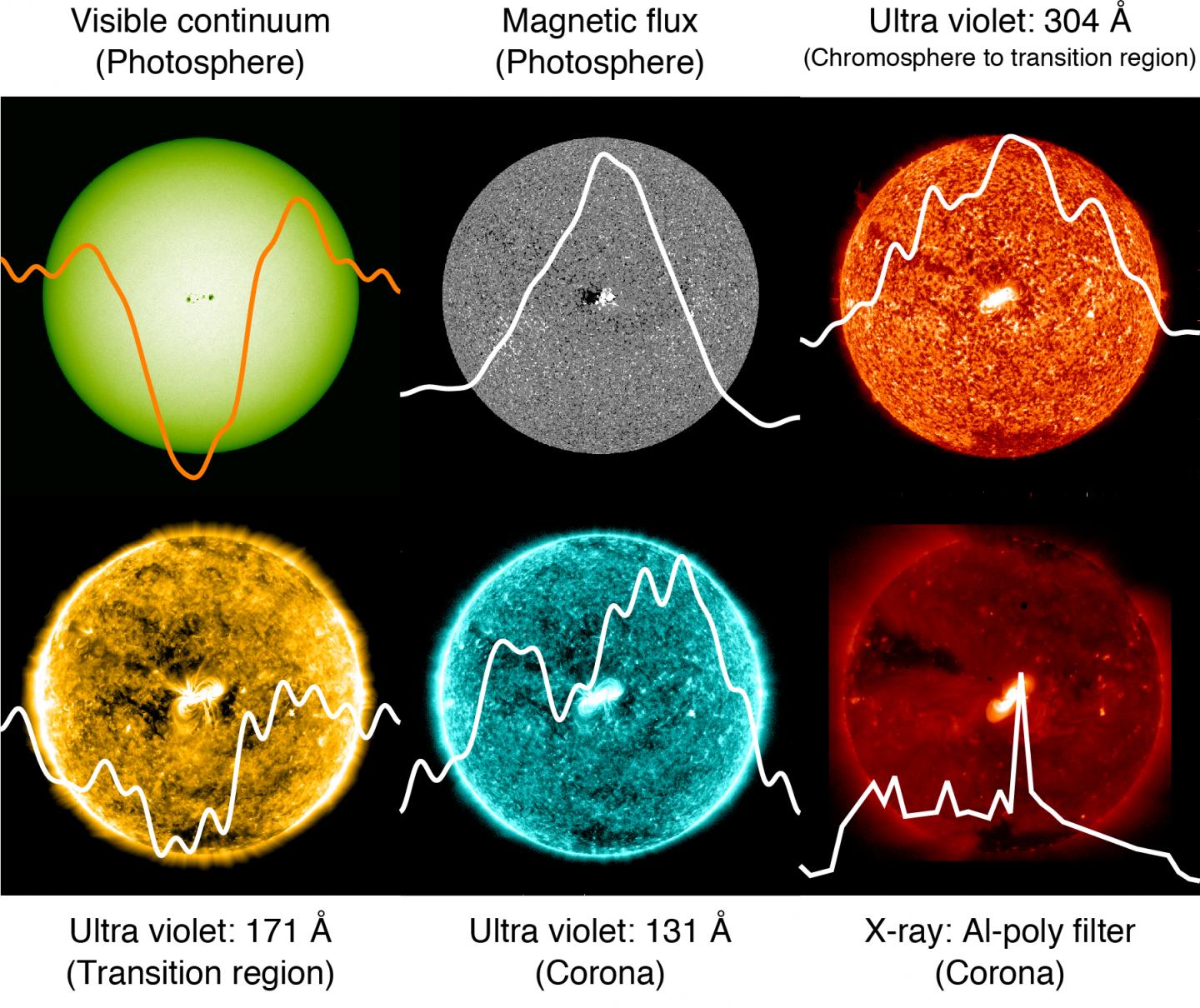
New research shows that sunspots and other active regions can change the overall solar emissions. The sunspots cause some emissions to dim and others to brighten; the timing of the changes also varies between different types of emissions. This knowledge will help astronomers characterize the conditions of stars, which has important implications for finding exoplanets around those stars.

An international research team led by Shin Toriumi at the Japan Aerospace Exploration Agency added up the different types of emissions observed by a fleet of satellites including “Hinode” and the “Solar Dynamics Observatory” to see what the Sun would look like if observed from far away as a single dot of light like other stars.

The team investigated how features like sunspots change the overall picture. They found that when a sunspot is near the middle of the side of the Sun facing us, it causes the total amount of visible light to dim. In contrast, when the sunspots are near the edge of the Sun the total visible light brightens because at that viewing angle bright structures known as faculae surrounding the sunspots are more visible than the dark centers.

In addition, X-rays which are produced in the corona above the solar surface grow brighter when a sunspot is visible. The coronal loops extending above the sunspots are magnetically heated, so this brightening appears before the sunspot itself rotates into view and persists even after the sunspot has rotated out of view.

Because the changes in the overall solar emissions and their timings carry information about the location and structure of features on the surface of the Sun, astronomers hope to be able to deduce the surface features of other stars such as starspots and magnetic fields. This will help astronomers to better recognize dimming caused by the shadow of an exoplanet. With better knowledge about the effects of starspots, we can estimate the parameters, such as the radii and orbits, of exoplanets more accurately.

As in-depth investigations into the Sun proceed, a better understanding of the detailed mechanisms of atmospheric heating and flare eruptions will be gained. Toriumi comments, “To this end, the next-generation solar-observing satellite Solar-C(EUVST), being developed by Japan in close collaboration with US and European partners, aims to observe the Sun in emissions that probe the chromosphere, transition region, and corona as a single system.”

###

Media Contact
Dr. Chisato Ikuta
[email protected]

Original Source

https://www.nao.ac.jp/en/news/science/2020/20201012-sso.html

Related Journal Article

http://dx.doi.org/10.3847/1538-4357/abadf9

Tags: AstronomyAstrophysicsSatellite Missions/ShuttlesSpace/Planetary ScienceStars/The Sun
Share12Tweet8Share2ShareShareShare2

Related Posts

Miniature Sensor Uses Light to Detect Touch — Chemistry

Miniature Sensor Uses Light to Detect Touch

May 8, 2026
Iron Minerals Determine Whether Dissolved Organic Matter Fuels Microbes or Becomes Long-Term Carbon Storage — Chemistry

Iron Minerals Determine Whether Dissolved Organic Matter Fuels Microbes or Becomes Long-Term Carbon Storage

May 8, 2026

Kate Evans Appointed Associate Lab Director for Biological and Environmental Systems Science at ORNL

May 8, 2026

Advancing Multiscale Modeling and Overcoming Operational Challenges in Autothermal COâ‚‚-to-Methanol Reactors

May 8, 2026
Please login to join discussion

POPULAR NEWS

  • Research Indicates Potential Connection Between Prenatal Medication Exposure and Elevated Autism Risk

    840 shares
    Share 336 Tweet 210
  • New Study Reveals Plants Can Detect the Sound of Rain

    727 shares
    Share 290 Tweet 181
  • Salmonella Haem Blocks Macrophages, Boosts Infection

    61 shares
    Share 24 Tweet 15
  • Breastmilk Balances E. coli and Beneficial Bacteria in Infant Gut Microbiomes

    57 shares
    Share 23 Tweet 14

About

We bring you the latest biotechnology news from best research centers and universities around the world. Check our website.

Follow us

Recent News

New Post-Hoc Analysis Explores Daily Oral Orforglipron Use in Adults Over 65 with Obesity, Regardless of Diabetes Status

Evaluating Digoxin Use in Patients with Symptomatic Rheumatic Heart Disease

Evaluating the Effectiveness and Safety of Digitalis Glycosides in Treating Heart Failure

Subscribe to Blog via Email

Enter your email address to subscribe to this blog and receive notifications of new posts by email.

Join 82 other subscribers
  • Contact Us

Bioengineer.org © Copyright 2023 All Rights Reserved.

Welcome Back!

Login to your account below

Forgotten Password?

Retrieve your password

Please enter your username or email address to reset your password.

Log In
No Result
View All Result
  • Homepages
    • Home Page 1
    • Home Page 2
  • News
  • National
  • Business
  • Health
  • Lifestyle
  • Science

Bioengineer.org © Copyright 2023 All Rights Reserved.