• HOME
  • NEWS
  • EXPLORE
    • CAREER
      • Companies
      • Jobs
    • EVENTS
    • iGEM
      • News
      • Team
    • PHOTOS
    • VIDEO
    • WIKI
  • BLOG
  • COMMUNITY
    • FACEBOOK
    • INSTAGRAM
    • TWITTER
Saturday, February 7, 2026
BIOENGINEER.ORG
No Result
View All Result
  • Login
  • HOME
  • NEWS
  • EXPLORE
    • CAREER
      • Companies
      • Jobs
        • Lecturer
        • PhD Studentship
        • Postdoc
        • Research Assistant
    • EVENTS
    • iGEM
      • News
      • Team
    • PHOTOS
    • VIDEO
    • WIKI
  • BLOG
  • COMMUNITY
    • FACEBOOK
    • INSTAGRAM
    • TWITTER
  • HOME
  • NEWS
  • EXPLORE
    • CAREER
      • Companies
      • Jobs
        • Lecturer
        • PhD Studentship
        • Postdoc
        • Research Assistant
    • EVENTS
    • iGEM
      • News
      • Team
    • PHOTOS
    • VIDEO
    • WIKI
  • BLOG
  • COMMUNITY
    • FACEBOOK
    • INSTAGRAM
    • TWITTER
No Result
View All Result
Bioengineer.org
No Result
View All Result
Home NEWS Science News Health

Study: Walking backward to get ahead

Bioengineer by Bioengineer
June 30, 2020
in Health
Reading Time: 2 mins read
0
IMAGE
Share on FacebookShare on TwitterShare on LinkedinShare on RedditShare on Telegram

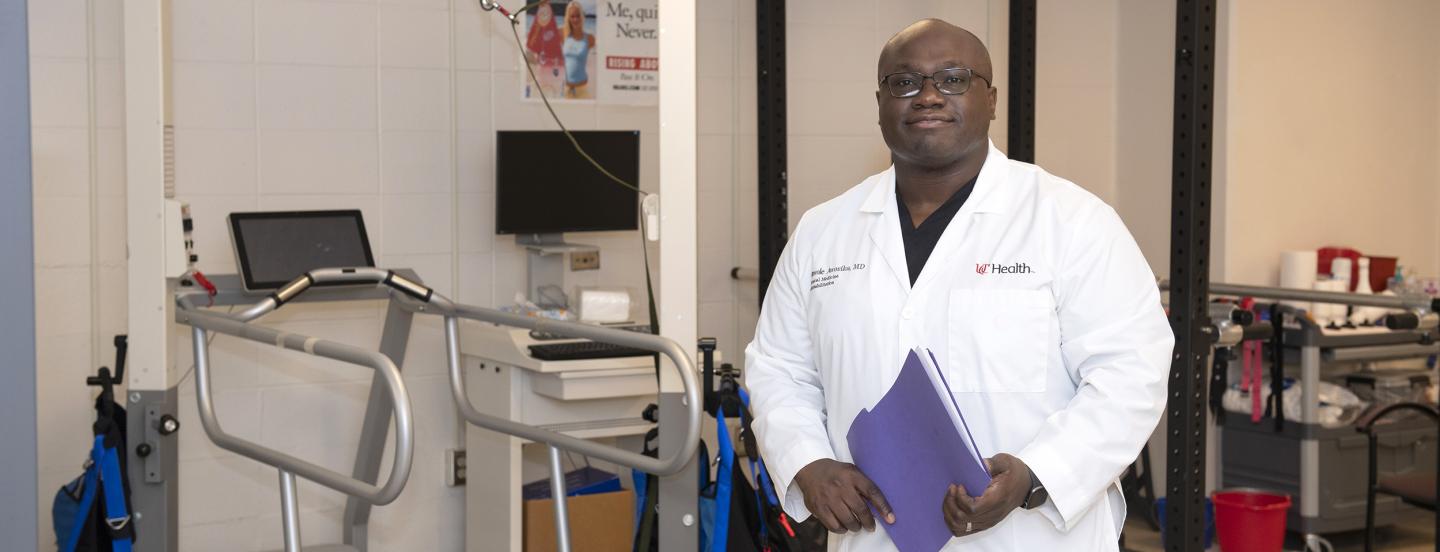
UC researchers study backward treadmill walking to help stroke survivors learn to stride forward
IMAGE

Credit: Colleen Kelley/UC Creative + Brand

Walking backward may seem counterintuitive, but to athletes in training, doing so on a treadmill builds strength and agility.

Now, a researcher with the University of Cincinnati Gardner Neuroscience Institute thinks this practice could also help patients who have experienced stroke learn to walk again.

Oluwole Awosika, MD, assistant professor in the department of neurology and rehabilitative medicine at UC and a UC Health stroke expert, is leading research examining how walking backward on a treadmill might impact sensory signaling in the brain and body to improve walking in this group of patients.

He received funding from the American Academy of Neurology ($450,000 over three years) and the National Institutes of Health ($100,000 over two years) to help continue this study.

“Despite current walking rehabilitation strategies, the majority of stroke survivors are unable to walk independently and remain at an increased risk for falls,” Awosika explains. “Backward treadmill training is a novel training approach used by elite athletes to enhance speed, agility and balance; however, it is currently unknown how this exercise interacts with the central nervous system or if it could benefit stroke survivors with remaining walking impairment.

“Knowledge gained from our study will likely lead to more effective walking rehabilitation strategies in stroke and related disorders.”

In this study, researchers will use sensors to measure training-related changes to the sensory pathways in the brain and spinal cord that affect balance and position of the body, as well as walking symmetry. These changes will be compared to study participants who are assigned to walk forward on the treadmill.

“What is known is that backwards walking exercises additional groups of muscles which are underactivated and underutilized with traditional forward walking,” he says. “The use of a treadmill produces a more challenging training, which may lead to faster results and greater cardiovascular conditioning.

“From a neuroscience perspective, we think that backward treadmill training requires continuous awareness of where the foot is in space to keep from falling during training. Therefore, it is possible that it may increase sensory responses, essential for signaling to brain regions controlling balance and walking symmetry, and may improve walking speed.”

The basis for this project originated from a pilot study led by Awosika, and funded by the Neuroscience Institute, which tested and confirmed the safety and likelihood of this rehabilitation approach. This study was published in the journal Brain Communications.

“Walking impairment impacts nearly 66% of stroke survivors which often leads to falls and injuries. Newer and more comprehensive approaches are needed to improve walking recovery in these survivors. We hope our research reveals a more effective strategy to help this group improve their quality of life and achieve independence.”

###

Media Contact
Katie Pence
[email protected]

Original Source

https://www.uc.edu/news/articles/2020/06/n20927286.html

Tags: Medicine/Healthneurobiology
Share12Tweet8Share2ShareShareShare2

Related Posts

Palmitoylation of Tfr1 Drives Platelet Ferroptosis and Exacerbates Liver Damage in Heat Stroke

February 7, 2026

Oxygen-Enhanced Dual-Section Microneedle Patch Improves Drug Delivery and Boosts Photodynamic and Anti-Inflammatory Treatment for Psoriasis

February 7, 2026

Scientists Identify SARS-CoV-2 PLpro and RIPK1 Inhibitors Showing Potent Synergistic Antiviral Effects in Mouse COVID-19 Model

February 7, 2026

Neg-Entropy: The Key Therapeutic Target for Chronic Diseases

February 7, 2026
Please login to join discussion

POPULAR NEWS

  • Robotic Ureteral Reconstruction: A Novel Approach

    Robotic Ureteral Reconstruction: A Novel Approach

    82 shares
    Share 33 Tweet 21
  • Digital Privacy: Health Data Control in Incarceration

    63 shares
    Share 25 Tweet 16
  • Study Reveals Lipid Accumulation in ME/CFS Cells

    57 shares
    Share 23 Tweet 14
  • Breakthrough in RNA Research Accelerates Medical Innovations Timeline

    53 shares
    Share 21 Tweet 13

About

We bring you the latest biotechnology news from best research centers and universities around the world. Check our website.

Follow us

Recent News

Palmitoylation of Tfr1 Drives Platelet Ferroptosis and Exacerbates Liver Damage in Heat Stroke

Oxygen-Enhanced Dual-Section Microneedle Patch Improves Drug Delivery and Boosts Photodynamic and Anti-Inflammatory Treatment for Psoriasis

Scientists Identify SARS-CoV-2 PLpro and RIPK1 Inhibitors Showing Potent Synergistic Antiviral Effects in Mouse COVID-19 Model

Subscribe to Blog via Email

Enter your email address to subscribe to this blog and receive notifications of new posts by email.

Join 73 other subscribers
  • Contact Us

Bioengineer.org © Copyright 2023 All Rights Reserved.

Welcome Back!

Login to your account below

Forgotten Password?

Retrieve your password

Please enter your username or email address to reset your password.

Log In
No Result
View All Result
  • Homepages
    • Home Page 1
    • Home Page 2
  • News
  • National
  • Business
  • Health
  • Lifestyle
  • Science

Bioengineer.org © Copyright 2023 All Rights Reserved.