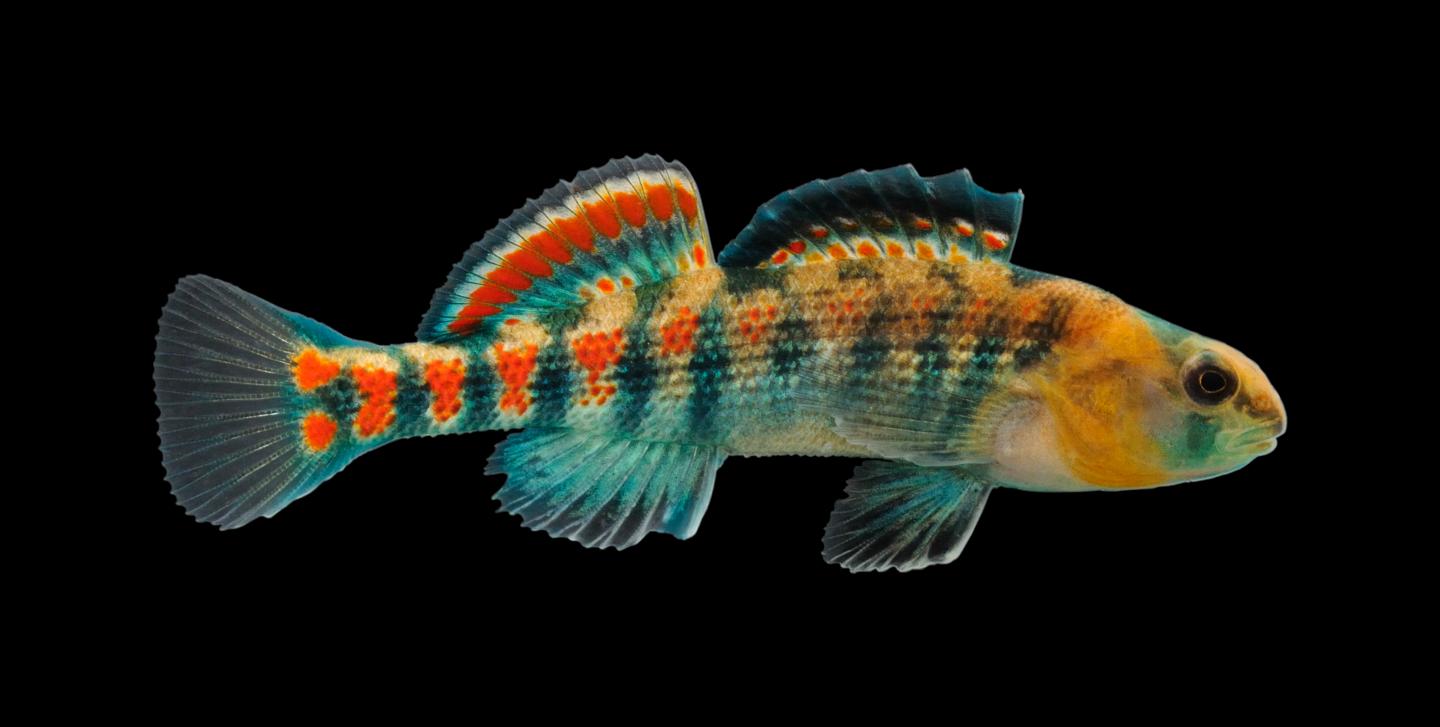
Credit: Photo by Lance Merry
CHAMPAIGN, Ill. — When they share habitat, orangethroat and rainbow darters tend to avoid one another, even though they are closely related and can produce “hybrid” offspring. The males compete with males of their own species and will almost always ignore females of the other species. A new study offers an analysis of the genomic changes that occur when these fish hybridize, offering insight into the gradual accumulation of incompatible traits that likely drives them to diverge.
The researchers report their findings in the journal Molecular Biology and Evolution.
Scientists have spent decades trying to understand the factors that allow closely related organisms to evolve into separate species, said Becky Fuller, a University of Illinois professor of evolution, ecology and behavior who led the research with study lead author Rachel Moran. Now a postdoctoral researcher at the University of Minnesota, Moran conducted the research as a graduate student in Fuller’s lab.
The most obvious driver of speciation is geographic isolation, but other factors also contribute, Fuller said.
“For example, two populations may randomly develop anatomical or physiological differences that prevent them from successfully mating with one another,” she said.
Other behavioral and genomic changes that contribute to species divergence are subtler and more difficult to track, Moran said.
“We were particularly interested in comparing the orangethroat darter with the rainbow darter because the two species co-occur and can form hybrids,” she said. “Interspecies mating is costly for these fish, as it does not result in healthy offspring.”
If the offspring die, they fail to pass their genetic heritage to the next generation. Those lineages with a proclivity for interspecies mating gradually die out.
“Consequently, when the two species co-occur in the same habitat, they evolve strong preferences to mate with their own species and ignore the other species,” Moran said.
To understand how genomic factors influence this process, the researchers mated orangethroat and rainbow darters in the lab and analyzed the genomes of the few hybrid offspring that survived past hatching. They sequenced the genome of the orangethroat darter and conducted a series of analyses to determine which regions of the two species were misaligned.
“We found that areas of the genome that had a lot of genetic divergence between the two species likely contributed to their reproductive incompatibility,” Moran said. These differences are widespread and include problematic variations in the sequence and order of genes on the chromosomes.
The differences would likely disrupt cell division and could alter gene expression in hybrid offspring, Fuller said.
“This study opens a window on the post-reproductive mechanisms that contribute to the evolution of differing traits in closely related species,” Fuller said.
“How species that exchange genetic material through hybridization are able to coexist and remain distinct from one another has puzzled evolutionary biologists for decades,” Moran said. “The insights we’ve gained from this study have hopefully gotten us a little closer to answering that big question.”
###
The National Science Foundation, National Institutes of Health and U. of I. School of Integrative Biology supported this research.
Editor’s notes:
To reach Rachel Moran, email [email protected].
To reach Becky Fuller, call 217-333-9065; email [email protected].
The paper “Genomic resources for darters (Percidae: Etheostominae) provide insight into postzygotic barriers implicated in speciation” is available online and from the U. of I. News Bureau.
Media Contact
Diana Yates
[email protected]
217-333-5802
Original Source
https:/
Related Journal Article
http://dx.