• HOME
  • NEWS
  • EXPLORE
    • CAREER
      • Companies
      • Jobs
    • EVENTS
    • iGEM
      • News
      • Team
    • PHOTOS
    • VIDEO
    • WIKI
  • BLOG
  • COMMUNITY
    • FACEBOOK
    • INSTAGRAM
    • TWITTER
Tuesday, May 12, 2026
BIOENGINEER.ORG
No Result
View All Result
  • Login
  • HOME
  • NEWS
  • EXPLORE
    • CAREER
      • Companies
      • Jobs
        • Lecturer
        • PhD Studentship
        • Postdoc
        • Research Assistant
    • EVENTS
    • iGEM
      • News
      • Team
    • PHOTOS
    • VIDEO
    • WIKI
  • BLOG
  • COMMUNITY
    • FACEBOOK
    • INSTAGRAM
    • TWITTER
  • HOME
  • NEWS
  • EXPLORE
    • CAREER
      • Companies
      • Jobs
        • Lecturer
        • PhD Studentship
        • Postdoc
        • Research Assistant
    • EVENTS
    • iGEM
      • News
      • Team
    • PHOTOS
    • VIDEO
    • WIKI
  • BLOG
  • COMMUNITY
    • FACEBOOK
    • INSTAGRAM
    • TWITTER
No Result
View All Result
Bioengineer.org
No Result
View All Result
Home NEWS Science News Chemistry

Study reveals composition of ‘gel-like’ substance discovered by Chang’e-4 rover on moon’s far side

Bioengineer by Bioengineer
July 21, 2020
in Chemistry
Reading Time: 2 mins read
0
IMAGE
Share on FacebookShare on TwitterShare on LinkedinShare on RedditShare on Telegram

IMAGE

Credit: CNSA, CLEP, and AIR

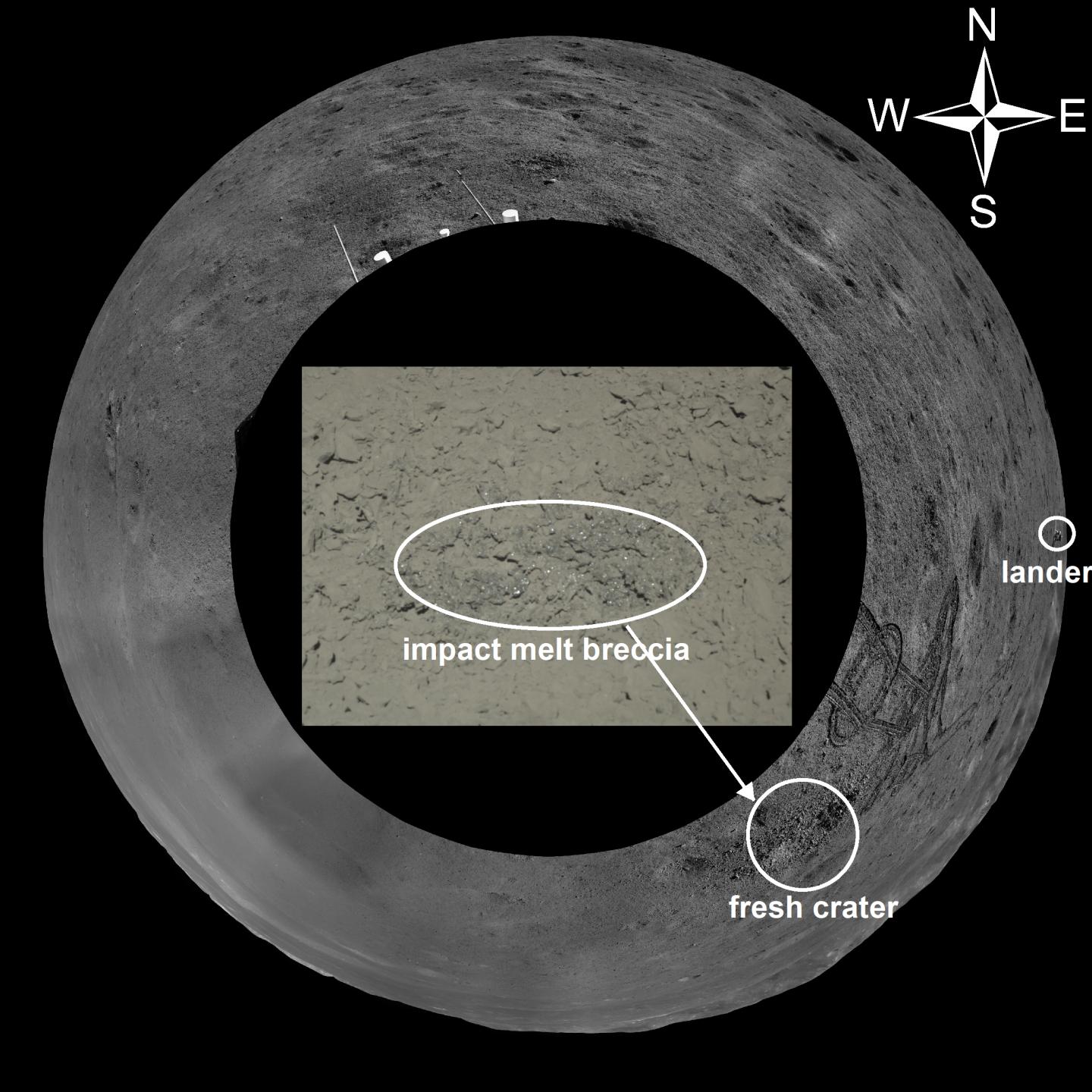
The unusual dark greenish and glistening “gel-like” substance in a crater on the far side of the moon has attracted widespread interest following its discovery by the Chang’e-4 rover in July 2019.

A research team led by Prof. DI Kaichang from the Aerospace Information Research Institute (AIR) of the Chinese Academy of Sciences and their collaborators analyzed the substance in detail by using multiple datasets from the rover’s panoramic camera (Pancam), hazard avoidance camera (Hazcam), and the visible and near-infrared spectrometer (VNIS).

The researchers found that the unusual substance is actually an impact melt breccia, and the provenance of the rover measured surrounding regolith might originate from a differentiated melt pool or from a suite of igneous rocks. Their findings were published in Earth and Planetary Science Letters.

China’s Chang’e-4 probe, including a lander and a rover, successfully touched down within the 185-km-wide Von Kármán crater inside the South Pole-Aitken (SPA) basin on January 3, 2019, making the first-ever soft landing on the lunar far side.

The gel-like substance was discovered in a crater (Fig. 1) during the eighth lunar day of the rover’s mission. Detailed measurements on the breccia and surrounding regolith were conducted during the ninth lunar day.

The discovered breccia, measuring 52 by 16 centimeters, resembles the lunar impact melt breccia samples 15466 and 70019 (Fig. 2) returned by the Apollo missions. It was formed by impact-generated welding, cementing and agglutinating of lunar regolith and breccia.

Clods surrounding the breccia-hosting crater were crushed into regolith powders by the rover’s wheels (Fig. 3), indicating the regolith may be compacted slightly and becomes blocky and friable.
Hapke model-based spectral unmixing results showed that plagioclase was abundant, and pyroxene and olivine had almost equal fractions, indicating the regolith was likely the weathering products of noritic rocks.

The regolith measured by Chang’e-4 rover was actually a mixture of multiple sources, with ejecta from Finsen crater being primary and possible contributions from Alder crater. Finsen and Alder craters are on the margin of the proposed impact melt pool produced by the SPA basin-forming event. Therefore, the provenance of the regolith might originate from a differentiated melt pool or from a suite of igneous rocks.

###

Media Contact
DI Kaichang
[email protected]

Related Journal Article

http://dx.doi.org/10.1016/j.epsl.2020.116378

Tags: AstrophysicsPlanets/MoonsSpace/Planetary Science
Share12Tweet8Share2ShareShareShare2

Related Posts

Humans and Zebra Finches Share Similar Speech Learning Techniques #ASA190 — Chemistry

Humans and Zebra Finches Share Similar Speech Learning Techniques #ASA190

May 11, 2026
Unveiling Dark Matter Through Molecular Insights — Chemistry

Unveiling Dark Matter Through Molecular Insights

May 11, 2026

From Touch to Sight: A Bioinspired Multisensory Framework Endows Robots with Human-Like Perception

May 11, 2026

Announcing the 2026 Carbon Future Young Investigator Award Winners

May 11, 2026
Please login to join discussion

POPULAR NEWS

  • Research Indicates Potential Connection Between Prenatal Medication Exposure and Elevated Autism Risk

    841 shares
    Share 336 Tweet 210
  • New Study Reveals Plants Can Detect the Sound of Rain

    728 shares
    Share 290 Tweet 182
  • Salmonella Haem Blocks Macrophages, Boosts Infection

    62 shares
    Share 25 Tweet 16
  • Breastmilk Balances E. coli and Beneficial Bacteria in Infant Gut Microbiomes

    57 shares
    Share 23 Tweet 14

About

We bring you the latest biotechnology news from best research centers and universities around the world. Check our website.

Follow us

Recent News

Humans and Zebra Finches Share Similar Speech Learning Techniques #ASA190

New Study Uncovers How Fungal Parasites Attack Strawberries and Raspberries

City of Hope Researchers to Present Groundbreaking Immunotherapy and Precision Medicine Advances Across Multiple Cancer Types at ASCO 2026

Subscribe to Blog via Email

Enter your email address to subscribe to this blog and receive notifications of new posts by email.

Join 82 other subscribers
  • Contact Us

Bioengineer.org © Copyright 2023 All Rights Reserved.

Welcome Back!

Login to your account below

Forgotten Password?

Retrieve your password

Please enter your username or email address to reset your password.

Log In
No Result
View All Result
  • Homepages
    • Home Page 1
    • Home Page 2
  • News
  • National
  • Business
  • Health
  • Lifestyle
  • Science

Bioengineer.org © Copyright 2023 All Rights Reserved.