• HOME
  • NEWS
  • EXPLORE
    • CAREER
      • Companies
      • Jobs
    • EVENTS
    • iGEM
      • News
      • Team
    • PHOTOS
    • VIDEO
    • WIKI
  • BLOG
  • COMMUNITY
    • FACEBOOK
    • INSTAGRAM
    • TWITTER
Sunday, August 23, 2026
BIOENGINEER.ORG
No Result
View All Result
  • Login
  • HOME
  • NEWS
  • EXPLORE
    • CAREER
      • Companies
      • Jobs
        • Lecturer
        • PhD Studentship
        • Postdoc
        • Research Assistant
    • EVENTS
    • iGEM
      • News
      • Team
    • PHOTOS
    • VIDEO
    • WIKI
  • BLOG
  • COMMUNITY
    • FACEBOOK
    • INSTAGRAM
    • TWITTER
  • HOME
  • NEWS
  • EXPLORE
    • CAREER
      • Companies
      • Jobs
        • Lecturer
        • PhD Studentship
        • Postdoc
        • Research Assistant
    • EVENTS
    • iGEM
      • News
      • Team
    • PHOTOS
    • VIDEO
    • WIKI
  • BLOG
  • COMMUNITY
    • FACEBOOK
    • INSTAGRAM
    • TWITTER
No Result
View All Result
Bioengineer.org
No Result
View All Result
Home NEWS Science News Biology

Study: Obesity raises the risk of gum disease by inflating growth of bone-destroying cells

Bioengineer by Bioengineer
November 12, 2021
in Biology
Reading Time: 3 mins read
0
Obesity-Perio-Bone-Loss-final-HI
Share on FacebookShare on TwitterShare on LinkedinShare on RedditShare on Telegram

BUFFALO, N.Y. – Chronic inflammation caused by obesity may trigger the development of cells that break down bone tissue, including the bone that holds teeth in place, according to new University at Buffalo research that sought to improve understanding of the connection between obesity and gum disease.
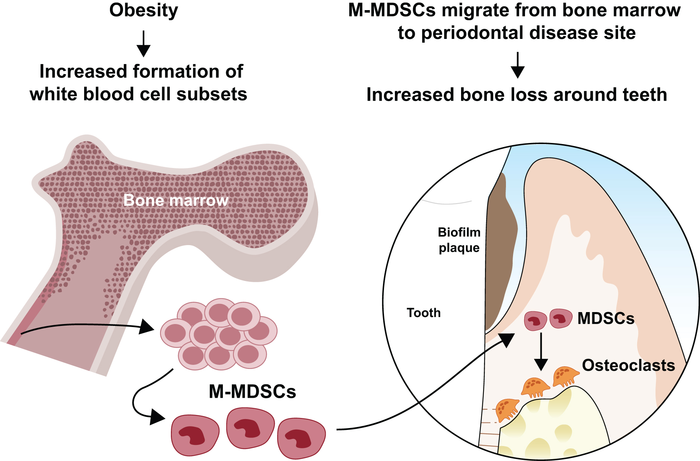
Obesity-Perio-Bone-Loss-final-HI

Credit: Photo: Keith Kirkwood.

BUFFALO, N.Y. – Chronic inflammation caused by obesity may trigger the development of cells that break down bone tissue, including the bone that holds teeth in place, according to new University at Buffalo research that sought to improve understanding of the connection between obesity and gum disease.

The study, completed in an animal model and published in October in the Journal of Dental Research, found that excessive inflammation resulting from obesity raises the number of myeloid-derived suppressor cells (MDSC), a group of immune cells that increase during illness to regulate immune function. MDSCs, which originate in the bone marrow, develop into a range of different cell types, including osteoclasts (a cell that breaks down bone tissue). 

Bone loss is a major symptom of gum disease and may ultimately lead to tooth loss. Also known as periodontal disease, gum disease affects more than 47% of adults 30 years and older, according to the Centers for Disease Control and Prevention.

“Although there is a clear relationship between the degree of obesity and periodontal disease, the mechanisms that underpin the links between these conditions were not completely understood,” says Keith Kirkwood, DDS, PhD, professor of oral biology in the UB School of Dental Medicine.

“This research promotes the concept that MDSC expansion during obesity to become osteoclasts during periodontitis is tied to increased alveolar bone destruction. Taken together, this data supports the view that obesity raises the risk of periodontal bone loss,” says Kyuhwan Kwack, PhD, postdoctoral associate in the UB Department of Oral Biology. 

The study examined two groups of mice fed vastly different diets over the course of 16 weeks: one group a low-fat diet that derived 10% of energy from fat, the other group a high-fat diet that drew 45% of energy from fat.

The investigation found that the high-fat diet group experienced obesity, more inflammation and a greater increase of MDSCs in the bone marrow and spleen compared to the low-fat diet group. The high-fat diet group also developed a significantly larger number of osteoclasts and lost more alveolar bone (the bone that holds teeth in place).

Also, the expression of 27 genes tied to osteoclast formation were significantly elevated in the group fed a high-fat diet. 

The findings may shed more light on the mechanisms behind other chronic inflammatory, bone-related diseases that develop concurrently with obesity, such as arthritis and osteoporosis, says Kirkwood.

Additional investigators include Lixia Zhang, PhD, research scientist in the UB Department of Oral Biology; Jiho Sohn, doctoral candidate in the Jacobs School of Medicine and Biomedical Sciences at UB; Victoria Maglaras, student in the UB School of Dental Medicine; and Ramkumar Thiyagarajan, research scientist in the Jacobs School.


Journal

Journal of Dental Research

DOI

10.1177/00220345211040729

Article Title

Novel Preosteoclast Populations in Obesity-Associated Periodontal Disease

Article Publication Date

12-Oct-2021
Share12Tweet8Share2ShareShareShare2

Related Posts

Delayed antiviral response in alveolar type 2 cells heightens influenza susceptibility

Delayed antiviral response in alveolar type 2 cells heightens influenza susceptibility

August 22, 2026
Genetic evidence links sleep disruption to hemorrhoidal disease, revealing a hidden connection

Genetic evidence links sleep disruption to hemorrhoidal disease, revealing a hidden connection

August 22, 2026

LASIK Versus Contact Lenses for Correcting Myopia

August 22, 2026

New Advances in Minimally Invasive Laryngeal Surgery

August 22, 2026

POPULAR NEWS

  • Blocking glucosylceramide production kills cancer cells via lysosomal dysfunction, not ceramide buildup

    29 shares
    Share 12 Tweet 7
  • ZCCHC4 boosts replication-dependent histone mRNA translation by interacting with eIF3

    29 shares
    Share 12 Tweet 7
  • KAIST Surface Defects Boost Droplet Formation, Removal, and Heat Transfer by 5.5-Fold

    29 shares
    Share 12 Tweet 7
  • Dual-oxygen pancreatic cancer organoids mirror basal-classical diversity, spatial transcriptomics confirms

    29 shares
    Share 12 Tweet 7

About

We bring you the latest biotechnology news from best research centers and universities around the world. Check our website.

Follow us

Recent News

Blocking glucosylceramide production kills cancer cells via lysosomal dysfunction, not ceramide buildup

ZCCHC4 boosts replication-dependent histone mRNA translation by interacting with eIF3

KAIST Surface Defects Boost Droplet Formation, Removal, and Heat Transfer by 5.5-Fold

Subscribe to Blog via Email

Success! An email was just sent to confirm your subscription. Please find the email now and click 'Confirm' to start subscribing.

Join 85 other subscribers
  • Contact Us

Bioengineer.org © Copyright 2023 All Rights Reserved.

Welcome Back!

Login to your account below

Forgotten Password?

Retrieve your password

Please enter your username or email address to reset your password.

Log In
No Result
View All Result
  • Homepages
    • Home Page 1
    • Home Page 2
  • News
  • National
  • Business
  • Health
  • Lifestyle
  • Science

Bioengineer.org © Copyright 2023 All Rights Reserved.