Philadelpia, January 26, 2022 – Researchers exploring dementia-related proteins in the brain identified Apolipoprotein E (ApoE) as a key misfolded protein. About 25% of individuals, and 50% of individuals with Alzheimer disease, have a genetic mutation, the APOE ε4 allele — a known risk factor for the disease. The researchers were surprised to find that even in the brains of patients without the disease-driving APOE ε4 allele, ApoE proteins were strongly enriched in dementia. Their findings appear in The American Journal of Pathology, published by Elsevier.
Credit: The American Journal of Pathology
Philadelpia, January 26, 2022 – Researchers exploring dementia-related proteins in the brain identified Apolipoprotein E (ApoE) as a key misfolded protein. About 25% of individuals, and 50% of individuals with Alzheimer disease, have a genetic mutation, the APOE ε4 allele — a known risk factor for the disease. The researchers were surprised to find that even in the brains of patients without the disease-driving APOE ε4 allele, ApoE proteins were strongly enriched in dementia. Their findings appear in The American Journal of Pathology, published by Elsevier.
“Dementia is very complex, but you can simplify it: the disease is caused by ‘gloppy proteins’ in the brain,” explained lead investigator Peter T. Nelson, MD, PhD, Sanders-Brown Center on Aging and Department of Pathology, University of Kentucky, Lexington, KY, USA. “I’m not making light of it – these ‘sticky’ misfolded proteins often end up destroying the brain, the mind, the memories and everything else for millions of people who suffer from dementia. We want to understand specifically which proteins are the problem.”
The investigators used mass spectrometry to characterize the complete set of proteins, or proteome, from the amygdalae of 40 participants from the University of Kentucky Alzheimer’s Disease Center autopsy cohort. The amygdala is vulnerable to mis-aggregated proteins associated with dementia and is often affected even at the earliest stages of disease. The subjects ranged from cognitively normal to severe amnestic dementia. Although previous studies have examined the human amygdala proteome, none have reported on a sample of this size with dementia subjects and control subjects for comparison.
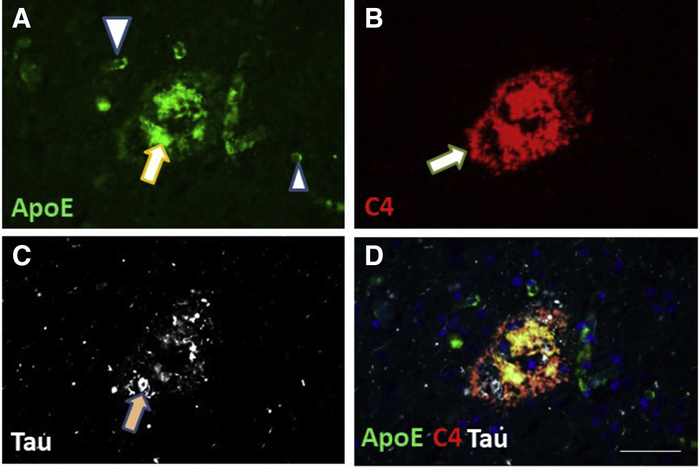
As anticipated, portions of proteins previously associated with neurodegenerative diseases were found in the brains of patients with dementia, including proteins called Tau (associated with neurofibrillary tangles), Aβ (associated with amyloid plaques), and α-Synuclein (associated with Lewy Body disease). Aβ and α-Synuclein correlated strongly with clinical diagnosis of dementia. Tau and Aβ proteins, but not α-Synuclein, were occasionally detectible in cognitively normal subjects and those with mild cognitive impairment. Overall, Dr. Nelson observes, the findings for these proteins were in line with expectations.
The data also revealed a close correlation between dementia diagnosis and the detection of ApoE peptides in the brain. The correlation with dementia for ApoE was even stronger than that seen for Tau, Aβ, or α-Synuclein. Moreover, the ApoE peptides were significantly enriched even in dementia patients who lack the APOE ε4 allele. The results emphasize the relevance of the ApoE protein as an aberrantly aggregated protein in its own right, rather than just an “upstream” genetic risk factor.
“Our study adds to an evolving appreciation of multiple misfolded proteins in the human brain and moves the field forward by emphasizing that ApoE may be a stong contributor to the dementia prototype, even in individuals who do not have the disease-driving version of the APOE gene,” said Dr. Nelson. “Even in persons lacking the APOE ε4 allele, ApoE may indeed be among the most impactful ‘gloppy proteins’ in aging brains.”
Journal
American Journal Of Pathology
DOI
10.1016/j.ajpath.2021.11.013
Method of Research
Experimental study
Subject of Research
People
Article Title
Apolipoprotein E Proteinopathy Is a Major Dementia-Associated Pathologic Biomarker in Individuals with or without the APOE Epsilon 4 Allele