• HOME
  • NEWS
  • EXPLORE
    • CAREER
      • Companies
      • Jobs
    • EVENTS
    • iGEM
      • News
      • Team
    • PHOTOS
    • VIDEO
    • WIKI
  • BLOG
  • COMMUNITY
    • FACEBOOK
    • INSTAGRAM
    • TWITTER
Thursday, July 2, 2026
BIOENGINEER.ORG
No Result
View All Result
  • Login
  • HOME
  • NEWS
  • EXPLORE
    • CAREER
      • Companies
      • Jobs
        • Lecturer
        • PhD Studentship
        • Postdoc
        • Research Assistant
    • EVENTS
    • iGEM
      • News
      • Team
    • PHOTOS
    • VIDEO
    • WIKI
  • BLOG
  • COMMUNITY
    • FACEBOOK
    • INSTAGRAM
    • TWITTER
  • HOME
  • NEWS
  • EXPLORE
    • CAREER
      • Companies
      • Jobs
        • Lecturer
        • PhD Studentship
        • Postdoc
        • Research Assistant
    • EVENTS
    • iGEM
      • News
      • Team
    • PHOTOS
    • VIDEO
    • WIKI
  • BLOG
  • COMMUNITY
    • FACEBOOK
    • INSTAGRAM
    • TWITTER
No Result
View All Result
Bioengineer.org
No Result
View All Result
Home NEWS Science News Chemistry

Study: New model for predicting belief change

Bioengineer by Bioengineer
August 19, 2022
in Chemistry
Reading Time: 2 mins read
0
A new predictive network model for belief change
Share on FacebookShare on TwitterShare on LinkedinShare on RedditShare on Telegram

A new kind of predictive network model could help determine which people will change their minds about contentious scientific issues when presented with evidence-based information. 
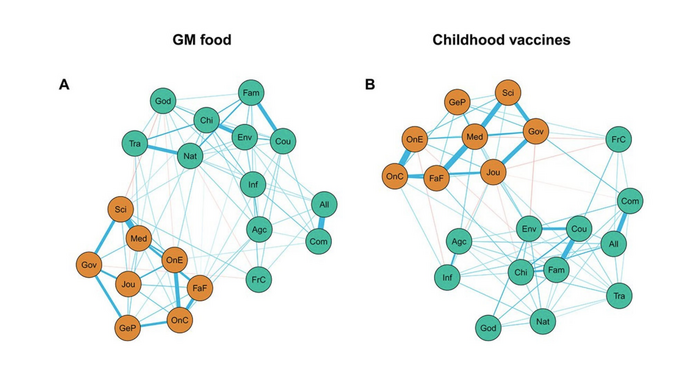
A new predictive network model for belief change

Credit: Jonas Dalege and Tamara van der Does

A new kind of predictive network model could help determine which people will change their minds about contentious scientific issues when presented with evidence-based information. 

A study in Science Advances presents a framework to accurately predict if a person will change their opinion about a certain topic. The approach estimates the amount of dissonance, or mental discomfort, a person has from holding conflicting beliefs about a topic. 

Santa Fe Institute Postdoctoral Fellows Jonas Dalege and Tamara van der Does built on previous efforts to model belief change by integrating both moral and social beliefs into a statistical physics framework of 20 interacting beliefs. 

They then used this cognitive network model to predict how the beliefs of a group of nearly 1,000 people, who were at least somewhat skeptical about the efficacy of genetically modified foods and childhood vaccines, would change as the result of an educational intervention.

Study participants were shown a message about the scientific consensus on genetic modification and vaccines. Those who began the study with a lot of dissonance in their interwoven network of beliefs were more likely to change their beliefs after viewing the messaging, but not necessarily in accordance with the message. On the other hand, people with little dissonance showed little change following the intervention.

“For example, if you believe that scientists are inherently trustworthy, but your family and friends tell you that vaccines are unsafe, this is going to create some dissonance in your mind,” van der Does says. “We found that if you were already kind of anti-GM foods or vaccines to begin with, you would just move more towards that direction when presented with new information even if that wasn’t the intention of the intervention.” 

While still in an early stage, the research could ultimately have important implications for communicating scientific, evidence-based information to the public. 

“On the one hand you might want to target people who have some dissonance in their beliefs, but at the same time this also creates some danger that they will reduce their dissonance in a way that you didn’t want them to,” Dalege says. “Moving forward, we want to expand this research to see if we can learn more about why people take certain paths to reduce their dissonance.”


Journal

Science Advances

DOI

10.1126/sciadv.abm0137

Method of Research

Computational simulation/modeling

Subject of Research

People

Article Title

Using a Cognitive Network Model of Moral and Social Beliefs to Explain Belief Change

Article Publication Date

19-Aug-2022

COI Statement

No COI
Share13Tweet8Share2ShareShareShare2

Related Posts

Graz University of Technology Deciphers the Structural Secrets of MOF Thin Films — Chemistry

Graz University of Technology Deciphers the Structural Secrets of MOF Thin Films

July 2, 2026
Breaking Thermodynamic Limits: Wavelength-Driven Catalysis Advances Ammonia Synthesis — Chemistry

Breaking Thermodynamic Limits: Wavelength-Driven Catalysis Advances Ammonia Synthesis

July 2, 2026

From Quantum Mechanics to AI-Powered Materials Discovery: MARVEL Marks 12 Years of Transforming Computational Science

July 2, 2026

Djire Recognized with National Award for Outstanding Contributions in Research and Teaching

July 2, 2026

POPULAR NEWS

  • Detection of EDCs in Breast Milk and Infant Urine Up to Six Months Highlights Early Exposure Risks

    77 shares
    Share 31 Tweet 19
  • Saying Goodbye to PGY-6: Pediatric Fellowship Realities

    103 shares
    Share 41 Tweet 26
  • New Drug Candidate Developed at McMaster Shows Potential for Treating Brain Cancer

    58 shares
    Share 23 Tweet 15
  • KTU Researchers Explore Ultrasound’s Role in Enhancing Blood Flow Beyond Diagnostics

    53 shares
    Share 21 Tweet 13

About

BIOENGINEER.ORG

We bring you the latest biotechnology news from best research centers and universities around the world. Check our website.

Follow us

Recent News

Steatosis Drives Liver Metastasis Diversity in CRC

Unlocking the Mysteries of Alzheimer’s Disease

Pensoft Introduces New Peer-Reviewed Journal of Regeneration to Advance Restorative Biology Across Species

Subscribe to Blog via Email

Enter your email address to subscribe to this blog and receive notifications of new posts by email.

Join 83 other subscribers
  • Contact Us

Bioengineer.org © Copyright 2023 All Rights Reserved.

Welcome Back!

Login to your account below

Forgotten Password?

Retrieve your password

Please enter your username or email address to reset your password.

Log In
No Result
View All Result
  • Homepages
    • Home Page 1
    • Home Page 2
  • News
  • National
  • Business
  • Health
  • Lifestyle
  • Science

Bioengineer.org © Copyright 2023 All Rights Reserved.