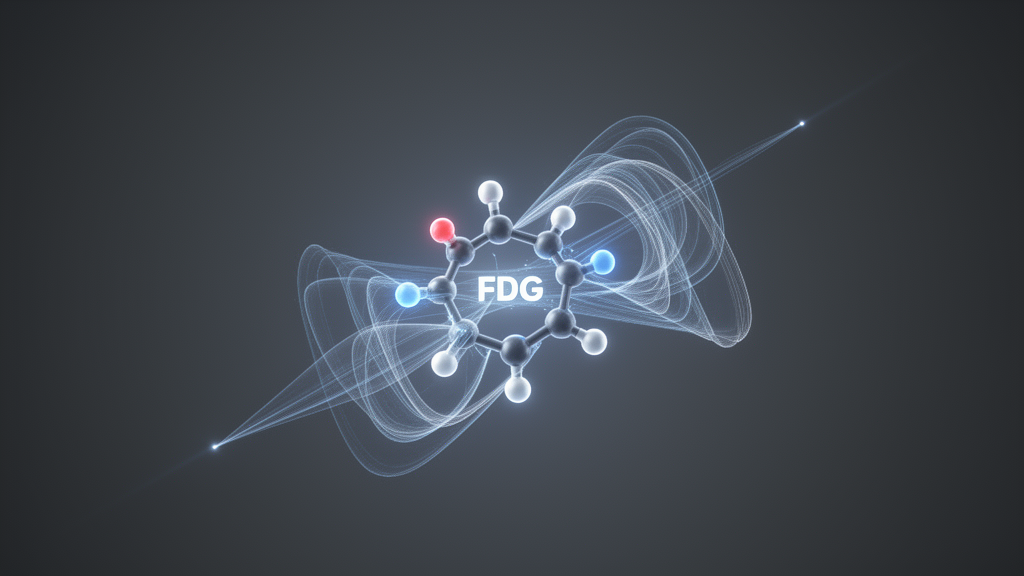
Researchers have systematically calculated the fundamental photon interaction parameters of fluorodeoxyglucose F-18 across an extensive energy range, establishing baseline physical data for the medical tracer. Fluorodeoxyglucose F-18, commonly designated as FDG, serves as the most widely utilized positron-emitting radiotracer in clinical positron emission tomography. Medical practitioners rely on the radiopharmaceutical primarily for detecting and monitoring tumor metabolism as well as various inflammatory processes in patients.
Despite widespread clinical adoption, the fundamental photon interaction properties of the tracer compound have remained relatively underexplored in literature.
To characterize these interaction behaviors, the study determined the effective atomic numbers, denoted as Zeff, alongside the effective electron density, denoted as Nel, for the FDG molecule, which has the chemical formula C6H11FO5. The determinations were conducted over a wide photon energy spectrum ranging from 1 keV to 100 GeV. The investigators derived these fundamental values using mass attenuation coefficients obtained through Penelope Monte Carlo simulations together with the WinXCOM program.
The analysis further examined the energy-dependent variation of the effective atomic number by evaluating distinct photon interaction mechanisms independently. Specifically, the researchers assessed variations occurring under photoelectric absorption, Compton scattering, and pair production processes across the energy spectrum. By isolating these three individual interaction regimes, the resulting evaluation provides a physics-based perspective on how photons interact with the fluorodeoxyglucose compound at different energy thresholds.
The resulting graphical and tabulated findings establish a systematic dataset detailing the photon interaction parameters of FDG. According to the author, these compiled parameters offer a structured resource for future theoretical calculations and computational simulation studies. Ultimately, the comprehensive dataset provides reference physical parameters that may assist ongoing efforts in PET and CT imaging optimization as well as radiation dosimetry calculations.
Subject of Research: Photon interaction parameters and effective atomic numbers of FDG in PET imaging
Article Title: Radiation interaction parameters of 18F-FDG: effective atomic number and electron density for PET applications
Article References: Çakir, T. (2026). Radiation interaction parameters of 18F-FDG: effective atomic number and electron density for PET applications. EJNMMI Physics. https://doi.org/10.1186/s40658-026-00964-3
Image Credits: AI Generated
DOI: 10.1186/s40658-026-00964-3
Keywords: 18F-FDG, fluorodeoxyglucose, positron emission tomography, PET/CT, effective atomic number, electron density, mass attenuation coefficient, Penelope Monte Carlo, WinXCOM, photoelectric absorption, Compton scattering, pair production, radiation dosimetry, photon interaction, tumor metabolism, radiotracer, radiation physics
News Source: Denise Maddox. (November 20, 2026). Study Maps Photon Interaction Parameters and Electron Density for PET Radiotracer FDG. Scienmag.