MIAMI—While rubbing up against a shark sounds like a risky move if you’re a fish, a collaborative research team led by the University of Miami (UM) Shark Research and Conservation Program at the Rosenstiel School of Marine and Atmospheric Science found that this behavior is frequent, widespread, and could play a previously unappreciated important ecological role for aquatic animals.
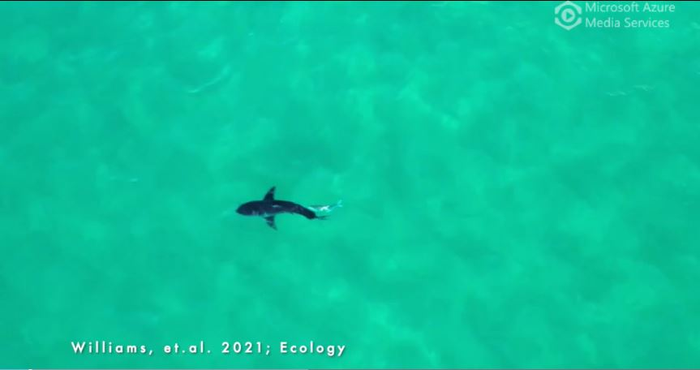
Credit: Credit as shown:
Great white and Leerie by Lacey Williams and Alex Anstett
Great white and Pacific jack mackerel
by Jesus Erick Higuera Rivas
Silky shark and rainbow runner by Victor Bach Munoz
Whale shark and silky sharks by Jonathan Green
MIAMI—While rubbing up against a shark sounds like a risky move if you’re a fish, a collaborative research team led by the University of Miami (UM) Shark Research and Conservation Program at the Rosenstiel School of Marine and Atmospheric Science found that this behavior is frequent, widespread, and could play a previously unappreciated important ecological role for aquatic animals.
Although instances of fish chaffing against sharks has previously been observed, this study finds this cross-species behavior to be more pervasive than previously understood. The research team examined underwater photos, video, drone footage, and witness reports to find 47 instances of fish rubbing themselves against a shark’s skin. The chafing events, which were documented in 13 locations around the world, varied in duration from eight seconds to over five minutes. They recorded 12 fin fish chafing against eight different species of shark, including great whites. The team even documented silky sharks chafing on the head of a whale shark. The number of fish chafing against sharks ranged from one to over 100 individuals at a time.
“While chafing has been well documented between fish and inanimate objects, such as sand or rocky substrate, this shark-chaffing phenomenon appears to be the only scenario in nature where prey actively seek out and rubs up against a predator,” said UM Rosenstiel School graduate student Lacey Williams, who co-led the study with fellow graduate student Alexandra Anstett.
Using aerial drone surveys in Plettenberg Bay, South Africa, Williams and Anstett documented 25 occurrences of a leervis fish turning to chafe against a passing great white shark.
“While we don’t exactly know why it’s happening, we have a few theories. Shark skin is covered in small tooth-like scales called dermal denticles, which provide a rough sandpaper surface for the chafing fish,” said UM Rosenstiel School research associate professor and study co-author Neil Hammerschlag. “We suspect that chafing against shark skin might play a vital role in the removal of parasites or other skin irritants, thus improving fish health and fitness.”
###
The accepted article, titled “Sharks as exfoliators: widespread chafing between marine organisms suggests an unexplored ecological role,” was published in pre-print online on October 28, 2021 in the journal Ecology, The Scientific Naturalist. The study’s authors include: Lacey Williams, Alexandra Anstett, Victor Bach Muñoz, Neil Hammerschlag from the UM Rosenstiel School; John Chisholm and Gregory Skomal from the Massachusetts Division of Marine Fisheries; Chris Fallows from Apex Shark Expeditions in South Africa; Jonathan Green from Galapagos Whale Shark Project; Jesús Erick Higuera Rivas from Protección y Conservación Pelágica AC in Mexico; and Megan Winton from the Atlantic White Shark Conservancy in Massachusetts.
Funding for the study was provided in part by grants from the Isermann Family Foundation.
Journal
Ecology
DOI
10.1002/ecy.3570
Method of Research
Observational study
Article Title
Sharks as exfoliators: widespread chafing between marine organisms suggests an unexplored ecological role
Article Publication Date
28-Oct-2021
COI Statement
none