• HOME
  • NEWS
  • EXPLORE
    • CAREER
      • Companies
      • Jobs
    • EVENTS
    • iGEM
      • News
      • Team
    • PHOTOS
    • VIDEO
    • WIKI
  • BLOG
  • COMMUNITY
    • FACEBOOK
    • INSTAGRAM
    • TWITTER
Thursday, August 20, 2026
BIOENGINEER.ORG
No Result
View All Result
  • Login
  • HOME
  • NEWS
  • EXPLORE
    • CAREER
      • Companies
      • Jobs
        • Lecturer
        • PhD Studentship
        • Postdoc
        • Research Assistant
    • EVENTS
    • iGEM
      • News
      • Team
    • PHOTOS
    • VIDEO
    • WIKI
  • BLOG
  • COMMUNITY
    • FACEBOOK
    • INSTAGRAM
    • TWITTER
  • HOME
  • NEWS
  • EXPLORE
    • CAREER
      • Companies
      • Jobs
        • Lecturer
        • PhD Studentship
        • Postdoc
        • Research Assistant
    • EVENTS
    • iGEM
      • News
      • Team
    • PHOTOS
    • VIDEO
    • WIKI
  • BLOG
  • COMMUNITY
    • FACEBOOK
    • INSTAGRAM
    • TWITTER
No Result
View All Result
Bioengineer.org
No Result
View All Result
Home NEWS Science News Chemistry

Study elucidates the regulation mechanism for electrocatalytic nitrate reduction

Bioengineer by Bioengineer
March 7, 2024
in Chemistry
Reading Time: 2 mins read
0
Study Elucidates the Regulation Mechanism for Electrocatalytic Nitrate Reduction
Share on FacebookShare on TwitterShare on LinkedinShare on RedditShare on Telegram

A research team led by Prof. ZHANG Haimin from the Institute of Solid State Physics, Hefei Institutes of Physical Science (HFIPS) of Chinese Academy of Sciences (CAS) has conducted a systematic study on the regulation mechanism of heterostructure bimetallic phosphide electrocatalysts for enhanced electrochemical nitrate reduction reaction performance.
Study Elucidates the Regulation Mechanism for Electrocatalytic Nitrate Reduction

Credit: JIN Meng

A research team led by Prof. ZHANG Haimin from the Institute of Solid State Physics, Hefei Institutes of Physical Science (HFIPS) of Chinese Academy of Sciences (CAS) has conducted a systematic study on the regulation mechanism of heterostructure bimetallic phosphide electrocatalysts for enhanced electrochemical nitrate reduction reaction performance.

“The catalyst exhibits varying ammonia synthesis performance in different reactors,” said Dr. Jinmeng, “so we has tried three different electrolyzers to determine how the performance of the electrocatalysts could be improved.”

“The configuration of the electrolyzer will greatly affect the local reaction environment near the electrode, and then affect the catalytic performance”, said Dr. Jinmeng, “so we have chosen three different electrolyzers to study the regulate mechanism of the electrocatalysts performance.”

The result was published in Nano Research.

The nitrate anion (NO3– ) is significant pollutant in industrial wastewater and agriculture production. Electrocatalytic nitrate reduction (NO3RR) is an effective path to solving environmental problems and the preparation of green ammonia (NH3). However, the NO3RR process is complex, involving multiple electrons and protons transfer, and suffers from low Faraday efficiency due to competition of hydrogen evolution reactions. Electrochemical NO3RR reactor is also critically for achieving high-efficiency conversion of NO3– to NH3.

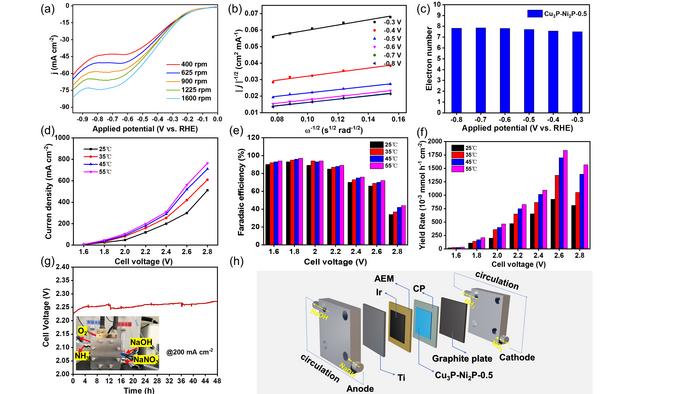
In this study, researchers synthesized a series of bimetallic copper-nickel phosphide electrocatalysts on commercial carbon paper (CP) via a facile vapor-phase hydrothermal method. The electrocatalytic performance of these catalysts for NO3RR was first evaluated in an H-type electrolytic cell. The results showed that the Cu3P-Ni2P/CP-x could establish rich heterointerfaces which boosted the electron transfer, and improved the NO3RR efficiency.

To further understand the the kinetics of electrocatalytic NO3RR, researchers employed a rotating disk electrode (RDE) setup to explore performance variations.

To further understand the NO3RR kinetics difference of electrocatalysts, researchers employed a rotating disk electrode (RDE) setup to test the corresponding catalytic kinetics parameters.

In addition, they assembled the catalyst into the membrane-electrode-assemblies (MEA) electrolyzer, exhibiting the high-efficient activity and durability for NO3RR at industrial current densities. In-situ spectroscopy characterization, combined with theoretical calculations, revealed that the presence of heterointerfaces effectively regulated reactant adsorption, and the reaction mechanism followed a successive hydrodeoxygenation pathway.

These findings contribute to a better understanding of the electrocatalytic NO3RR process and pave the way for the development of efficient and durable catalysts for sustainable ammonia synthesis.


Journal

Nano Research

Article Title

Heterostructure Cu3P-Ni2P/CP catalyst assembled membrane electrode for high-efficiency electrocatalytic nitrate to ammonia

Article Publication Date

8-Feb-2024

Share12Tweet8Share2ShareShareShare2

Related Posts

Jet engines can’t tell coconut-blend fuel from jet fuel—but the environment can

Jet engines can’t tell coconut-blend fuel from jet fuel—but the environment can

August 20, 2026
Scientists Create Twisted, Two-Faced Polymer with Unique Properties

Scientists Create Twisted, Two-Faced Polymer with Unique Properties

August 20, 2026

Scientists Move Closer to Controlling Individual Electrons

August 20, 2026

New molecular building block combines proteins with diverse molecules

August 20, 2026

POPULAR NEWS

  • Seoul Study Links Short-Term VOC Exposure to Children’s Eczema and Asthma Burden

    29 shares
    Share 12 Tweet 7
  • How Nicotine Products Affect Heart Health and Global Cardiovascular Risks

    29 shares
    Share 12 Tweet 7
  • Jet engines can’t tell coconut-blend fuel from jet fuel—but the environment can

    29 shares
    Share 12 Tweet 7
  • Engineers Develop Self-Powered Pacemaker 恒一

    29 shares
    Share 12 Tweet 7

About

BIOENGINEER.ORG

We bring you the latest biotechnology news from best research centers and universities around the world. Check our website.

Follow us

Recent News

Seoul Study Links Short-Term VOC Exposure to Children’s Eczema and Asthma Burden

How Nicotine Products Affect Heart Health and Global Cardiovascular Risks

Jet engines can’t tell coconut-blend fuel from jet fuel—but the environment can

Subscribe to Blog via Email

Enter your email address to subscribe to this blog and receive notifications of new posts by email.

Join 85 other subscribers
  • Contact Us

Bioengineer.org © Copyright 2023 All Rights Reserved.

Welcome Back!

Login to your account below

Forgotten Password?

Retrieve your password

Please enter your username or email address to reset your password.

Log In
No Result
View All Result
  • Homepages
    • Home Page 1
    • Home Page 2
  • News
  • National
  • Business
  • Health
  • Lifestyle
  • Science

Bioengineer.org © Copyright 2023 All Rights Reserved.